Lions Gallery Figurative Paintings

to
114
109
163
96
78
Overall Width
to
Overall Height
to
1
523
36
2
15
14
14
39
30
46
29
177
45
41
40
29
27
24
22
5
3
316
213
18
55
38
20
16
15
10
8
5
5
4
4
3
3
3
3
3
3
3
3
3
517
384
245
234
112
9
8
7
7
7
28
560
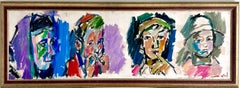
Modernist Israeli Soldiers Judaica Mixed Media Painting IDF Pilots Moshe Katz
By Moshe Katz
Located in Surfside, FL
IDF Tzahal Fighter Pilots Dimensions: framed 31 X 25.25 canvas 30 X 24 inches Moshe Katz ( Romanian, Israeli ) Moshe Katz was born March 2 1937 in Bucharest, Romania. With his pa...
Category

20th Century Modern Portrait Paintings

Materials

Canvas, Mixed Media, Acrylic

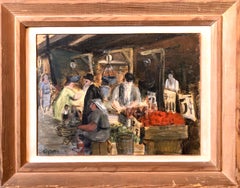
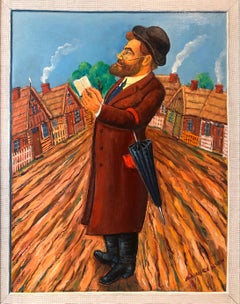
Judaica Market Scene, Shuk, European Hasidic Rabbi Oil Painting
Located in Surfside, FL
framed sight size 10 x 13.5 inches painting, framed to 15 x 19. Impressionistic Realistic portrait of an older rabbi visiting the marketplace. Children playing. Here the artist conveys a sense of quiet grandeur through the eyes of his subject and the way it's rendered. following a distinguished lineage of Jewish genre...
Category

Early 20th Century Realist Portrait Paintings

Materials

Oil

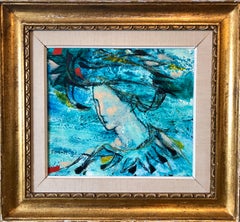
Italian Modernist Surrealist Lady With a Hat Oil Painting, Signora dal Cappello
By Lazzaro Donati
Located in Surfside, FL
Lazzaro Donati (Italian, 1926-1977), "Signora dal Cappello," oil on panel, signed lower left, signed, titled and dated verso, overall (with frame): 22.5"h x 24.5"w Lazzaro Donati wa...
Category

1960s Surrealist Figurative Paintings

Materials

Oil, Panel

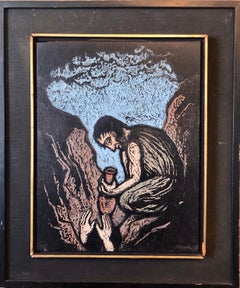
German Expressionist Hand Carved Colored Original Wood Pane Art Israeli Bezalel
By Jacob Steinhardt
Located in Surfside, FL
This is original hand carved wood carving used to produce a woodcut print. Hand colored with painting. signed woodblock (unique piece, not a print) by Jacob Steinhardt 1887-1968 "Reuben Offering Food and Drink to Joseph" Hand carved and painted surface, painted in relief. Signed LR, dated LL. In thin wood painted frame, woodcut panel approx. 1/2" thick, raised on frame. panel within gold painted wood liner 16"H x 12.5 framed 22.5 x 18.75 Judaica biblical scene. Steinhardt, Jakob, Painter and Woodcut Artist. b. 1887, Yaacov Steinhardt was born in the then remote, largely Polish town of Zerkow in the Posen District of Germany. (poland/german) Immigrated 1933. Studies: 1906 School of Art, 1906 Studied in Berlin Arts and Crafts School. Berlin; 1907 painting...
Category

Mid-20th Century Expressionist Figurative Paintings

Materials

Woodcut

Whimsical Judaica Shtetl Shadchan Matchmaker Oil Painting WPA Jewish Folk Artist
By Maurice Kish
Located in Surfside, FL
Genre: Modern Subject: Fiddler on the roof, Shtetl matchmaker Medium: Oil Surface: Board, size includes artist decorated frame Country: United States The imagery of Maurice Kish (18...
Category

Mid-20th Century Folk Art Figurative Paintings

Materials

Oil, Board

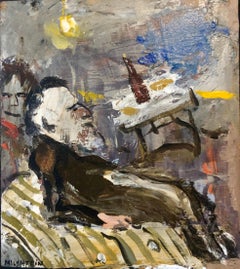
French Israeli Surrealist Judaica Jewish Oil Painting Rabbi at Table, Bottle
By Zvi Milshtein
Located in Surfside, FL
This is a small oil painting on on panel. A Rabbi at a Farbrengen 15.5 X 14.5 with frame. 6.5 X 5.5 painting alone Zwy Milshtein (Zvi Tzvi Milstein) BIOGRAPHY 1934 Born in Kishinev...
Category

20th Century Expressionist Figurative Paintings

Materials

Oil, Panel

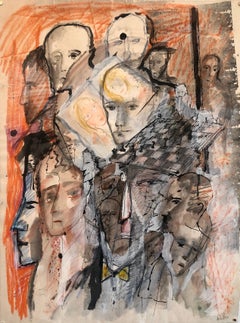
Chess Game Set French Israeli Surrealist Watercolor Gouache Painting
By Zvi Milshtein
Located in Surfside, FL
This is a large hand signed mixed media paiting on Arches French paper. A chess game encounter. Figurative Abstract Expressionist painting. Zwy Milshtein (Zvi Tzvi Milstein) BIOGRA...
Category

20th Century Expressionist Figurative Paintings

Materials

Mixed Media, Watercolor, Gouache

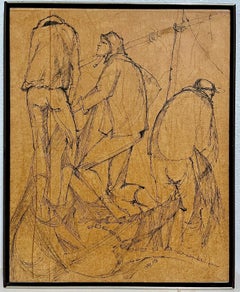
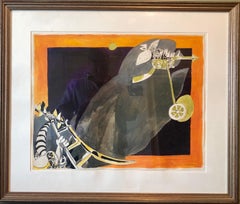
Rare German Israeli Surrealist Judaica Abstract Gouache Watercolor Painting
By Naftali Bezem
Located in Surfside, FL
A Surrealist Judaica scene of a bearded man (Rabbi) in a boat with Shabbat candlesticks. Sight size: 17.75" x 22.5". Overall size with frame: 26.5" x31.5" Naftali Bezem (Hebrew: נ...
Category

1970s Modern Abstract Paintings

Materials

Ink, Watercolor, Gouache

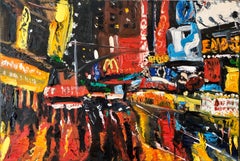
Vibrant New York City Times Square, Figural Abstract Expressionist Oil Painting
By Simon Gaon
Located in Surfside, FL
Simon Gaon (born 1943) is an American painter, Expressionist, and action painter. This is a thick impasto oil painting. with a lot of texture and color. Times Square with 42nd st in...
Category

Early 2000s Abstract Expressionist Figurative Paintings

Materials

Canvas, Oil

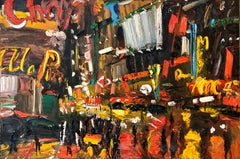
Vibrant New York City Times Square, Figural Abstract Expressionist Oil Painting
By Simon Gaon
Located in Surfside, FL
Simon Gaon (born 1943) is an American painter, Expressionist, and action painter. This is a thick impasto oil painting. with a lot of texture and color. This is a nighttime scene of...
Category

Early 2000s Abstract Expressionist Figurative Paintings

Materials

Canvas, Oil

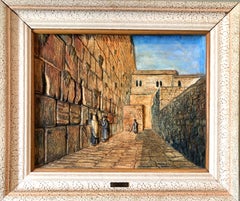
Vintage Jerusalem Western Wall Relief Sculpture Model Diorama Painting Judaica
By Manobla
Located in Surfside, FL
Joseph Manobla, (Israeli, 1930-1979), The Western Wall (The Wailing Wall), Painted diorama sculptural relief, 12.5 x 15.75 inches (relief), 17 x 20.25 inches (including original painted artist’s frame), Signed lower right. titled verso "the Wailing Wall". I am not sure of the material used. I have seen some described as jerusalem stone and some as composition. Provenance: The Engel Gallery Jerusalem. The Engel Gallery was founded in Jerusalem in 1955. Rafi Lavi, Arieh Aroch, Aviva Uri...
Category

20th Century Modern Figurative Sculptures

Materials

Mixed Media

Israeli Judaica Original Painting "The Lovers" in Garden Polish Artist Arie Dubi
Located in Surfside, FL
Dubi Arie (born Poland, 1939) "The Lovers" Image: 11 3/4" x 10" Original mixed media on paper painting, Hand signed and dated lower right and signed and titled on reverse. depictin...
Category

20th Century Post-Modern Figurative Paintings

Materials

Paper, Oil Crayon, Mixed Media, Watercolor
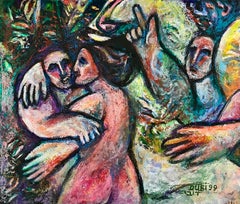
Israeli Judaica Original Painting, "Temptation" Dancing Polish Artist Arie Dubi
Located in Surfside, FL
Dubi Arie (born Poland, 1939) "The Temptation" Image: 11 3/4" x 10" Original mixed media on paper painting, Hand signed and dated lower right and signed and titled on reverse. depi...
Category

20th Century Post-Modern Figurative Paintings

Materials

Paper, Oil Crayon, Mixed Media, Watercolor
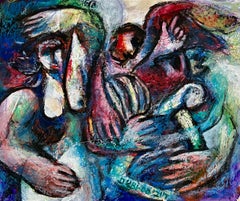
Israeli Judaica Original Painting King David and Angel Polish Artist Arie Dubi
Located in Surfside, FL
Dubi Arie (born Poland, 1939) "A Song in the Garden" Original mixed media on paper painting, Hand signed and dated lower left. This piece depicts people dancing, including a King ...
Category

20th Century Post-Modern Figurative Paintings

Materials

Paper, Oil Crayon, Mixed Media, Watercolor
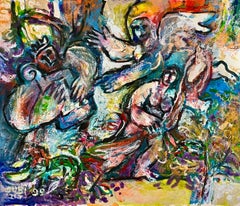
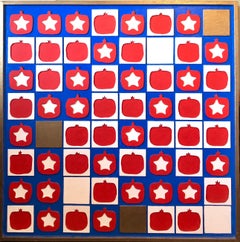
Red White Blue Americana Wall Hanging Painting Sculpture American Flag Motif
Located in Surfside, FL
Painted wood wall hanging sculpture "Red, White and Blue," (and gold) 2008 Stamped signed with initials, date and edition 2/5 Oded Halahmy, Abstract Modernist artist, was born in Iraq in the old city of Baghdad in 1938, the artist came from a family of Orthodox Jews with deep roots in ancient Babylonian culture. His father, Salech Haskel Chebbazah, was a prosperous goldsmith in Baghdad and a Jewish member of the Communist Party when Jews comprised more than a quarter of the population of Baghdad. He refers to his home as the “land of wheat, barley, grapes, figs, pomegranates, olives and dates.”, Oded moved with his family to Israel in the 1950s, was educated at St. Martin's School of Art in London which was then a leading center for sculpture, led by Anthony Caro and Philip King and having links to Henry Moore. He taught sculpture are in the collection of the Guggenheim Museum, the Hirshhorn Museum, and the Israel Museum in Jerusalem, as well as many other public and private collections worldwide. He currently lives in New York City and Old Jaffa, Israel. Like countless New Yorkers who arrived from distant lands, Oded Halahmy has a rich personal history of exile, migration and travels. Although New York has been his home for over 45 years, memories of Iraq left an indelible imprint on his life and work. Known for his dynamic yet often playful figurative pop art style sculptures in wood and bronze, he fills his work with images — albeit abstracted from reality — that evoke the landscape, architecture and rich colors of the Middle East. Palm trees, doves, pomegranates, temples and age-old symbols abound along with deep reds, amber, sky blue and the familiar greenish-blue hues of aged bronze. SELECTED SOLO EXHIBITIONS Dates-Pomegranates-Olive Oil: Chanukah Lamps, Yeshiva University Museum, New York, NY District of Columbia Jewish Community Center Ann Loeb Bronfman Gallery, Washington, D.C. Homeward: Baghdad - Jerusalem - New York, Sundaram Tagore Gallery, New York, NY Homelands: Baghdad-Jerusalem-New York, A Retrospective, The Ann Loeb Gallery, Washington, Homelands: Baghdad-Jerusalem-New York, A Retrospective, Yeshiva University Museum, NY The Common Ground; The Sculpture Of Oded Halahmy, Sundaram Tagore Gallery, New York, NY Herr-Chambliss Fine Arts, Hot Springs, AR Artists Studio, Old Jaffa, Israel Byer Museum of Art, Evanston, IL The Aldrich Museum of Contemporary Art, Ridgefield, CT Tomasulo Gallery, Union College, Cranford, NJ Martha White Gallery, Louisville, KY Louis K. Meisel Gallery, New York, NY New England Center for Contemporary Art, Brooklyn, CT Hebrew Union College, New York, NY Bicentennial Tribute, United States Federal Plaza, New York, NY Horace Richter Galleries, Jaffa, Israel, 1976 Parsons School of Design, New York, NY America-Israel Culture House, New York, NY Herbert F. Johnson Museum of Art, Cornell University, Ithaca, NY Louis K. Meisel Gallery, New York, NY Gallery Moos, Toronto, Canada Old Jaffa Gallery, Jaffa, Israel Pollack Gallery, Toronto, Canada SELECTED GROUP EXHIBITIONS 2006 Iraqi Art...
Category

Early 2000s Pop Art Figurative Paintings

Materials

Wood, Paint

Italian Pop Art Mixed Media Surrealist Painting Collage Gouache Emilio Tadini
By Emilio Tadini
Located in Surfside, FL
Emilio Tadini (1927-2002) Original Collage, Gouache and Watercolor painting. Dimensions: 41 X 29.5. framed. 39.75 X 28 artwork Emilio Tadini (1927 – 2002 ) was an Italian painter,...
Category

20th Century Surrealist Mixed Media

Materials

Paint, Paper, Mixed Media, Watercolor, Gouache
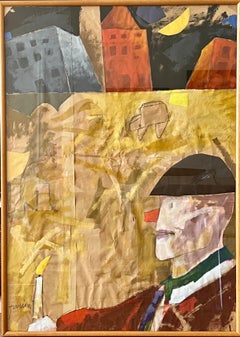
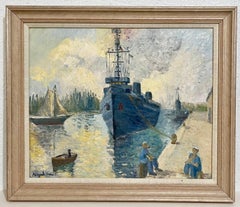
Oil Painting Harbor Scene with Naval Ships Sailors Boats Hildegarde Hamilton
By Hildegarde Hamilton
Located in Surfside, FL
Hildegarde Hamilton (Florida, Virginia 1898-1970) Oil on canvas painting of a docked navy ship with sailors on shore. Hand signed lower left Measures: Canvas 19"H x 23"W; Framed 23.5"H x 28"W. Hildegarde Hume Hamilton (1898 - 1970) was active/lived in Florida, Virginia. He is known for Impressionist buildings in landscape and coastal view painting, illustration. Hildegard Hume Hamilton was born in Syracuse, New York, in 1898. After her education there, and brief training at the age of six in art schools in Venice, Italy, while on a European sojourn with her father, she studied fine art at the Académie Julian, the École des Beaux-Arts and the Académie Grande Chaumière in Paris, France, during the 1920s and 1930s. Back in the United States, Hamilton studied for a short time at the Herron Art Institute in Indianapolis, the Cincinnati Art Academy and under the tutelage of the landscape and maritime painter Anthony Thieme (1888-1954) in Rockport, Massachusetts. The Ainslie Galleries on Fifth Avenue held an exhibit of Hamilton’s French Alpine Scenes to much acclaim. Hamilton exhibited in venues throughout the city and sold as many as 300 landscapes. In 1927, Vice President Charles Gates Dawes acquired one of Hamilton’s paintings following her one person exhibit at the Women’s National Party Headquarters in Washington D.C. In the autumn of 1928, an exhibition of her landscapes and cityscapes at the Galerie Bernheim Jeune in Paris was widely and positively reviewed. In 1929, she became the first American woman to exhibit at Philip Dillon’s club – L’Artistique, in Provence. She also contributed to the Salon des Artistes Independants in Paris. In 1930, Hamilton exhibited at the Carlton Hotel in Washington D.C. and in New York at the Grand Central Palace, American Art Association-Anderson Galleries on 57th Street, and the Huntington Bay and Yacht Clubs. During this period, the artist resided at 9 Gramercy Park in New York City. The picturesque neighborhood inspired Hamilton’s painting entitled 4 Gramercy Park, Mayor Harper’s House, Manhattan. C. 1930. The oil painting captures the red brick façade and intricate cast iron embellishments of 4 Gramercy Park, the former home of publisher and New York City Mayor James Harper (1795- 1869). The two lamps at the foot of the steps signify the home was a mayoral residence and remain at the site to this day. Mrs. Hamilton studied at the Art Students League, New York, New York, and the Cincinnati Art Academy, Cincinnati, Ohio. Hamilton exhibited her topographical street-scenes and landscapes widely throughout the United States with shows at the Syracuse, New York, Museum of Fine Art; the University of Kentucky; the University of Georgia, and most importantly, New York City’s Society of Independent Artists from 1929 to 1933, 1938, 1939, 1943 and 1944. She also illustrated books. Hamilton’s paintings are included in the collections of Wesleyan College, She was aof a generation of American artists that included Alfred Hutty, Wayne Beam Morrell, Frank Henry Shapleigh, Jane Peterson, Henry Martin Gasser, Emil Holzhauer...
Category

Mid-20th Century American Impressionist Landscape Paintings

Materials

Oil, Canvas

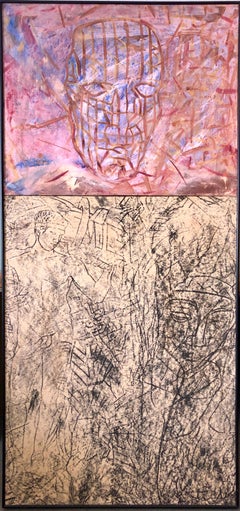
Post Conceptual Digital Artist Oil Painting Screenprint Diptych Joseph Nechvatal
Located in Surfside, FL
Joseph Nechvatal The Oedipal God of Oil Paint and Destruction, Diptych Oil and screenprint on two canvases, 1985, both signed 'Joseph Nechvatal', titled and dated on the reverse, with label from Brooke Alexander, NY. Joseph James Nechvatal (born 15 January 1951) is a post-conceptual digital artist and art theoretician who creates computer-assisted paintings and computer animations, often using custom-created computer viruses. Joseph Nechvatal was born in Chicago. He studied fine art and philosophy at Southern Illinois University Carbondale, Cornell University and Columbia University, where he studied with Arthur Danto while serving as the archivist to the minimalist composer La Monte Young. From 1979, he exhibited his work in New York City, primarily at Galerie Richard, Brooke Alexander Gallery and Universal Concepts Unlimited. He has also solo exhibited in Berlin, Paris, Chicago, Cologne, Atlanta, Los Angeles, Aalst, Belgium, Youngstown, Senouillac, Lund, Toulouse, Turin, Arles and Munich. His work in the early 1980s chiefly consisted of post minimalist gray graphite drawings that were often photo mechanically enlarged. During that period he was associated with the artist group Colab and helped establish the non-profit cultural space ABC No Rio. In 1983 he co-founded the avant-garde electronic art music audio project Tellus Audio Cassette...
Category

1980s Conceptual Abstract Paintings

Materials

Canvas, Oil, Screen

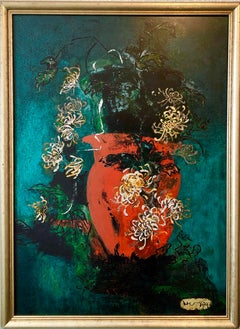
Bright Vibrant Pop Art Enamel Oil Painting Flowers NYC Abstract Expressionist
Located in Surfside, FL
Flowers in a Vase, intensely and seductively colored: almost in a Japonaise style. Swooning purples and reds, ecstatic lemon yellows, Jostling shapes, lyrical and soft-edged, refuse ...
Category

1990s Abstract Expressionist Figurative Paintings

Materials

Enamel

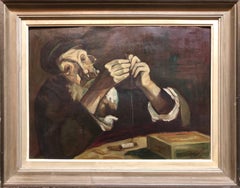
Polish Judaica Portrait of Hasidic Rabbi Shtetl Tailor Oil Painting
Located in Surfside, FL
Older, realistic portrait of an older Jewish shtetl tailor by Polish artist. Here the artist conveys a sense of quiet grandeur through the eyes of his subject and the way it's rendered. Part of a distinguished European lineage of Jewish genre...
Category

20th Century Realist Portrait Paintings

Materials

Canvas, Oil, Board

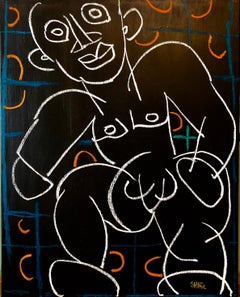
Rare Modernist Oil Painting Line Drawing Nude Man Louis Stettner
By Louis Stettner
Located in Surfside, FL
Signed and Dated Modern Line Drawing Oil Painting of Nude Man. Louis Stettner (November 7, 1922 – October 13, 2016) was an American photographer of the 20th century whose work inclu...
Category

21st Century and Contemporary American Modern Figurative Paintings

Materials

Canvas, Oil

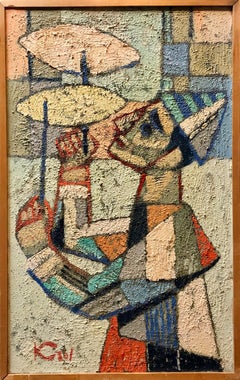
Polish French Ecole de Paris Mid Century Modernist Oil Painting Clown Juggler
By Abram Krol
Located in Surfside, FL
Abram Abraham Krol was born January 22, 1919, in Pabianice (Lodz), Poland. Abram Krol went to France in 1938 to study civil engineering at the University of Caen. In 1939 at the be...
Category

1950s Modern Figurative Paintings

Materials

Canvas, Oil

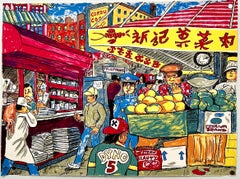
Red Grooms Canal St Chinatown Manhattan New York City Lithograph Cartoon Pop Art
By Red Grooms
Located in Surfside, FL
Red Grooms (American, b. 1937). Lithograph in colors on wove paper, 1993 "East of Canal Street, Corner of Canal." Published by the Brooklyn Museum (Reference: Red Grooms: The Graphic Work, Walter G. Knestrick. Harry Abrams Inc Publishers, New York, 2001. Cat. no 138 page 172, Alexander & Cowles 138). Downtown Manhattan, New York City Chinatown Street scene with various vendors. Hand signed in black crayon and numbered on image at bottom edge. "8/115 Red Grooms." Dimensions 22" x 30" Printer: Sharks Lithographs Ltd, Boulder, CO Red Grooms (born Charles Rogers Grooms on June 7, 1937) is an American multimedia artist best known for his colorful pop-art constructions depicting frenetic scenes of modern urban life. Grooms was given the nickname "Red" by Dominic Falcone (of Provincetown's Sun Gallery) when he was starting out as a dishwasher at a restaurant in Provincetown and was studying with Hans Hofmann. Grooms was born in Nashville, Tennessee during the middle of the Great Depression. Red Grooms came of age in the shadow of the Abstract Expressionists. He studied at the Art Institute of Chicago, then at Nashville's Peabody College. In 1956, Grooms moved to New York City, to enroll at the New School for Social Research. A year later, Grooms attended a summer session at the Hans Hofmann School of Fine Arts in Provincetown, Massachusetts. There he met experimental animation pioneer Yvonne Andersen, with whom he collaborated on several short films. Grooms follows in the tradition of William Hogarth and Honoré Daumier, who were canny commentators on the human condition. In 1969, Peter Schjeldahl compared Grooms to Marcel Duchamp, because both embodied "a movement of one man that is open to everybody." In the spring of 1958, Grooms, Yvonne Andersen and Lester Johnson each painted twelve-foot by twelve-foot panels, which they erected with telephone poles on a parking lot adjacent an amusement park in Salisbury, MA. Inspired by artist-run spaces such as New York's Hansa Gallery and Phoenix, and Provincetown's Sun Gallery, Grooms and painter Jay Milder opened the City Gallery in Grooms' second-floor loft in the Flatiron District. When Phoenix refused to show Claes Oldenburg, Grooms and Milder dropped out of Phoenix and City Gallery presented Oldenberg's first New York exhibition, as well as that of Jim Dine. Other artists who showed at City Gallery include Stephen Durkee, Mimi Gross (daughter of Chaim Gross and Red Grooms wife), Bob Thompson, Lester Johnson, and Alex Katz. Grooms never developed the detached stance of such Pop Art practitioners as Andy Warhol, Roy Lichtenstein or James Rosenquist. Instead he painted his own life, and became, literally, an actor on the stage of life -- in this case the art-as-life "happenings" of the downtown New York scene. Inspired by George Méliès's 1902 film A Trip to the Moon...
Category

1990s Pop Art Figurative Paintings

Materials

Lithograph

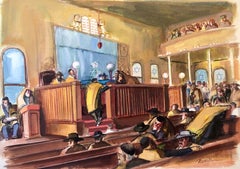
Modernist American Judaica Painting Synagogue Interior Ladies Section WPA Era
By Ervin B. Nussbaum
Located in Surfside, FL
Titled Torah Service, hand signed on Arches archival paper. In this painting, Nussbaum portrays a joyful holiday celebration of the Torah reading in the synagogue in a sketch-like m...
Category

20th Century Modern Figurative Paintings

Materials

Gouache

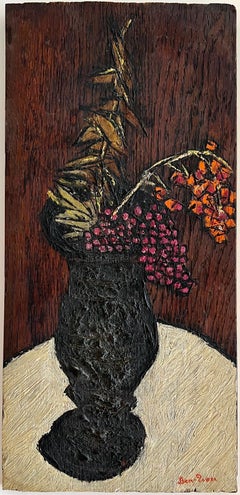
American Modernist Oil Painting Expressionist Vase, Flowers WPA Artist Ben ZIon
By Ben-Zion Weinman
Located in Surfside, FL
Ben-Zion (1897-1987) Flower Piece with Black Vase Oil on board, Hand signed 'Ben-Zion ' lower right, with the artist 's label and label from Duveen-Graham gallery, NY. 16 x 7 3/4 in., unframed as intended, Born in 1897, Ben-Zion Weinman celebrated his European Jewish heritage in his visual works as a sculptor, painter, and printmaker. Influenced by Spinoza, Knut Hamsun, and Wladyslaw Reymont, as well as Hebrew literature, Ben-Zion wrote poetry and essays that, like his visual work, attempt to reveal the deep “connection between man and the divine, and between man and earth.” An emigrant from the Ukraine, he came to the US in 1920. He wrote fairy tales and poems in Hebrew under the name Benzion Weinman, but when he began painting he dropped his last name and hyphenated his first, saying an artist needed only one name. Ben-Zion was a founding member of “The Ten: An Independent Group” The Ten” a 1930’s avant-garde group, Painted on anything handy. Ben-Zion often used cabinet doors (panels) in his work. Other members of group included Ilya Bolotowsky, Lee Gatch, Adolf Gottlieb, Louis Harris, Yankel Kufeld, Marcus Rothkowitz (later known as Mark Rothko), Louis Schanker, and Joseph Solman. Over the course of the group's existence, seventeen artists exhibited as members of The Ten at nine different shows. The group's nine shows were held at galleries and locations around New York City, including one international exhibition in Paris. David Burliuk, Lee Gatch, John Graham, Earl Kerkam, Karl Knaths, Edgar Levy, Jean Liberté...
Category

Mid-20th Century Expressionist Figurative Paintings

Materials

Oil, Wood Panel

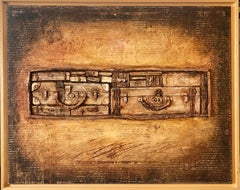
Modernist Judaica "Les Valises" French Jewish Modernist Mixed media Oil Painting
By Alain Kleinmann
Located in Surfside, FL
Painting measures 28 X 36 inches. There is a sulpture quality to the suitcase, it has texture to the piece. It subtly recalls the european Holocaust, travel and displacement. Provena...
Category

20th Century Modern Figurative Paintings

Materials

Canvas, Mixed Media, Oil

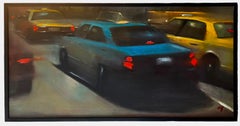
Large Suong Yangchareon Thai American Photorealist LA California Street Painting
Located in Surfside, FL
Suong Yangchareon (Thai American, 1952-) Acrylic on Canvas Los Angeles Street Scene with yellow taxi cab and cars. Hand signed with Initials. Dimensions: Overall Size: 25 1/4 x 49 1/4 in. Sight Size: 23 5/8 x 47 5/8 in. Yangchareon came to Los Angeles, California from Lampang, Thailand, Southeast Asia where he studied Fine Arts at the Arts & Crafts College (Poh Chang), Bangkok, Thailand and Sculpture and Graphic Arts, Silpakorn University, Bangkok, Thailand. In California he continued his studies at Woodbury University, receiving a degree in Advertising Design. He is a contemporary figurative realist artist. He painted the urban landscape of California, which have been exhibited in solo and group shows. His work is represented by prominent galleries nationally. Yangchareon spent much of his childhood at his father’s movie theater where he became fascinated with the world of American Westerns. The nostalgia for this idyllic film Americana can be garnered through his subject matter. Abandoned theaters, factories and businesses of an almost extinct era of architecture are carefully rendered in the soft morning light. Working from his own photography, shot during the early hours of the day, Yangchareon’s acrylic and oil paintings are largely devoid of human figures, but deeply imbued with their past presence. Recently, the artist has broadened his focus to include imagery of the city at night––rendering glistening rain-soaked sidewalks bathed in the artificial light of street lamps and movie marquees against an inky black sky. Yet, Yangchareon’s motivation remains the same; to find the hidden beauty in varying industrial landscapes and seeing splendor where most would argue it does not exist. Reminiscent of Edward Hopper, a sense of melancholy pervades his compositions in a quiet, detached manner. The influence of Richard Diebenkorn and Wayne Thiebaud can also be detected in the artist’s sense of color and in his interpretation of light. Moody LA auto culture artwork dealing with themes of isolation and alienation. Select Exhibitions 2017 Golden Dreams, The Hilbert Museum of California Art at Chapman University, Orange, CA 2016 In the Land of Sunshine: Imaging the California Coast Culture, Pasadena Museum of California Art 2016 Recent Paintings & Works on Paper, Paul Thiebaud Gallery, San Francisco, CA 2013–2014 Suong Yangchareon: Places Out of Time, St. Supéry Estate, Vineyards & Winery, Rutherford, CA 2012 Palm Springs Fine Art Fair, Palm Springs Convention Center LA Art Show, Los Angeles Convention Center Paintings, Paul Thiebaud Gallery, San Francisco, CA (solo) Texas Contemporary Art Fair, George R. Brown Convention Center, artMRKT San Francisco, Concourse Exhibition Center Art Chicago 2011, Merchandise Mart, Chicago, IL 2010 San Francisco Fall Antiques Show, Fort Mason, San Francisco, CA San Francisco Fine Art Fair, Fort Mason, San Francisco, CA Art Chicago 2010, Merchandise Mart, Chicago IL 2009 Recent Paintings, Paul Thiebaud Gallery, San Francisco, CA (solo) 2008 Twenty-Five Treasures, Paul Thiebaud Gallery, San Francisco, CA Robert Arneson, Joan Brown, Fred Dalkey, Eileen David, Roy De Forest, Richard Diebenkorn, David Fertig, John Graham, Robert Hudson, Ed Musante, Manuel Neri, Arthur Okamura, John Santoro, Richard Shaw, Pam Sheehan...
Category

20th Century Figurative Paintings

Materials

Canvas, Acrylic

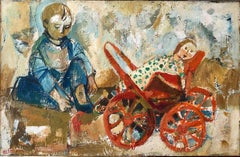
Israeli Oil Painting Ruth Schloss Child, Doll, Wagon, Kibbutz Social Realist Art
By Ruth Schloss
Located in Surfside, FL
Large magnificent colorful Ruth Schloss oil painting of a child with a wagon with a doll or a baby in a carriage stroller.. Signed in Hebrew size measures 31x43 with frame , 23x35.25 without the frame. (this is being sold unframed). Ruth Schloss (22 November 1922 – 2013) was an Israeli painter and illustrator who mainly depicted neglected scenes such as Arabs, transition camps, children and women at eye-level as egalitarian, socialist view via social realism style painting and drawing. Schloss became Israeli painting’s sensitive, conscious, remembering eye. Ruth Schloss was born on 22 November 1922, in Nuremberg, Germany, to Ludwig and Dian Schloss, as the second of three daughters of bourgeois assimilationist Jewish family well-integrated into German culture. As the Nazis came into power in 1933, her family immigrated to Israel in 1937, and settled in Kfar Shmaryahu, then an agricultural settlement. Schloss studied at the Department of Schloss graphic design at "Bezalel" from 1938 to 1942 alongside Friedel Stern and Joseph Hirsch. She was a realistic painter who focused on disadvantaged people in the society and social matters as an egalitarian. Her realism was thus an “inevitable realism,” motivated by an inner necessity: the need to observe reality as it is. Her painting repeatedly addressed the door pulled from its frame, employing drawing’s unique ability to stop time and prolong the image’s persistence in the retina, she repeatedly committed to paper - in a matter-of-fact, non-evasive manner devoid of mystery – man’s tendency to generate chaos, suffering and pain. Throughout her life, Schloss remained minimalist. Painting about human fate was the main subject of her artworks. Her natural inclination was to describe the darker aspect of human existence. 1930s The Schloss household was characterized by open, liberal spirit, in keeping with the parents’ progressive views. It deeply influenced Ruth’s mental development, as she learned to tie culture and art with sensitivity towards the weak and underprivileged. In Jerusalem, she joined a commune of Hashomer Hatzair in which she shaped her socialist views, which she maintained throughout her long career. 1940s In this period she mainly depicted landscapes of kibbutz and wretched women living hard life, children in huger, older people, refugees. After completing her art studies, Schloss joined a training group at Kibbutz Merhavia in 1942, and after two years moved to Karkur region, the nucleus established Kibutz Lehavot Habashan in the Upper Galilee. Through this time, she fell in love with the surroundings and drew landscapes. They are simple and direct with fresh, lucid lines. These paintings were selected as the main works of her first exhibition in 1949. In early 1945, Schloss started to draw illustrations in the children’s magazine Mishmar Leyeladim, and designed the logo of Al Hamishmar, the paper’s new name in 1948. In 1948, upon the founding of Mapam (United Workers’ Party), she designed her party’s emblem, which became a well-known icon. She kept working as an illustrator for Mishmar Layeladim until 1949. "Mor the Monkey" project yielded financial profits and this income was used for a study trip to Paris for two years. She was succesfull as illustrator however, she had inner conflicts of her identity as witnessed painter toward neglected class in Israeli society. First Exhibition at Mikra-Studio Gallery, 1949 She presented forty drawings on paper in her first solo exhibition, representing a selection of the themes of kibbutz landscape, its lifestyle. Schloss confidently proposed her direction through simplicity without using colors in her drawings. 1950s Between 1949 and 1951, she studied at the Académie de la Grande Chaumière in Paris. She began working in oils, with which she continued throughout the 1960s. The exhibition “Back from Paris” opened in November 1951 at Mikra-Studio Gallery . In 1951 she married Benjamin Cohen, who served as chairman of the national leadership of Hashomer Hatzair Workers Party in Tel Aviv. He was a theoretician and a man of principle, highly esteemed by its leaders who became a professor of history at Tel Aviv University. In 1953, following the Mordechai Oren affair and the publication of Moshe Sneh 's followers from Kibbutz Artzi, she and her husband left the kibbutz and moved to the agricultural farm, Kfar Shmaryahu, where she lived until her death. At a certain point in Israeli history, segments of the socialist movement felt that Israel should become part of the Communist bloc, rather than seek the support of the western world. Because the Schloss couple support of Moshe Sneh’s left-wing party, they had to leave the kibbutz. She loved to depict ordinary women as figurative on her painting without hiding or making up anything. The poet Natan Zach wrote about her works in 1955: “Her motto remains that which has been all these years: life as it is, without bluffing." Schloss’s “Pietà” (1953) became a universal cry expressing the pain of mothers on either side of the divide. In the late 1950s, she was the mother of two daughters. When she drew her daughters, unlike the universal babies she depicted, naked and with clenched fists, the painting of her children employed babyish sweetness to the full in a quiet, peaceful and heart-stirring filling rather than urgency. She also painted children in the transition camp and Jaffa in the 1950s and 1960s. 1960s-1980s – The period of Studio in Jaffa Schloss painted at a studio in Jaffa from 1962 till 1983. In this time, she turned her interest to people around her more than kibbutz – the children, mothers, and poor workers, the alleys and houses. She opened the space to the street and its dwellings, built interactions around it, and was nurtured by the presence of the outside in her work. 1960s Schloss familiarized to an Arab woman, Nabava, lived in poor. Schloss returned to painting images of old people later, and she called her painting figurative elderly people in the old age homes “waiting”. In the late 1960s, Ruth discovered acrylic paint and never turn back to oil painting. In 1965 Schloss devoted a series “Area 9 (1965)”, dedicated to the demolition of Israeli-Arab houses and the expropriation of the land, and carried a definite socio-political messages. The series was exhibited at Beit Zvi, Ramat Gan, in 1966. She was the only artist who addressed the result of the Six-Day War immediately afterward. In 1968, Schloss and Gansser-Markus presented “Drawing of War” in Zurich gallery. She expressed the war as an ultimate expression of destruction and ruin, regardless of victors and vanquished. 1970s In late 1970s Schloss began printing the selected photograph directly on the canvas, posterior reworking it in acrylic. She decided to print her work at Har-El Printers in Jaffa, and these became the surface of her painting. This technique was mainly adopted in two large series: Anne Frank (1979-1980) and Borders (1982). Through this technique she placed the figure of elder Frank next to that of the famous young Frank, and released it at the exhibition at Bet Ariela Cultural Center, Tel Aviv, in 1981. The series touched upon the Nazi Holocaust. 1980s The Lebanon War raised the question of “The Good Fence” and the effect of the war. She dedicated a large series Boarders, one of the most powerful image linked to the series is the figure of Yemenite woman raising her hand. She was the first to raise the Black Panthers demonstration to the level of a social icon. In the 1980s and again in 2000, the Intifada uprisings also led Schloss to the easel to render a good number of representational and symbolic works that in their way denounced Israel's political and military actions. 1990s – 2000s Ruth Schloss never had an exhibition in a major Israeli museum. Her works were presented in private galleries and small museums. The main museums, the Tel Aviv Museum of Art and the Israel Museum, included her works only in group exhibitions, and only in 1991 was her retrospective exhibited at the Herzliya Museum. In the 2000s, Schloss’s metaphors turned into animal kingdom and Bedouins in the south. A huge rhinoceros, birds of prey, and other "bad animals," as Cohen Evron, daughter of Ruth, calls them and "I connected this to the Nazis," said Schloss. Schloss' work after she didn't find human expression able to transmit the endless cruelty she saw in Israel's political mentality. Schloss also continued to follow and collect documentary photographs of destructions of houses from the war, the Intifada, the sequence of her work about ruin from 1949 to 2005, was a cumulative testimony about the painful history of Israel and Palestine. In 2006, a large retrospective exhibition of her work was presented at the Museum of Art in Ein Harod, curated by Tali Tamir. Education 1938-41 Bezalel Art Academy, Jerusalem, with Mordecai Ardon 1946 painting course for Kibbutz Artzi artists with Yohanan Simon and Marcel Janco 1949-51 Académie de la Grande Chaumière, Paris Awards and recognition 1965 Silver Medal, International exhibition in Leipzig, Germany 1977 Artist-in-Residence, The Cité Internationale Universitaire de Paris Selected solo exhibitions 2004 “Micha...
Category

Mid-20th Century Realist Figurative Paintings

Materials

Canvas, Oil

Large Oil Painting Israeli Pinchas Litvinovsky Jerusalem Israel Bezalel School
By Pinchas Litvinovsky
Located in Surfside, FL
Pinchas Litvinovsky (Russian/Israeli, 1894-1985) A group of people, Jerusalem Types Hand signed indistinctly (lower right) in English and in Hebrew Verso. Oil on canvas Dimensions 16 1/8 x 51 1/16in Pinchas Litvinovsky (1894-1985) was a prominent Israeli painter, born in the Russian Empire (now Belarus) in Novo-Georgiyevsk, Russia. As a student he visited the Bezalel exhibition in Odessa and met Boris Schatz, the founder of the Bezalel School of Arts and Crafts. Schatz persuaded the young, talented student to study art in Jerusalem at Bezalel. He immigrated to Palestine in 1911, where he became a key figure in the local art scene and was among the pioneers of Israeli art. Litvinovsky studied art in Odessa and later in Paris at the Académie Julian. In the 1930’s he traveled to Paris, France where he encountered the art of Henri Matisse, Pablo Picasso and artists of the Ecole Juif Jewish School of Paris. (Marc Chagall, Modigliani, Chaim Soutine). Litvinovsky worked in many modernist styles, especially Cubism as reflected in the Russian constructivist paintings of the 1920’s His work, which includes landscapes, portraits, and biblical scenes, reflects a blend of European influences and Middle Eastern motifs. He was a member of the Bezalel group of artists and participated in the establishment of the Tel Aviv Artists' House. Throughout his career, Litvinovsky's art evolved, but he remained dedicated to exploring the unique light and landscapes of Israel, contributing significantly to the cultural fabric of the young nation. Select Group exhibitions Jewish Artists Association, Levant Fair, Tel Aviv, 1929 Artists: Arie Allweil, Ludwig Blum, Nachum Gutman, Itzhak Frenel Frenkel, Reuven Rubin, Shmuel Schlezinger, Eged - Palestine Painters Group, Allenby Street, Tel Aviv, 1929 Artists: Chana Orloff, Abraham Melnikoff, Sionah Tagger, Elias Newman, A Collection of Works by Artists of the Land of Israel The Bezalel National Museum, Jerusalem, 1940 Artists: Moshe Mokady, Jakob Steinhardt, Anna Ticho, Joseph Budko, Mordecai Ardon, Moshe Castel, Abel Pann, Hermann Struck, Rina Gallery, Jerusalem Artists: Motke Blum, Efraim Fima (Roytenberg, Ephraim) Zelig Segal, David Sharir, Joseph Halevi, David Caftori, Menashe kadishman, Dedi Ben Shaul, Raffi Lavie Exposition des Artistes de Jérusalem Grand Palais, Paris, France Artists: Samuel Ackerman, Marek Yanai, Zvi Tolkovsky, Zvi Miron Sima...
Category

20th Century Modern Abstract Paintings

Materials

Canvas, Oil

Oil Painting Interior Scene Chair w Chinese Rug Joseph Solman American Art WPA
By Joseph Solman
Located in Surfside, FL
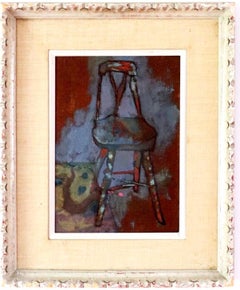
Joseph Solman (1909-2008), Chair with Chinese Rug, oil paint on masonite, initialed JS on recto, titled and signed "J.S." verso, Dimensions 14" x 10" Framed to 21 X 17 Provenance...
Category

20th Century Modern Interior Paintings

Materials

Oil, Board

Modernist Judaica Jewish Ink Drawing Painting "New Immigrant" Off the Boat WPA
By Ben-Zion Weinman
Located in Surfside, FL
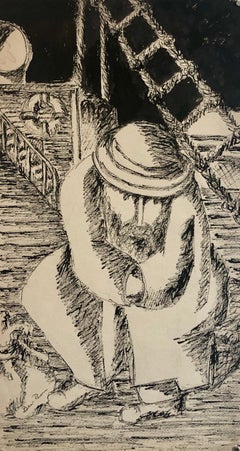
An ink drawing Judaic painting by modern artist Ben-Zion Weinman. It depicts a portrait of an old Jewish man. Coming over from Europe on a ship crossing. The work is signed "Ben-Zion". Born in 1897, Ben-Zion Weinman celebrated his European Jewish heritage in his visual works as a sculptor, painter, and printmaker. Influenced by Spinoza, Knut Hamsun, and Wladyslaw Reymont, as well as Hebrew literature, Ben-Zion wrote poetry and essays that, like his visual work, attempt to reveal the deep “connection between man and the divine, and between man and earth.” An emigrant from the Ukraine, he came to the US in 1920. He wrote fairy tales and poems in Hebrew under the name Benzion Weinman, but when he began painting he dropped his last name and hyphenated his first, saying an artist needed only one name. In 1920 he settled in America, where he found little interest in his writing. He began teaching Hebrew to support himself and then in the early 1930s returned to painting. He used his art to comment on the rise of fascism in Europe, events he felt could not be adequately explored with words. Largely self-taught, Ben-Zion visited the museums of New York City to learn his new trade. His first painting on a large scale, Friday Evening (1933, Jewish Museum, New York), depicts a Sabbath dinner table as recalled from his family home. Ben-Zion supported himself by working odd jobs until the establishment of the Works Progress Administration's Federal Art Project. Under the auspices of the wpa, Ben-Zion thrived and galleries began to show his work. In 1936, after his first one-man show at the Artists' Gallery in New York Ben-Zion was a founding member of “The Ten: An Independent Group” The Ten” a 1930’s...
Category

1940s American Modern Figurative Paintings

Materials

Watercolor, Gouache

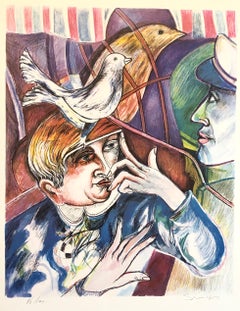
1980 s Large Modernist Israeli Film Noir Figures Lithograph Neo-Expressionism
By Shaoul Smira
Located in Surfside, FL
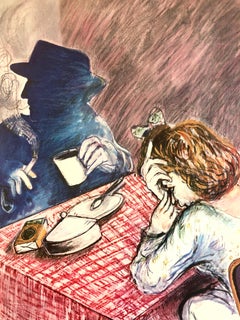
Shaoul Smira (Israeli, b. 1939) City Light Publisher, San Francisco. (Lawrence Ferlinghetti) signed "SMIRA" in pencil l.r. and numbered "86/100" in pencil l.l., Color lithograph on ...
Category

1980s Post-Modern Figurative Paintings

Materials

Lithograph

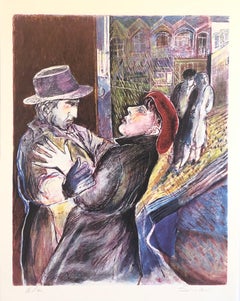
1980 s Large Modernist Israeli Film Noir Figures Lithograph Neo-Expressionism
By Shaoul Smira
Located in Surfside, FL
Shaoul Smira (Israeli, b. 1939) City Light Publisher, San Francisco. (Lawrence Ferlinghetti) signed "SMIRA" in pencil l.r. and numbered "86/100" in pencil l.l., Color lithograph on ...
Category

1980s Post-Modern Figurative Paintings

Materials

Lithograph

1980 s Large Modernist Israeli Film Noir Figures Lithograph Neo-Expressionism
By Shaoul Smira
Located in Surfside, FL
Shaoul Smira (Israeli, b. 1939) City Light Publisher, San Francisco. (Lawrence Ferlinghetti) signed "SMIRA" in pencil l.r. and numbered "86/100" in pencil l.l., Color lithograph on ...
Category

1980s Post-Modern Figurative Paintings

Materials

Lithograph

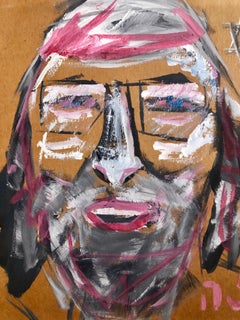
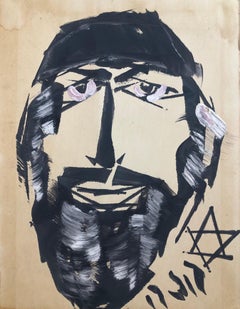
Outsider Folk Art Expressionist Rabbi Israeli Painting Signed Hebrew Jewish Star
Located in Surfside, FL
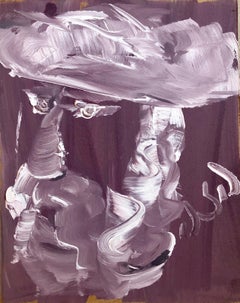
This is a signed portrait painting done in an outsider, folk art, expressionist style. This one looks like a Chassidic Breslov Hasidic man. it is signed in Hebrew, also marked with a Jewish star. this is from a collection of works by the same hand. they are all signed. Some have markings to the back of the paper. they have some age to them. They bear similarities to artists as dissimilar as Moshe Tamir, Mane Katz and an Israeli version of Purvis Young. In this piece the artist choice of colors is muted yet powerful. Israel has had a Vibrant Folk Art, Naive art scene for a long time now, artists like Yisrael Paldi, Nahum Guttman, Reuven Rubin and even Yefim Ladyzhensky...
Category

20th Century Outsider Art Portrait Paintings

Materials

Gouache

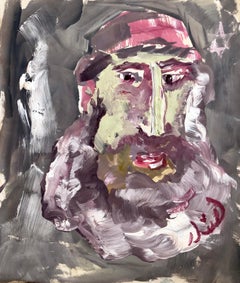
Outsider Folk Art Expressionist Rabbi Israeli Painting Signed Hebrew Jewish Star
Located in Surfside, FL
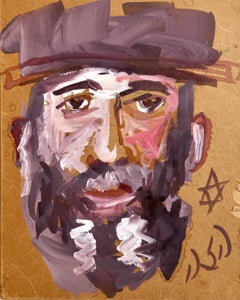
This is a signed portrait painting done in an outsider, folk art, expressionist style. it is signed in Hebrew, also marked with a Jewish star. this is from a collection of works by the same hand. they are all signed. Some have markings to the back of the paper. they have some age to them. They bear similarities to artists as dissimilar as Moshe Tamir, Mane Katz and an Israeli version of Purvis Young. In this piece the artist choice of colors is muted yet powerful. Israel has had a Vibrant Folk Art, Naive art scene for a long time now, artists like Yisrael Paldi, Nahum Guttman, Reuven Rubin and even Yefim Ladyzhensky had naive periods. The most well know of the strict naive artists are Shalom of Safed, Irene Awret, Gabriel Cohen, Natan Heber, Michael Falk and Kopel Gurwin. Naïve art is any form of visual art that is created by a person who lacks the formal education and training that a professional artist undergoes (in anatomy, art history, technique, perspective, ways of seeing). Unlike folk art, naïve art does not necessarily evince a distinct cultural context or tradition. Naïve art is recognized, and often imitated, for its childlike simplicity and frankness. Paintings of this kind typically have a flat rendering style with a rudimentary expression of perspective. One particularly influential painter of "naïve art" was Henri Rousseau (1844–1910), a French Post-Impressionist who was discovered by Pablo Picasso. Naïve art is often seen as outsider art that is by someone without formal (or little) training or degree. While this was true before the twentieth century, there are now academies for naïve art. Naïve art is now a fully recognized art genre, represented in art galleries worldwide. Museums devoted to naïve art now exist in Kecskemét, Hungary; Riga, Latvia; Jaen, Spain; Rio de Janeiro, Brasil; Vicq France and Paris. "Primitive art" is another term often applied to art by those without formal training, but is historically more often applied to work from certain cultures that have been judged socially or technologically "primitive" by Western academia, such as Native American, sub saharan African or Pacific Island art (see Tribal art). This is distinguished from the self-conscious, "primitive" inspired movement primitivism. Another term related to (but not completely synonymous with) naïve art is folk art. There also exist the terms "naïvism" and "primitivism" which are usually applied to professional painters working in the style of naïve art (like Paul Gauguin, Mikhail Larionov, Paul Klee). At all events, naive art can be regarded as having occupied an "official" position in the annals of twentieth-century art since - at the very latest - the publication of the Der Blaue Reiter, an almanac in 1912. Wassily Kandinsky and Franz Marc, who brought out the almanac, presented 6 reproductions of paintings by le Douanier' Rousseau (Henri Rousseau), comparing them with other pictorial examples. However, most experts agree that the year that naive art was "discovered" was 1885, when the painter Paul Signac became aware of the talents of Henri Rousseau and set about organizing exhibitions of his work in a number of prestigious galleries. The Earth Group (Grupa Zemlja) were Croatian artists, architects and intellectuals active in Zagreb from 1929 to 1935. The group included the painters Krsto Hegedušić, Edo Kovačević, Omer Mujadžić, Kamilo Ružička, Ivan Tabaković, and Oton Postružnik, the sculptors Antun Augustinčić, Frano Kršinić, and the architect Drago Ibler. Art brut, primitive art, primitive, art naïf, naïve art. Outsider art. A term applied to Yugoslav (Croatian) naive painters working in or around the village of Hlebine, near the Hungarian border, from about 1930. Some of the best known naive artists are Dragan Gaži, Ivan Generalić, Josip Generalić, Krsto Hegedušić, Mijo Kovačić, Ivan Lacković-Croata, Franjo Mraz, Ivan Večenaj and Mirko Virius. Camille Bombois (1883–1970) Ferdinand Cheval, known as 'le facteur Cheval' (1836–1924) Henry Darger (1892–1973) L. S. Lowry (1887–1976) Grandma Moses, Anna Mary Robertson (1860–1961) Nikifor (1895–1968) Poland, Horace Pippin (1888–1946) Jon Serl (1894-1993) United States Alfred Wallis (1855–1942) Scottie Wilson (1890–1972) Gesner Abelard (b. 1922) Jan Balet (1913–2009) Michel Delacroix (b. 1933) France Howard Finster (1916–2001) Ivan Rabuzin (1921–2008) Spontaneous Art Museum in Brussels Art en Marge Museum in Brussels MADmusée in Liege International Museum of Naive Art of Brazil in Cosme Velho, Rio de Janeiro Gallery Jacques Ardies in São Paulo Musée international d'art naïf de Magog in Magog Croatian Museum of Naïve Art in Zagreb Gallery of Croatian Naïve Art...
Category

20th Century Outsider Art Portrait Paintings

Materials

Gouache

Outsider Folk Art Expressionist Rabbi Israeli Painting Signed Hebrew Jewish Star
Located in Surfside, FL
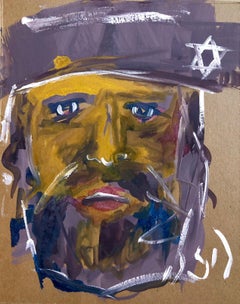
This is a signed portrait painting done in an outsider, folk art, expressionist style. it is signed in Hebrew, also marked with a Jewish star. this is from a collection of works by the same hand. they are all signed. Some have markings to the back of the paper. they have some age to them. They bear similarities to artists as dissimilar as Moshe Tamir, Mane Katz and an Israeli version of Purvis Young. In this piece the artist choice of colors is muted yet powerful. Israel has had a Vibrant Folk Art, Naive art scene for a long time now, artists like Yisrael Paldi, Nahum Guttman, Reuven Rubin and even Yefim...
Category

20th Century Outsider Art Portrait Paintings

Materials

Gouache

Outsider Folk Art Expressionist Rabbi Israeli Painting Signed Hebrew Jewish Star
Located in Surfside, FL
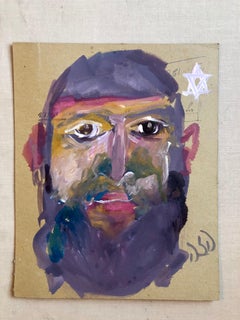
This is a signed portrait painting done in an outsider, folk art, expressionist style. it is signed in Hebrew, also marked with a Jewish star. this is from a collection of works by the same hand. they are all signed. Some have markings to the back of the paper. they have some age to them. They bear similarities to artists as dissimilar as Moshe Tamir, Mane Katz and an Israeli version of Purvis Young. In this piece the artist choice of colors is muted yet powerful. Israel has had a Vibrant Folk Art, Naive art scene for a long time now, artists like Yisrael Paldi, Nahum Guttman, Reuven Rubin and even Yefim Ladyzhensky had naive periods. The most well know of the strict naive artists are Shalom of Safed, Irene Awret, Gabriel Cohen, Natan Heber, Michael Falk and Kopel Gurwin. Naïve art is any form of visual art that is created by a person who lacks the formal education and training that a professional artist undergoes (in anatomy, art history, technique, perspective, ways of seeing). Unlike folk art, naïve art does not necessarily evince a distinct cultural context or tradition. Naïve art is recognized, and often imitated, for its childlike simplicity and frankness. Paintings of this kind typically have a flat rendering style with a rudimentary expression of perspective. One particularly influential painter of "naïve art" was Henri Rousseau (1844–1910), a French Post-Impressionist who was discovered by Pablo Picasso. Naïve art is often seen as outsider art that is by someone without formal (or little) training or degree. While this was true before the twentieth century, there are now academies for naïve art. Naïve art is now a fully recognized art genre, represented in art galleries worldwide. Museums devoted to naïve art now exist in Kecskemét, Hungary; Riga, Latvia; Jaen, Spain; Rio de Janeiro, Brasil; Vicq France and Paris. "Primitive art" is another term often applied to art by those without formal training, but is historically more often applied to work from certain cultures that have been judged socially or technologically "primitive" by Western academia, such as Native American, sub saharan African or Pacific Island art (see Tribal art). This is distinguished from the self-conscious, "primitive" inspired movement primitivism. Another term related to (but not completely synonymous with) naïve art is folk art. There also exist the terms "naïvism" and "primitivism" which are usually applied to professional painters working in the style of naïve art (like Paul Gauguin, Mikhail Larionov, Paul Klee). At all events, naive art can be regarded as having occupied an "official" position in the annals of twentieth-century art since - at the very latest - the publication of the Der Blaue Reiter, an almanac in 1912. Wassily Kandinsky and Franz Marc, who brought out the almanac, presented 6 reproductions of paintings by le Douanier' Rousseau (Henri Rousseau), comparing them with other pictorial examples. However, most experts agree that the year that naive art was "discovered" was 1885, when the painter Paul Signac became aware of the talents of Henri Rousseau and set about organizing exhibitions of his work in a number of prestigious galleries. The Earth Group (Grupa Zemlja) were Croatian artists, architects and intellectuals active in Zagreb from 1929 to 1935. The group included the painters Krsto Hegedušić, Edo Kovačević, Omer Mujadžić, Kamilo Ružička, Ivan Tabaković, and Oton Postružnik, the sculptors Antun Augustinčić, Frano Kršinić, and the architect Drago Ibler. Art brut, primitive art, primitive, art naïf, naïve art. Outsider art. A term applied to Yugoslav (Croatian) naive painters working in or around the village of Hlebine, near the Hungarian border, from about 1930. Some of the best known naive artists are Dragan Gaži, Ivan Generalić, Josip Generalić, Krsto Hegedušić, Mijo Kovačić, Ivan Lacković-Croata, Franjo Mraz, Ivan Večenaj and Mirko Virius. Camille Bombois (1883–1970) Ferdinand Cheval, known as 'le facteur Cheval' (1836–1924) Henry Darger (1892–1973) L. S. Lowry (1887–1976) Grandma Moses, Anna Mary Robertson (1860–1961) Nikifor (1895–1968) Poland, Horace Pippin (1888–1946) Jon Serl (1894-1993) United States Alfred Wallis (1855–1942) Scottie Wilson (1890–1972) Gesner Abelard (b. 1922) Jan Balet (1913–2009) Michel Delacroix (b. 1933) France Howard Finster (1916–2001) Ivan Rabuzin (1921–2008) Spontaneous Art Museum in Brussels Art en Marge Museum in Brussels MADmusée in Liege International Museum of Naive Art of Brazil in Cosme Velho, Rio de Janeiro Gallery Jacques Ardies in São Paulo Musée international d'art naïf de Magog in Magog Croatian Museum of Naïve Art in Zagreb Gallery of Croatian Naïve Art...
Category

20th Century Outsider Art Portrait Paintings

Materials

Gouache

Outsider Folk Art Expressionist Rabbi Israeli Painting Signed Hebrew Jewish Star
Located in Surfside, FL
This is a signed portrait painting done in an outsider, folk art, expressionist style. it is signed in Hebrew, also marked with a Jewish star. this is from a collection of works by the same hand. they are all signed. Some have markings to the back of the paper. they have some age to them. They bear similarities to artists as dissimilar as Moshe Tamir, Mane Katz and an Israeli version of Purvis Young. In this piece the artist choice of colors is muted yet powerful. Israel has had a Vibrant Folk Art, Naive art scene for a long time now, artists like Yisrael Paldi, Nahum Guttman, Reuven Rubin and even Yefim Ladyzhensky had naive periods. The most well know of the strict naive artists are Shalom of Safed, Irene Awret, Gabriel Cohen, Natan Heber, Michael Falk and Kopel Gurwin. Naïve art is any form of visual art that is created by a person who lacks the formal education and training that a professional artist undergoes (in anatomy, art history, technique, perspective, ways of seeing). Unlike folk art, naïve art does not necessarily evince a distinct cultural context or tradition. Naïve art is recognized, and often imitated, for its childlike simplicity and frankness. Paintings of this kind typically have a flat rendering style with a rudimentary expression of perspective. One particularly influential painter of "naïve art" was Henri Rousseau (1844–1910), a French Post-Impressionist who was discovered by Pablo Picasso. Naïve art is often seen as outsider art that is by someone without formal (or little) training or degree. While this was true before the twentieth century, there are now academies for naïve art. Naïve art is now a fully recognized art genre, represented in art galleries worldwide. Museums devoted to naïve art now exist in Kecskemét, Hungary; Riga, Latvia; Jaen, Spain; Rio de Janeiro, Brasil; Vicq France and Paris. "Primitive art" is another term often applied to art by those without formal training, but is historically more often applied to work from certain cultures that have been judged socially or technologically "primitive" by Western academia, such as Native American, sub saharan African or Pacific Island art (see Tribal art). This is distinguished from the self-conscious, "primitive" inspired movement primitivism. Another term related to (but not completely synonymous with) naïve art is folk art. There also exist the terms "naïvism" and "primitivism" which are usually applied to professional painters working in the style of naïve art (like Paul Gauguin, Mikhail Larionov, Paul Klee). At all events, naive art can be regarded as having occupied an "official" position in the annals of twentieth-century art since - at the very latest - the publication of the Der Blaue Reiter, an almanac in 1912. Wassily Kandinsky and Franz Marc, who brought out the almanac, presented 6 reproductions of paintings by le Douanier' Rousseau (Henri Rousseau), comparing them with other pictorial examples. However, most experts agree that the year that naive art was "discovered" was 1885, when the painter Paul Signac became aware of the talents of Henri Rousseau and set about organizing exhibitions of his work in a number of prestigious galleries. The Earth Group (Grupa Zemlja) were Croatian artists, architects and intellectuals active in Zagreb from 1929 to 1935. The group included the painters Krsto Hegedušić, Edo Kovačević, Omer Mujadžić, Kamilo Ružička, Ivan Tabaković, and Oton Postružnik, the sculptors Antun Augustinčić, Frano Kršinić, and the architect Drago Ibler. Art brut, primitive art, primitive, art naïf, naïve art. Outsider art. A term applied to Yugoslav (Croatian) naive painters working in or around the village of Hlebine, near the Hungarian border, from about 1930. Some of the best known naive artists are Dragan Gaži, Ivan Generalić, Josip Generalić, Krsto Hegedušić, Mijo Kovačić, Ivan Lacković-Croata, Franjo Mraz, Ivan Večenaj and Mirko Virius. Camille Bombois (1883–1970) Ferdinand Cheval, known as 'le facteur Cheval' (1836–1924) Henry Darger (1892–1973) L. S. Lowry (1887–1976) Grandma Moses, Anna Mary Robertson (1860–1961) Nikifor (1895–1968) Poland, Horace Pippin (1888–1946) Jon Serl (1894-1993) United States Alfred Wallis (1855–1942) Scottie Wilson (1890–1972) Gesner Abelard (b. 1922) Jan Balet (1913–2009) Michel Delacroix (b. 1933) France Howard Finster (1916–2001) Ivan Rabuzin (1921–2008) Spontaneous Art Museum in Brussels Art en Marge Museum in Brussels MADmusée in Liege International Museum of Naive Art of Brazil in Cosme Velho, Rio de Janeiro Gallery Jacques Ardies in São Paulo Musée international d'art naïf de Magog in Magog Croatian Museum of Naïve Art in Zagreb Gallery of Croatian Naïve Art...
Category

20th Century Outsider Art Portrait Paintings

Materials

Gouache

Outsider Folk Art Expressionist Rabbi Israeli Painting Signed Hebrew Jewish Star
Located in Surfside, FL
This is a signed portrait painting done in an outsider, folk art, expressionist style. it is signed in Hebrew, also marked with a Jewish star. this is from a collection of works by the same hand. they are all signed. Some have markings to the back of the paper. they have some age to them. They bear similarities to artists as dissimilar as Moshe Tamir, Mane Katz and an Israeli version of Purvis Young. In this piece the artist choice of colors is muted yet powerful. Israel has had a Vibrant Folk Art, Naive art scene for a long time now, artists like Yisrael Paldi, Nahum Guttman, Reuven Rubin and even Yefim Ladyzhensky had naive periods. The most well know of the strict naive artists are Shalom of Safed, Irene Awret, Gabriel Cohen, Natan Heber, Michael Falk and Kopel Gurwin. Naïve art is any form of visual art that is created by a person who lacks the formal education and training that a professional artist undergoes (in anatomy, art history, technique, perspective, ways of seeing). Unlike folk art, naïve art does not necessarily evince a distinct cultural context or tradition. Naïve art is recognized, and often imitated, for its childlike simplicity and frankness. Paintings of this kind typically have a flat rendering style with a rudimentary expression of perspective. One particularly influential painter of "naïve art" was Henri Rousseau (1844–1910), a French Post-Impressionist who was discovered by Pablo Picasso. Naïve art is often seen as outsider art that is by someone without formal (or little) training or degree. While this was true before the twentieth century, there are now academies for naïve art. Naïve art is now a fully recognized art genre, represented in art galleries worldwide. Museums devoted to naïve art now exist in Kecskemét, Hungary; Riga, Latvia; Jaen, Spain; Rio de Janeiro, Brasil; Vicq France and Paris. "Primitive art" is another term often applied to art by those without formal training, but is historically more often applied to work from certain cultures that have been judged socially or technologically "primitive" by Western academia, such as Native American, sub saharan African or Pacific Island art (see Tribal art). This is distinguished from the self-conscious, "primitive" inspired movement primitivism. Another term related to (but not completely synonymous with) naïve art is folk art. There also exist the terms "naïvism" and "primitivism" which are usually applied to professional painters working in the style of naïve art (like Paul Gauguin, Mikhail Larionov, Paul Klee). At all events, naive art can be regarded as having occupied an "official" position in the annals of twentieth-century art since - at the very latest - the publication of the Der Blaue Reiter, an almanac in 1912. Wassily Kandinsky and Franz Marc, who brought out the almanac, presented 6 reproductions of paintings by le Douanier' Rousseau (Henri Rousseau), comparing them with other pictorial examples. However, most experts agree that the year that naive art was "discovered" was 1885, when the painter Paul Signac became aware of the talents of Henri Rousseau and set about organizing exhibitions of his work in a number of prestigious galleries. The Earth Group (Grupa Zemlja) were Croatian artists, architects and intellectuals active in Zagreb from 1929 to 1935. The group included the painters Krsto Hegedušić, Edo Kovačević, Omer Mujadžić, Kamilo Ružička, Ivan Tabaković, and Oton Postružnik, the sculptors Antun Augustinčić, Frano Kršinić, and the architect Drago Ibler. Art brut, primitive art, primitive, art naïf, naïve art. Outsider art. A term applied to Yugoslav (Croatian) naive painters working in or around the village of Hlebine, near the Hungarian border, from about 1930. Some of the best known naive artists are Dragan Gaži, Ivan Generalić, Josip Generalić, Krsto Hegedušić, Mijo Kovačić, Ivan Lacković-Croata, Franjo Mraz, Ivan Večenaj and Mirko Virius. Camille Bombois (1883–1970) Ferdinand Cheval, known as 'le facteur Cheval' (1836–1924) Henry Darger (1892–1973) L. S. Lowry (1887–1976) Grandma Moses, Anna Mary Robertson (1860–1961) Nikifor (1895–1968) Poland, Horace Pippin (1888–1946) Jon Serl (1894-1993) United States Alfred Wallis (1855–1942) Scottie Wilson (1890–1972) Gesner Abelard (b. 1922) Jan Balet (1913–2009) Michel Delacroix (b. 1933) France Howard Finster (1916–2001) Ivan Rabuzin (1921–2008) Spontaneous Art Museum in Brussels Art en Marge Museum in Brussels MADmusée in Liege International Museum of Naive Art of Brazil in Cosme Velho, Rio de Janeiro Gallery Jacques Ardies in São Paulo Musée international d'art naïf de Magog in Magog Croatian Museum of Naïve Art in Zagreb Gallery of Croatian Naïve Art...
Category

20th Century Outsider Art Portrait Paintings

Materials

Gouache

Outsider Folk Art Expressionist Rabbi Israeli Painting Signed Hebrew Jewish Star
Located in Surfside, FL
This is a signed portrait painting done in an outsider, folk art, expressionist style. it is signed in Hebrew, also marked with a Jewish star. this is from a collection of works by the same hand. they are all signed. Some have markings to the back of the paper. they have some age to them. They bear similarities to artists as dissimilar as Moshe tamir, Mane Katz and an Israeli version of Purvis Young. In this piece the artist choice of colors is muted yet powerful. Israel has had a Vibrant Folk Art, Naive art scene for a long time now, artists like Yisrael Paldi, Nahum Guttman, Reuven Rubin and even Yefim Ladyzhensky had naive periods. The most well know of the strict naive artists are Shalom of Safed, Irene Awret, Gabriel Cohen, Natan Heber, Michael Falk and Kopel Gurwin. Naïve art is any form of visual art that is created by a person who lacks the formal education and training that a professional artist undergoes (in anatomy, art history, technique, perspective, ways of seeing). Unlike folk art, naïve art does not necessarily evince a distinct cultural context or tradition. Naïve art is recognized, and often imitated, for its childlike simplicity and frankness. Paintings of this kind typically have a flat rendering style with a rudimentary expression of perspective. One particularly influential painter of "naïve art" was Henri Rousseau (1844–1910), a French Post-Impressionist who was discovered by Pablo Picasso. Naïve art is often seen as outsider art that is by someone without formal (or little) training or degree. While this was true before the twentieth century, there are now academies for naïve art. Naïve art is now a fully recognized art genre, represented in art galleries worldwide. Museums devoted to naïve art now exist in Kecskemét, Hungary; Riga, Latvia; Jaen, Spain; Rio de Janeiro, Brasil; Vicq France and Paris. "Primitive art" is another term often applied to art by those without formal training, but is historically more often applied to work from certain cultures that have been judged socially or technologically "primitive" by Western academia, such as Native American, sub saharan African or Pacific Island art (see Tribal art). This is distinguished from the self-conscious, "primitive" inspired movement primitivism. Another term related to (but not completely synonymous with) naïve art is folk art. There also exist the terms "naïvism" and "primitivism" which are usually applied to professional painters working in the style of naïve art (like Paul Gauguin, Mikhail Larionov, Paul Klee). At all events, naive art can be regarded as having occupied an "official" position in the annals of twentieth-century art since - at the very latest - the publication of the Der Blaue Reiter, an almanac in 1912. Wassily Kandinsky and Franz Marc, who brought out the almanac, presented 6 reproductions of paintings by le Douanier' Rousseau (Henri Rousseau), comparing them with other pictorial examples. However, most experts agree that the year that naive art was "discovered" was 1885, when the painter Paul Signac became aware of the talents of Henri Rousseau and set about organizing exhibitions of his work in a number of prestigious galleries. The Earth Group (Grupa Zemlja) were Croatian artists, architects and intellectuals active in Zagreb from 1929 to 1935. The group included the painters Krsto Hegedušić, Edo Kovačević, Omer Mujadžić, Kamilo Ružička, Ivan Tabaković, and Oton Postružnik, the sculptors Antun Augustinčić, Frano Kršinić, and the architect Drago Ibler. Art brut, primitive art, primitive, art naïf, naïve art. Outsider art. A term applied to Yugoslav (Croatian) naive painters working in or around the village of Hlebine, near the Hungarian border, from about 1930. Some of the best known naive artists are Dragan Gaži, Ivan Generalić, Josip Generalić, Krsto Hegedušić, Mijo Kovačić, Ivan Lacković-Croata, Franjo Mraz, Ivan Večenaj and Mirko Virius. Camille Bombois (1883–1970) Ferdinand Cheval, known as 'le facteur Cheval' (1836–1924) Henry Darger (1892–1973) L. S. Lowry (1887–1976) Grandma Moses, Anna Mary Robertson (1860–1961) Nikifor (1895–1968) Poland, Horace Pippin (1888–1946) Jon Serl (1894-1993) United States Alfred Wallis (1855–1942) Scottie Wilson (1890–1972) Gesner Abelard (b. 1922) Jan Balet (1913–2009) Michel Delacroix (b. 1933) France Howard Finster (1916–2001) Ivan Rabuzin (1921–2008) Spontaneous Art Museum in Brussels Art en Marge Museum in Brussels MADmusée in Liege International Museum of Naive Art of Brazil in Cosme Velho, Rio de Janeiro Gallery Jacques Ardies in São Paulo Musée international d'art naïf de Magog in Magog Croatian Museum of Naïve Art in Zagreb Gallery of Croatian Naïve Art...
Category

20th Century Outsider Art Portrait Paintings

Materials

Gouache

Large Pop Art Painting Dennis Hollingsworth LA Artist Post Modernist Abstract
By Dennis Hollingsworth
Located in Surfside, FL
Dennis Hollingsworth (American, b. 1956) large scale painting, 1994 "Leaf Blower #15", oil & alkyd on canvas over wood panel, Hand signed and dated verso, Dimensions: 72" X 72" Dennis Hollingsworth, Born 1956 in Madrid, Spain he has lived and worked in Los Angeles, California. He currently lives and works in New York City and Tossa De Mar Spain. He attended Claremont Graduate School, Claremont, USA, 1991, B.A. Architecture, California Polytechnic State University, San Luis Obispo, USA, 1985 Dennis Hollingsworth is a painter whose works combine abstraction with a pop art sensibility. The newer pieces bring to mind other artists whose work also investigates the structure and support, including Molly Zuckerman-Hartung, Elizabeth Murray, Ron Gorchov, James Hyde, Rosy Keyser, and Fabian Marcaccio. His first exhibition was Painting Beyond The Idea at Manny Silverman Gallery in Los Angeles, CA in 1995, and the most recent exhibition was TEN at Hionas Gallery in New York City, NY in 2021. Dennis Hollingsworth is most frequently exhibited in United States, but also had exhibitions in Germany, Spain and elsewhere. Hollingsworth has at least 27 solo shows and 67 group shows over the last 26 years. Hollingsworth has also been in no less than 14 art fair. A notable show was Dennis Hollingsworth - Wet On Wet at Blum & Poe in Los Angeles, CA in 1996. He was included in the show “Under Erasure” at Pierogi Gallery curated by Heather and Raphael Rubinstein. Artists included: Jean-Michel Basquiat, Mel Bochner, Jane Hammond, Dennis Hollingsworth, Glenn Ligon, Richard Prince, Robert Rauschenberg, Nicole Eisenman and Antoni Tapies. His work was exhibited in 1999 at the Kunsthalle Basel as part of the group show ‘Nach-Bild’, which also featured artists Richard Hamilton and Laura Owens. Other notable shows were at Nicole Klagsbrun Gallery in New York City, NY and Kohn Gallery in Los Angeles, CA. Dennis Hollingsworth has been exhibited with Katharina Grosse and Herbert Brandl. Dennis Hollingsworth’s art is in museum collections, including MOCA Grand Avenue in Los Angeles, CA and Columbus Art Foundation in Ravensburg among others. He is represented by Hionas Gallery, New York, NY 1956, BORN IN MADRID, SPAIN 1985, BACHELOR OF ARCHITECTURE, CALIFORNIA POLYTECHNIC STATE UNIVERSITY 1991, MASTERS OF FINE ARTS, CLAREMONT GRADUATE SCHOOL LIVES AND WORKS IN NEW YORK CITY, USA AND TOSSA DE MAR, SPAIN SOLO EXHIBITIONS: GALERIA MIGUEL MARCOS, BARCELONA, SPAIN GALERIE RICHARD, NYC, USA HIONAS GALLERY, NYC, USA FRONT GALLERY, HOUSTON, TEXAS, USA TOMIO KOYAMA GALLERY (HIKARIE),TOKYO, JAPAN MICHAEL KOHN GALLERY, LOS ANGELES, CA, USA CIRRUS GALLERY, LOS ANGELES, CA, USA GALERIA PELAIRES, PALMA DE MALLORCA, SPAIN NICOLE KLAGSBRUN GALLERY, NEW YORK, NY, USA GALERIA ANA SERRATOSA, VALENCIA, SPAIN GALERIE ANDRÉ BUCHMANN, COLOGNE, GERMANY GALERIE TANYA RUMPFF, HAARLEM, NETHERLANDS GALERIE MARK MULLER, ZURICH SWITZERLAND CHAC MOOL GALLERY, LOS ANGELES, CA, USA BRETT/MITCHELL SHAHEEN GALLERY, CLEVELAND, OH BARBARA FARBER/LA SERRE, TRETS FRANCE THE BOX, TORINO, ITALY STEENDRUKKERIJ AMSTERDAM, M.V., HOLLAND BARBARA FARBER/ROB JURKA GALLERY, AMSTERDAM, HOLLAND LAWING GALLERY, HOUSTON, TX, USA SCHMIDT CONTEMPORARY ART, ST. LOUIS, MI MEYERSON & NOWINSKI GALLERY, SEATTLE, WASHINGTON BLUM POE GALLERY, SANTA MONICA, CA, USA SCARABB GALLERY, CLEVELAND, OH BENNETT ROBERTS FINE ART, LOS ANGELES, CA, USA LEE ARTHUR STUDIO, NEW YORK, NY STUDIO RAID GALLERY, LOS ANGELES, CA, USA GROUP EXHIBITIONS 2020 “OEUVRES CHOISIES”, GALERIE RICHARD, PARIS GALERIE RICHARD, NYC, PARIS Rainer Gross, Dennis Hollingsworth, Kim Young-Hun, Jeremy Thomas. “UNTITLED”, GALERIE RICHARD, NYC, PARIS 2019 “LITTORAL”, MUNICIPAL MUSEUM OF TOSSA DE MAR, TOSSA DE MAR, SPAIN “DIVINE INTERVENTIONS”, CHRIST EPISCOPAL CHURCH IN SAG HARBOR, LONG ISLAND, USA “ANGLES DE REFLEXIÓ”, GALERIE RICHARD VANDERAA, GIRONA, SPAIN 2018 “UNDER/ERASURE”, PIEROGI GALLERY, NYC, USA “COLOR MATTERS”, GALERIE RICHARD, NYC,USA “EVOLUTION”, GALERIA MIGUEL MARCOS, BARCELONA, SPAIN “WORKS FROM THE GALLERY ARTISTS AND THE COLLECTION 3”, TOMIO KOYAMA GALLERY, TOKYO, JAPAN 2012 “NEXUS”, GALERIA MIGUEL MARCOS, BARCELONA, SPAIN “FOR EXAMPLE PAINTING”, GALERIE MARK MÜLLER, ZÜRICH, SWITZERLAND “FRÜHLING”, GALERIE EUGEN LENDL, GRAZ, SWITZERLAND 2011 GROUP SHOW, GALERIE MARK MÜLLER, ZÜRICH, SWITZERLAND “ALUSIONES-ILUSIONES”, GALERIA MIGUEL MARCOS, BARCELONA, SPAIN “THE WORKING TITLE”, BRONX ART CENTER, BRONX, NEW YORK, USA “GREATER LA”, NEW YORK, NEW YORK, USA 2010 25TH ANNIVERSARY SHOW, MICHAEL KOHN GALLERY, LOS ANGELES, CALIFORNIA, USA “CRYSTAL WORLD”, ANDRE BUCHMANN GALLERY, BERLIN, GERMANY GROUP SHOW, TOMIO KOYAMA GALLERY, TOKYO, JAPAN PINTURA SIN TREGUA GALERIE MIGUEL MARCOS, BARCELONA, SPAIN GROUP SHOW, TANYA RUMPFF GALLERY, HAARLEM, NETHERLANDS PALM PAINTINGS, ANDRÉ BUCHMANN GALLERY, BERLIN, GERMANY 2007 “QUIRKY”, WESTPORT ART CENTER, WESTPORT, CONNECTICUT “ROOM 3: ACCROCHAGE”, GALERIE MARK MÜLLER, ZÜRICH, SWITZERLAND “POP ART 1960’S TO 2000’S”, HIROSHIMA CITY MUSEUM OF CONTEMPORARY ART, HIROSHIMA, JAPAN An important exhibition from Misumi Art Collection of post-war American art, including Roy Lichtenstein and Andy Warhol, Keith Haring, David Hockney, Christopher Wool, Vic Muniz...
Category

1990s Pop Art Abstract Paintings

Materials

Canvas, Oil, Alkyd

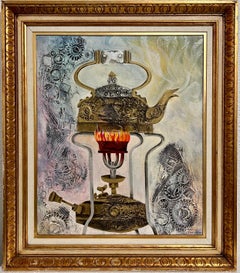
Jerusalem Samovar Israeli Judaica Eliezer Weishoff Oil Painting Bezalel Artist
Located in Surfside, FL
Eliezer Weishoff (Israeli, 20th century) Still life of kettle (Russian samovar) over a warmer, 1973 Acrylic or oil on canvas Signed, dated and signed ...
Category

1970s Modern Still-life Paintings

Materials

Canvas, Oil, Acrylic

Itzhak Holtz (Judaica Master) Oil Painting Portrait John Sloan Ashcan Artist WPA
By Itshak Holtz
Located in Surfside, FL
Oil Painting Portrait of Ashcan Artist John Sloan. Signed I. Holtz. The youngest of four children, Holtz was born and spent his early childhood in Skierniewice, Poland, a small town near Warsaw. His father was a hat maker and a furrier. In 1935, prior to World War II, when Holtz was ten years old, his family moved to Jerusalem, Israel, where they settled in the Geula neighborhood near Meah Shearim. Itzhak Holtz's passion for art began early. When he was five years old, in Poland, his father first drew a picture of a horse and sled in the snow for him. The young Holtz looked at the drawing and studied it in wonderment. From that moment on, Holtz remembers, he constantly begged his father to draw for him. His enthusiasm for art grew and Holtz longed to study art. In 1945, he enrolled at the Bezalel Academy of Art and Design in Jerusalem, where he primarily studied lettering and poster work in a program geared toward commercial art Holtz became interested in painting, prompting him to move to New York City in 1950 to study at the Art Students League of New York under Robert Brackman and Harry Sternberg, and then at the National Academy of Design under Robert Philipp. Holtz has stated that his artwork, which primarily but not exclusively, depict scenes of Jewish spirituality and tradition, is driven by his Orthodox Jewish beliefs: "You have to live that religious life to fully capture it on canvas." He has been classified in the school of genre painting, often depicting street scenes of ordinary people in everyday Jewish life in the back alleys and markets of Jerusalem neighborhoods such as Me'ah Shearim and Geula; and in New York neighborhoods and hamlets such as Monsey, Boro Park and Williamsburg. Along with street scenes, his work includes portraits of scribes, tailors, cobblers and fishmongers, and images such as shtetls, lighthouses, and wedding scenes. He started out painting mostly portraits in order to support his family, before expanding to include street scenes. His beloved subject matter is painting scenes of Jewish life, his childhood memories when his mother took him along shopping for the Sabbath to the markets of Meah Shearim, has left a deep impression on him and influenced many of his works. Holtz has experimented in the abstract, but then reverted to representational and figurative art to which he devoted himself exclusively. His Israeli street scenes are said to combine “an affectionate recollection of the past with the brilliance of the color of modern Israel.” Holtz has stated that he struggled at first when he arrived to the USA because of financial reasons and because he only knew Polish, Yiddish and Hebrew, but then made good ties with his instructor who greatly influenced him Robert Philipp who helped him make friends and referred him to paint portraits. Examples of Holtz's work throughout the years include: Yerusalem Wedding (2010), depicting a Chuppa in Jerusalem on early evening, oil on canvas; The Funeral(1966), depicting five stoic Hasidim carrying a body on a bier over to a gravesite, with the people behind them crying, in charcoal on paper and oil on canvas; Rejoicing (1974), an image of religious men dancing, in felt pen and marker on paper; and the oil painting Shamash Learning in Shul (2003), a portrait of a pious Jew studying the Talmud inside a claustrophobic synagogue scene. Throughout the years Holtz has created hundreds of works in many art mediums, including, genre scenes, portraits, still lifes and landscape scenery, his works are sought after by art collectors worldwide, and he has been called the greatest living Jewish artist. It is said that no artist ever explored the Jewish subject like Holtz. Today some of his oil paintings have been commanding over $100,000. Holtz creates his scenes after researching locations, and often uses locals as models. He paints slowly and with great care, but with a swift Impressionistic style. The people in his portraits and scenes are generally more cheerful and optimistic than standard portraits of Hassidic individuals. He paints oils and watercolors, and also does felt pen, pastel, marker, ink and charcoal drawings, as well as woodcuts. His oil paintings typically have a brown hue, while his work with felt pen is often in sepia tones, and on some of his works he used very bright colors, with a strong emphasis on the interplay of light and shadow. He is heavily influenced by the ancient staircases and alleyways of Jerusalem, with its modest religious population, which has made a strong impression on him in his youth, the streets of Tzfat, and the works of Rembrandt, Johannes Vermeer and Peter Bruegel, as well as Jewish artists Moritz Daniel Oppenheim...
Category

1940s Realist Portrait Paintings

Materials

Canvas, Oil

Original Modernist Oil Stick Pigment Painting by Aaron Fink, Cherry. Pop Art
By Aaron Fink
Located in Surfside, FL
Aaron Fink (American, b. 1955) "Cherry" Signed and dated "Aaron Fink 1980" lower right. framed. there is a label that was on the board on back from Obelisk gallery. it is currently not attached. it is unframed. Floated against a foam core backing so that the edges of the sheet are visible. The two tiny tears are probably at site of old tack holes, where the tacks pulled through the paper due to the weight. Born in Boston, Fink received his BFA from the Maryland Institute College of Art and his MFA from the Yale University School of Art. His work has been exhibited widely throughout the U.S., Europe, Japan and Australia. He has been the subject of solo exhibitions at the Massachusetts Institute of Technology, the Muskegon Museum of Art, Michigan, the Rockford Art Museum, Illinois, and Colorado State University, Fort Collins. In 2002 a monograph on Fink’s work, Out of the Ordinary, was published, with text by Eleanor Heartney. In 1983 Fink met the collector John Powers, who remained a strong supporter of his work until his death in 1999. Fink’s work is represented in the collections of the Art Institute of Chicago, the Hara Museum, Tokyo, the Metropolitan Museum of Art, New York, the Museum of Modern Art, New York and the National Gallery of Art, Washington, DC, among many others. Fink currently divides his time between Boston and Rockport, Massachusetts. S E L E C T E D C O L L E C T I O N S Art Institute of Chicago Bank of America Boston Public Library Bouwfonds Netherlandse Gemeenten, The Netherlands Brooklyn Museum of Art Castelli Collection, New York Chase Manhattan Bank Chemical Bank Childrens Hospital, Chicago Choate Rosemary Hall...
Category

1980s Contemporary Figurative Paintings

Materials

Oil Pastel, Mixed Media, Pigment

2 Sided Expressionist Detroit Modernist Painting Female Nude, Night Cruise Ship
Located in Surfside, FL
This is a two sided painting. Nude reclining woman and a ship lit at night. Harold Cohn (1908 - 1982) Harold Cohn was active/lived in New Jersey, Michigan. Harold Cohn is known fo...
Category

Mid-20th Century Modern Nude Paintings

Materials

Watercolor, Gouache

2 Sided Expressionist Detroit Modernist Painting Female Nude, Night Cruise Ship
Located in Surfside, FL
This is a two sided painting. Nude reclining woman and a ship lit at night. Harold Cohn (1908 - 1982) Harold Cohn was active/lived in New Jersey, Michigan. Harold Cohn is known fo...
Category

Mid-20th Century Modern Nude Paintings

Materials

Watercolor, Gouache

Large Judaica Oil Painting, Polish Jewish Wedding in the Shtetl Chaim Goldberg
By Chaïm Goldberg
Located in Surfside, FL
Genre: Judaica Subject: Architecture Medium: Oil Surface: Canvas Country: United States Dimensions: 40X60 inches Temple Chaim Goldberg has worked in nearly every medium available...
Category

20th Century Impressionist Figurative Paintings

Materials

Canvas, Oil

Outside the Synagogue Russian Judaica Oil Painting
By Emmanuel Snitkovsky
Located in Surfside, FL
This piece came from the collection of the Bezalel Art Gallery on the Lower East Side of New York City. Emmanuil Snitkovsky is an internationally known artist, sculpture and poet. Emmanuil Snitkovsky was born into a family of artists and scholars from the Odessa Art College in Russia. Immersed in the traditions of Russia art, he approaches form, line, space and color with relentless vision and impeccable technique. Two highly successful artists, the husband and wife team of Emmanuil and Janet Snitkovsky have exhibited a selection of eight large Judaic paintings at the Chabad Chassidic Art Institute (Chai Gallery) in Crown Heights. Three of those paintings are truly singular visions of Jewish Art that cause us to stop and reassess our preconceptions about the meaning and importance of their subjects. Emmanuil and Janet Snitkovsky were both born in the Ukraine in the 1930′s. Emmanuil was trained in Odessa in public monument art, and Janet majored in fashion at the Lvov Decorative Art Institute. After both narrowly survived the devastation of the Second World War in Stalin’s Russia, they began to collaborate on state sponsored art works in 1962. For ten years, they worked on grandiose public sculptural projects to commemorate the fallen Russian heroes of the Second World War in Moscow, Kiev, Tula and Kazan. They were exemplary Soviet Realists working for the Soviet regime. Eventually, this career became untenable for them, both as artists and as Jews, when they clashed with Soviet officialdom over a commission to commemorate the Babi-Yar massacre. The Soviets refused to acknowledge this massacre of 100,000 Jews and eventually suppressed the memorial. In 1978, Emmanuil and Janet arrived in New York and began to recreate their artistic lives. In the ensuing 25 years, they have been quite successful, exhibiting widely in the United States and Europe. They have nurtured a hybrid style of painting and sculpture called “Renaissance Revival” combining contemporary and classical subjects in a stylized realism that evokes both the American regionalist Thomas Hart Benton and the Italian Renaissance master Sandro Botticelli. The works are highly proficient, polished, and commercial productions in a quirky decorative style. They have continued to accept sculptural projects that have not shied away from kitschy realistic sculptures of Charlie Chaplin as “The Kid,” The Little Tramp” and Buster Keaton as “Cameramen.” In some ways, they have appropriated American culture just as they once accepted Soviet culture. Janet, a graduate of the Lvov College, was invited- by virtue of the high honors she achieved there- to matriculate at the Lvov University of Art. Such an opportunity is extremely rare for anyone, particularly for someone of Jewish descent. Their works of art are included in collections of the Japanese Imperial Family...
Category

1980s Modern Landscape Paintings

Materials

Canvas, Oil, Illustration Board

Rare Modernist Hungarian Rabbi Pastel Drawing Gouache Painting Judaica Art Deco
By Hugó Scheiber
Located in Surfside, FL
Rabbi in the synagogue at prayer wearing tallit and tefillin. Hugó Scheiber (born 29 September 1873 in Budapest – died there 7 March 1950) was a Hungarian modernist painter. Hugo Scheiber was brought from Budapest to Vienna at the age of eight where his father worked as a sign painter for the Prater Theater. At fifteen, he returned with his family to Budapest and began working during the day to help support them and attending painting classes at the School of Design in the evening, where Henrik Papp was one of his teachers. He completed his studies in 1900. His work was at first in a post-Impressionistic style but from 1910 onward showed his increasing interest in German Expressionism and Futurism. This made it of little interest to the conservative Hungarian art establishment. However, in 1915 he met the great Italian avant-gardist Filippo Tommaso Marinetti and the two painters became close friends. Marinetti invited him to join the Futurist Movement. The uniquely modernist style that he developed was, however, closer to German Expressionism than to Futurism and eventually drifted toward an international art deco manner similar to Erté's. In 1919, he and his friend Béla Kádar held an exhibition at the Hevesy Salon in Vienna. It was a great success and at last caused the Budapest Art Museum to acquire some of Scheiber's drawings. Encouraged, Scheiber came back to live in Vienna in 1920. A turning point in Scheiber's career came a year later, when Herwarth Walden, founder of Germany's leading avant-garde periodical, Der Sturm, and of the Sturm Gallery in Berlin, became interested in Scheiber's work. Scheiber moved to Berlin in 1922, and his paintings soon appeared regularly in Walden's magazine and elsewhere. Exhibitions of his work followed in London, Rome, La Paz, and New York. Scheiber's move to Germany coincided with a significant exodus of Hungarian artists to Berlin, including Laszlo Moholy-Nagy and Sandor Bortnyik. There had been a major split in ideology among the Hungarian avant-garde. The Constructivist and leader of the Hungarian avantgarde, Lajos Kassák (painted by Hugó Scheiber in 1930) believed that art should relate to all the needs of contemporary humankind. Thus he refused to compromise the purity of his style to reflect the demands of either the ruling class or socialists and communists. The other camp believed that an artist should be a figurehead for social and political change. The fall out and factions that resulted from this politicisation resulted in most of the Hungarian avant gardists leaving Vienna for Berlin. Hungarian émigrés made up one of the largest minority groups in the German capital and the influx of their painters had a significant effect on Hungarian and international art. Another turning point of Scheiber's career came in 1926, with the New York exhibition of the Société Anonyme, organized by Katherine Dreier. Scheiber and other important avant garde artists from more than twenty-three countries were represented. In 1933, Scheiber was invited by Marinetti to participate in the great meeting of the Futurists held in Rome in late April 1933, Mostra Nazionale d’Arte Futurista where he was received with great enthusiasm. Gradually, the Hungarian artists began to return home, particularly with the rise of Nazism in Germany. Kádar went back from Berlin in about 1932 and Scheiber followed in 1934. He was then at the peak of his powers and had a special flair in depicting café and cabaret life in vivid colors, sturdily abstracted forms and spontaneous brush strokes. Scheiber depicted cosmopolitan modern life using stylized shapes and expressive colors. His preferred subjects were cabaret and street scenes, jazz musicians, flappers, and a series of self-portraits (usually with a cigar). his principal media being gouache and oil. He was a member of the prestigious New Society of Artists (KUT—Képzőművészek Új Társasága)and seems to have weathered Hungary's post–World War II transition to state-communism without difficulty. He continued to be well regarded, eventually even receiving the posthumous honor of having one of his images used for a Russian Soviet postage stamp (see image above). Hugó Scheiber died in Budapest in 1950. Paintings by Hugó Scheiber form part of permanent museum collections in Budapest (Hungarian National Museum), Pecs (Jannus Pannonius Museum), Vienna, New York, Bern and elsewhere. His work has also been shown in many important exhibitions, including: "The Nell Walden Collection," Kunsthaus Zürich (1945) "Collection of the Société Anonyme," Yale University Art Gallery, New Haven, Connecticut (1950) "Hugó Scheiber: A Commemorative Exhibition," Hungarian National Museum, Budapest (1964) "Ungarische Avantgarde," Galleria del Levante, Munich (1971) "Paris-Berlin 1900-1930," Centre Georges Pompidou, Paris (1978) "L’Art en Hongrie, 1905-1920," Musée d’Art et l’Industrie, Saint-Etienne (1980) "Ungarische Avantgarde in der Weimarer Republik," Marburg (1986) "Modernizmus," Eresz & Maklary Gallery, Budapest (2006) "Hugó Scheiber & Béla Kádár," Galerie le Minotaure, Paris and Tel Aviv (2007) Hugó Scheiber's paintings continue to be regularly sold at Sotheby's, Christie's, Gillen's Arts (London), Papillon Gallery (Los Angeles) and other auction houses. He was included in the exhibition The Art Of Modern Hungary 1931 and other exhibitions along with Vilmos Novak Aba, Count Julius Batthyany, Pal Bor, Bela Buky, Denes Csanky, Istvan Csok, Bela Czobel, Peter Di Gabor, Bela Ivanyi Grunwald, Baron Ferenc Hatvany, Lipot Herman, Odon Marffy, C. Pal Molnar...
Category

Early 20th Century Modern Figurative Paintings

Materials

Paper, Charcoal, Pastel, Watercolor, Gouache

Chicago Jewish Modernist Judaica Painting Simchat Torah WPA Artist Israeli Flags
By Alexander Raymond Katz
Located in Surfside, FL
This has young ISraeli pioneers dancing with the flag as typical of works of the late British mandate Palestine era early state of Israel. Genre: Modern Subject: Figurative (stained glass style) Medium: Mixed media gouache on paper Hand signed lower left Alexander Raymond Katz, Hungarian / American (1895 – 1974) Alexander Raymond Katz was born in Kassa, Hungary, and came to the United States in 1909. He studied at the Art Institute of Chicago and the Chicago Academy of Fine Arts. In the late 1920s, he worked as a director of the Poster Department at Paramount Studios. He was appointed the Director of Posters for the Chicago Civic Opera in 1930. During the Great Depression, notable architect Frank Lloyd Wright urged Katz to become a muralist. In 1933, he was commissioned to paint a mural for the Century of Progress exposition in Chicago. In 1936, he painted the mural History of the Immigrant for the Madison, Ill., post office. Katz’s works were included in various exhibitions and now are part of several museum collections, including those of the Art Institute of Chicago; Corcoran Gallery of Art, Washington, D.C.; and the Jewish Museum, New York. His murals, bas-reliefs and stained glass designs adorn more than 200 Jewish synagogues in the United States. Katz and other Jewish artists in Chicago who expressed Jewish and Biblical themes were inspired by the artist Abel Pann (1883-1963). Pann, who is regarded as the leading painter of the Land of Israel, exhibited in the Art Institute of Chicago in 1920. Early in his career, Katz began to explore the artistic possibilities inherent in the characters of the Hebrew alphabet. He developed aesthetic and philosophical interpretations of each letter and became the leading innovator and pioneer in the field of Hebraic art. Katz applies this concept in the woodcut Moses and the Burning Bush. Hebrew letters appears in Moses’ head, his cane and inside the flame. The initial of Moses’ name crowns his head. The letter in the flame is the first letter of the name of God. A combination of images and Hebrew letters appeared commonly in illustrations of the scene Moses and the Burning Bush in the Haggadah, the book of Passover. The symbolism of the burning bush corresponds to the motifs of A Gift to Biro-Bidjan. Among the fourteen participating artists were notable Chicago modernists Todros Geller, Mitchell Siporin...
Category

Mid-20th Century Modern Figurative Paintings

Materials

Paper, Gouache

Naive European French Folk Art Jovan Lazar Obican Tapestry Wall Hanging Weaving
Located in Surfside, FL
Lazar Obican 1944-2004 Tapestry, mixed media applique on woven background Taking The Bird Away, Folk Art, Dimensions: H 80 cm (32.25 in.) x W 58 cm (23in.) The artist Lazar Obican iconic style is child-like yet masterfully adult; a style that tells a story with sociological overtones. His funny little people are always colorful, full of spirit, living with music and birds to bring them happiness. This is not an aubusson style but a pieced applique, quilt like style on a wool woven background. Mid century modern textile art...
Category

Mid-20th Century Folk Art Figurative Paintings

Materials

Canvas, Oil

Latvian Israeli Surreal Gouache Illustration Art Painting Tel Aviv
By Maris Bishofs
Located in Surfside, FL
Maris Bishofs was born in 1939 in Rujiena, Latvia. In 1965 he became the first artist to graduate from the Latvian Art Academy with an interior design diploma. In 1972 he emigrated t...
Category

1970s Surrealist Figurative Paintings

Materials

Gouache

Original German Expressionist Drawing Ernst Ludwig Kirchner Women Dancing
By Ernst Ludwig Kirchner
Located in Surfside, FL
Ernst Ludwig Kirchner ( Germany 1880-1938 ) Expressionist Female Women Dancing Mixed Media on Paper Drawing or Painting Expressionism Dimensions: 20" L 16" H in This bore a sticker from Christies auction house and another collection sticker verso but they have been inadvertently removed. I do have the photo. Ernst Ludwig Kirchner (1880 – 1938) was a German expressionist painter and printmaker and one of the founders of the artists group Die Brücke or "The Bridge", a key group leading to the foundation of Expressionism in 20th-century art. He volunteered for army service in the First World War, but soon suffered a breakdown and was discharged. His work was branded as "Entartete Kunst" or "degenerate" by the Nazis in 1933, and in 1937 more than 600 of his works were sold or destroyed. Ernst Ludwig Kirchner was born in Aschaffenburg, Bavaria. His parents were of Prussian descent and his mother was a descendant of the Huguenots, a fact to which Kirchner often referred. As Kirchner's father searched for a job, the family moved frequently and Kirchner attended schools in Frankfurt and Perlen until his father earned the position of Professor of Paper Sciences at the College of technology in Chemnitz, where Kirchner attended secondary school. Although Kirchner's parents encouraged his artistic career they also wanted him to complete his formal education so in 1901, he began studying architecture at the Königliche Technische Hochschule (royal technical university) of Dresden. The institution provided a wide range of studies in addition to architecture, such as freehand drawing, perspective drawing and the historical study of art. While in attendance, he became close friends with Fritz Bleyl, whom Kirchner met during the first term. They discussed art together and also studied nature, having a radical outlook in common. Kirchner continued studies in Munich from 1903 to 1904, returning to Dresden in 1905 to complete his degree. In 1905, Kirchner, along with Bleyl and two other architecture students, Karl Schmidt-Rottluff and Erich Heckel, founded the artists group Die Brücke ("The Bridge") later to include Emil Nolde, Max Pechstein and Otto Mueller. From then on, he committed himself to art. The group aimed to eschew the prevalent traditional academic style and find a new mode of artistic expression, which would form a bridge (hence the name) between the past and the present. They responded both to past artists such as Albrecht Dürer, Matthias Grünewald and Lucas Cranach the Elder, as well as contemporary international avant-garde movements. As part of the affirmation of their national heritage, they revived older media, particularly woodcut or woodblock prints. Kirchner's studio became a venue which overthrew social conventions to allow casual love-making and frequent nudity. Group life-drawing sessions took place using nude models from the social circle, rather than professionals, and choosing quarter-hour poses to encourage spontaneity. In 1911, he moved to Berlin, where he founded a private art school, MIUM-Institut, in collaboration with Max Pechstein with the aim of promulgating "Moderner Unterricht im Malen" (modern teaching of painting). This was not a success and closed the following year, when he also began a relationship with Erna Schilling that lasted the rest of his life. In 1917, at the suggestion of Eberhard Grisebach [de], Helene Spengler invited Kirchner to Davos where he viewed an exhibition of Ferdinand Hodler paintings. "When I was leaving, I thought of Vincent Van Gogh's fate and thought that it would be his as well, sooner or later. Only later will people understand and see how much he has contributed to painting". In 1921 Kirchner visited Zurich at the beginning of May and met the dancer, Nina Hard, whom he invited back to Frauenkirch (despite Erna's objections). Nina Hard would become an important model for Kirchner and would be featured in many of his works. Kirchner began creating designs for carpets which were then woven by Lise Gujer. In 1925, Kirchner became close friends with fellow artist, Albert Müller...
Category

Early 20th Century Expressionist Figurative Drawings and Watercolors

Materials

Paper, Ink

French Mod Surrealist Commedia dell arte Circus Scene Oil Painting J.P. Serrier
By Jean Pierre Serrier
Located in Surfside, FL
Jean Pierre Serrier (French, 1934-1989) Oil on canvas painting depicting four figures Hand signed lower right. Measures (frame) 26.5" x 30" wide, and (sight) 18.25." x 22.25" wide. Jean Pierre Serrier (1934 – 1989) was a French painter known for surrealism and absurdist art. Jean-Pierre Serrier was born in Montparnasse, Paris and attended the Académie des Beaux-Arts in Paris. the son of Louis and Solange Serrier. His father fought in World War II and became a prisoner of war. In 1940, as a six-year-old, he and his mother fled Paris for Corrèze in southwest France. Childhood memories of close escapes from German bombardments would later influence his absurdist philosophy of life. Passionate about drawing, in 1951 he applied and was admitted to the École nationale supérieure des arts appliqués et des métiers d'art in Paris. He shared an attic apartment in the 16th arrondissement with fellow student Jean-Baptiste Valadié. For income, he decorated shop windows. A trip to Spain provided motifs for early works. His student work might be characterized as art naïf (Naive art). While still a student, he sold a ceramic artwork to the poet and publisher Pierre Seghers, who would later commission drawings from him. He frequented jazz clubs in Saint-Germain des Près, and while listening to Sidney Bechet at the Vieux Colombier, he met his wife, Yvette.One of the last French Surrealist and follower of Nietzsche. His art conveyed the message to all of mankind that we are only human. The other Surrealist to center his art in philosophy was Rene Magritte whose paintings reflect his understanding of Sigmund Freud. He had his first exhibition in 1955, before being sent to Algeria to complete his military service. After graduating in 1955, he was drafted for military service, spent time in Germany and Morocco, and was sent to the front lines of the Algerian War. In 1959 he exhibited works at two Parisian galleries and at Juan-les-Pins on the Côte d'Azur. From 1961, he exhibited annually at the Salon des Artistes Français. In 1962, the City of Paris purchased his painting Un dimanche In 1961, Serrier made his first visit to the United States to exhibit at a New York gallery. In 1975 and 1979, he had successful exhibitions in New Orleans, and his work was included in art and news magazines, including Time and Newsweek. Beginning in the 1950s, his works included stylized portraits similar in some ways to the "big eyes" art of Margaret Keane, though it is uncertain that either artist influenced the other. Keane painted children, and so did Serrier, sometimes from life, but Serrier’s models are usually somewhat older, though uniformly slender and with androgynous features. A gallery owner introduced Serrier to American collectors Edgar Garbisch and his wife, Bernice Chrysler (daughter of Chrysler founder Walter P. Chrysler), who had a particular interest in naïve art; they commissioned a series of portraits from Serrier. At the same time, he met Reine Ausset in Paris, who in 1961 invited him to New York to take part in an exhibition at Galerie Norval on 57th Street. The show also included work by Moïse Kisling, and the exhibition program explicitly linked the two artists, saying that Serrier, who considered Moise Kisling "the Master," had found his own technique, but "the same vision joins the grand Kisling to the young Serrier: plenitude of shapes, sureness of palette, precision in outlines." In the 1960s he began painting slender, young, androgynous figures in groups, set in sparse landscapes with suggestions of the surreal and sometimes wearing costumes of the Commedia dell'arte. In some of these paintings the eyes of the figures are completely black, a motif that would continue in his later work. In 1965, he exhibited at Forest and Reed Gallery in London. Also in 1965, he discovered the small town of Martel, and with his old roommate Jean-Baptiste Valadié purchased a house that they opened as the gallery La Licorne (The Unicorn) in 1967. Responding to the political upheavals of May 1968 in France, and following the advice of Geneva gallery owner Roger Ferrero, Serrier's work became increasingly complex, idiosyncratic, and surreal. Imagery included the Tower of Babel, bodies suspended in space, and crowds of people all dressed alike, with identical features and entirely black eyes. Mannequins, playing cards, nudes, and levitating orbs also figured in the work. In a nod to Magritte, his men sometimes wear bowler hats. Another influence may have been the works of the Franco-Belgian surrealist Gaston Bogaert (1918-2008). Serrier's first major exhibit of these works, in Geneva in 1971, was titled Le Réalisme Fantastique. (Magic Realism) In 1972, he was made a member of the Société du Salon d'Automne, under whose auspices he was invited by the Polish government to exhibit in Warsaw in 1973, as part of a cultural exchange across the Iron Curtain. In 1976, he served on the jury of the Salon d'Automne. In 1975, New Orleans gallery owner Kurt E. Schon brought his work to several cities in the United States. A copiously illustrated monograph in English, Surrealism and the Absurd: Jean Pierre Serrier, was published in 1977. Author Thomas M. Bayer wrote: Serrier's world is one where—to use Friedrich Nietzche's term—the "human herd animal" is being confronted with the overwhelming task of coping with the world, his solitude, and at times, his resignation in the face of its monstrous size and duration. It is a world where the characterless, "blind" man faces the institutions, rules and symbols that made him into the being he now is…But Serrier does not lose himself in this world he portrays. He never forgets the old French tradition, the "black" humor, à la Molière. This classical humor at times is more felt than seen, in a manner that can be terribly funny, because it is horrifying, laughable, poignant and always true. Serrier told a friend, "In each of my paintings there's a message of hope amid the crowd of stereotypical figures. It could be an escaping dirigible, or a nymphet who flees like a deer under the red and blue trees of paradise...
Category

Mid-20th Century Surrealist Figurative Paintings

Materials

Canvas, Oil

Folk Art Naive Oil Painting Ljubomir Milinkov Whimsical Pastoral Farm Landscape
By Ljubomir Milinkov
Located in Surfside, FL
Ljubomir Milinkov (1938) Oil painting on board, Whimsical pastoral farm landscape Hand signed upper right, Dimensions: painting 12-1/2 x 15-1/2 inches. framed 18.5 x 21.5 inches Ljubomir Milinkov depicts a fantasy like setting using bold colors, and carefully planned out brushstrokes. The figures and inanimate objects that fill the composition are out of proportion, bi-dimensional, and primitive, cartoonist in terms of style. In fact this painting is iconic of Milinkov's Naif style. His work was sold by Wally Findlay Galleries in New York and Palm Beach and he has designed silk scarves for Hermes. Born in Sovac, Serbia, Arrived in France in 1962. Milinkov enters the world of art. He begins to distill his own style. Good life and beautiful models on the Place du Tertre in Montmartre fill and inspire him. In 1967 he went on an adventure to the USA. For 6 months in 1968 he crossed America from New York to San Francisco aboard his own Cadillac hearse, bought for this trip. It's the full hippie period, he shaves his head in contrast to all the bearded people around him. Back in New York in 1969, he exhibited at the Woodstock Music & Art Fair with 60 artists, five hundred thousand visitors. Sponsored by the organizers to register for 2 years at the New York School of Fine Arts, he declines this generous offer to preserve his freedom and explore his own fauvist mode of expression. Proud to be a graduate of the Fine Arts Schools of “Nulle part” and “Every where”. In 1972 he opened his first solo exhibition at the Masseur Museum of Art, Monroe, Louisiana. In 1973 he joined the Wally Findlay International Gallery, with which he worked exclusively for 16 years, exhibiting in New York, Chicago, Palm Beach, Beverly Hills, Paris. He was included in the show "One of a Kind" along with Artists: Camille Bombois, Orville Bulman, Henri Maik, Gustavo Novoa and Annette Ollivary. His tapestry “Noah's Ark” was purchased by the royal family of Saudi Arabia. In 1974 he returned to France and settled between Cannes and Paris. His collaboration with French design house legend Hermes began in 1982: creation of the first Carré “Jardin Enchanté”, followed in 1998 by Gavroches scarves “La Cavale Joyeuse” and “Les Ailes pleines de Joie” and in 2013 the Carré “Bateau Flowery”. It is the “Enchanted Garden” which will have had the honor in 1983 of being the emblem of Hermès' participation in the 150th anniversary of Central Park in New York, where he will be the guest of honor. Also in 1982, creation of his second Aubusson tapestry "Arche de Noé n ° 2". In 2000 his famous “Twin towers” paintings...
Category

20th Century Folk Art Animal Paintings

Materials

Oil, Board

Bold Graphic Illustration Pop Art Image of Large Truck, Orignal Alkyd Painting
Located in Surfside, FL
Doug Fraser Graphic design illustration artist. Doug was born in Lethbridge, Alberta, Canada. He attended the Alberta College of Art & Design in Calgary where he studied graphic design and illustration. After four years at ACAD he went to New York for graduate school, attaining a masters degree, MFA, from the School of Visual Arts. Without missing a beat, Doug became an award winning illustrator, (in a cartoon, bold comic book sort of style) having executed commissioned works for an array of international clients including The New York Times, the Washington Post, TIME, Newsweek, BusinessWeek, Wirtschafts Woche (Germany), Rolling Stone, Mother Jones, Motor Trend, NHL, IBM, and Levis. His technique originally involved traditional media of oils on canvas and evolved over the years to incorporate digital aspects both exclusive and combined with paint. During the early 90's, he was approached by the ACAD(Alberta College of Art & Design in Calgary) to teach and accepted a part-time position. Doug has sat on several juries and spoken in numerous cities including New York and Los Angeles. His illustration work has been exhibited in the US, England, Japan and Canada. Memberships have included the prestigious Society of Illustrators(NY) for eighteen years, the advisory panel of ICON5, the American Illustrator Partnership (founding member status), CAPIC and the Graphic Artists Guild of New York. 2004 recipient of the Alberta College of Art & Design Board of Governors Alumni Award of Excellence. His style is similar to the graphic novel style of Art Spiegelman, Shepard Fairey, Ben Katchor or Robert Crumb in its graphic expressiveness After a long successful career as an illustrator, the desire to create works of a different nature and purpose began to surface. Building on the technical knowledge developed professionally as a visual communicator in the graphics world for 30 years, he began to experiment once again, without the burden of client and other constraints. This freedom enabled Doug to move beyond his past and develop a body of work which is more personal in subject. This new body of paintings strongly links artistic influences with personal observations. Influences affecting structure include graphic design, abstract and figurative art. A two dimensional quality is embraced and the construction becomes as important as the subject. The subject, which is somewhat banal in tone, is derived from his own first hand experience. Exploring subject that which is usually only seen in passing, but is now observed more closely. Intense visual study precedes a process of disassembling and then reconstruction. Throughout, there's an internal dialogue between the objective and the subjective. The experiential challenge of this process has Douglas tracing the edges of where the figurative meets abstraction. EDUCATION; Alberta College of Art & Design, Calgary, Alberta, Canada. Visual Communication Arts. School of Visual Arts, New York, New York, M.F.A. degree. ILLUSTRATION CLIENTS; Editorial: Boston Globe, Business Week, BUZZ, Esquire, Forbes, Globe & Mail, GQ, L.A. Times, Mademoiselle, Manhattan Inc, Mother Jones, Newsweek, New York Times, New York Woman,Omni, Penthouse, FORTUNE, TIME, Washington, Self, Sports Illustrated, Texas Monthly, Washington Post, Rolling Stone Book: David R. Godine, Houghton-Mufflin, Knopf, Macmillan, Rabbit Ears Video & Book, Simon Schuster, The Progressive, Turner Publishing (CNN), BLAB!, Telstar Comic compilation Corporate: Air Canada, Allen-Bradley [a Division of Rockwell International],Citibank, Coca-Cola, Danzas (Europe), IBM, Kingston Electronics, Kohler, Levis, Lowenbrau Beer, Concept-1 Calgary, Memorex, Oakland A's Baseball Team, National Football League, National Hockey League, Nike, Northern Telecom, Nynex NY, Pfizer, RCA, Roundtree U.K., Samsung Electronics, Sony, Suzuki Motorcycles, Tamko, USF&G [financial investment group]. Graphic Novel, Comic Book: Adhouse Press, story titles; "Electric Sheep...
Category

20th Century American Modern Figurative Paintings

Materials

Alkyd, Illustration Board

American Modernist Oil Painting Gestural Landscape WPA Artist Group of 10
By Ben-Zion Weinman
Located in Surfside, FL
Born in 1897, Ben-Zion Weinman celebrated his European Jewish heritage in his visual works as a sculptor, painter, and printmaker. Influenced by Spinoza, Knut Hamsun, and Wladyslaw Reymont, as well as Hebrew literature, Ben-Zion wrote poetry and essays that, like his visual work, attempt to reveal the deep “connection between man and the divine, and between man and earth.” An emigrant from the Ukraine, he came to the US in 1920. He wrote fairy tales and poems in Hebrew under the name Benzion Weinman, but when he began painting he dropped his last name and hyphenated his first, saying an artist needed only one name. Ben-Zion was a founding member of “The Ten: An Independent Group” The Ten” a 1930’s avant-garde group, Painted on anything handy. Ben-Zion often used cabinet doors...
Category

Mid-20th Century Expressionist Figurative Paintings

Materials

Oil, Wood Panel

Street Art Mixed Media Painting "Bang" Graffiti Style California Latino Artist
By Aldo Valdez
Located in Surfside, FL
Aldo Valdez is a San Francisco California based artist. He worked as Head Preparator at Paul Thiebaud Gallery and before that at Gagosian Gallery. These are earlier, one of a kind, m...
Category

Early 2000s Street Art Figurative Paintings

Materials

Mixed Media, Acrylic, Screen

Matthias Alfen German Sculptor Modern Expressionist Painting Psychogram
By Matthias Alfen
Located in Surfside, FL
Matthias Alfen’s series of Janus figures are an innovation in figural art predicated on the advances made by the Futurist sculptor and painter Umberto Boccioni and the Modernist Alberto Giacometti. The qualities of chance and spontaneity, necessarily excluded in the sculptural work, are clearly evident in his drawings and paintings. “Psychograms” of unchoreographed hand movements display wide variation, repeatedly playing through one form after another. In the end, this multitude of variation serves to enhance the logic, consistency, and seductively rich appearance of Alfen’s designed sculptural works. Represented by Gallery Schuckin in New York, Paris, France, and Moscow, Russia. Matthias Alfen’s was strongly influenced by his family’s experience during World War II. His grandfather Klemens Alfen (1894-1955) was an accomplished painter and photographer, recognized for his landscape photography and for his technique (Special Honors for Excellence in Photo-Print Technology, 1932). He enjoyed the friendship and support of many in the artistic community, a community largely influenced by its German Jewish members. Having lost his entire circle of friends under Nazi oppression. Klemens, although not Jewish, also suffered under the Nazis for refusing to join them and struggling in post-war Germany, which had nothing to offer an artist like him, Klemens took his own life. At around the age of 16 he worked for some weeks as an assistant at his uncle’s art studio. Fritz Koenig...
Category

Late 20th Century Neo-Expressionist Abstract Paintings

Materials

Plywood, Oil