Gold Paintings and Screens
to
22
147
28
229
18
2
1
50
123
56
20
19
14
3
2
1
2
6
1
12,656
782
765
730
535
242
234
220
13
5
249
242
246
16
8
2
1
1
Material: Gold
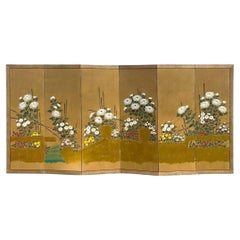
Garden of Chrysanthemums
Located in Fukuoka, JP
Against a shimmering golden background, chrysanthemums bloom in white, crimson, and yellow — flowers that in Japanese culture symbolize longevity, nobility, and the eternal cycle of ...
Category
Late 19th Century Japanese Meiji Antique Gold Paintings and Screens
Materials
Gold Leaf

$3,430
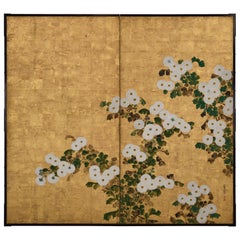
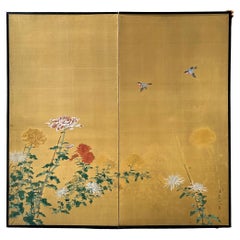
18th Century Japanese Rinpa Screen. White Chrysanthemums. School of Korin.
Located in Kyoto, JP
School of Ogata Korin
White Chrysanthemums
18th Century, Edo period.
A two-panel Japanese screen. Ink, color, gofun and gold leaf on paper.
Dimensions: H. 171 cm x W. 188 cm (67.5” x 74”)
On this two-panel Japanese screen we see blooming chrysanthemums, a flower which embodies the essence of autumn in Japan. Here the traditional floral theme has been simplified and stylized. The bright colors and asymmetrical composition against the delicate gold leaf create a luxurious and ornate work of art. Its background, a strikingly patinated grid of gold leaf, denies any sense of place or time and imbues everything with an ethereal glow. The leaves and stems of the plants are nothing more than pools of mottled color and ink without any outline whatsoever. These are typical Rinpa adaptations of traditional ink painting methods; tarashikomi, or diluted washes of color blended while very wet, and mokkotsu, or “bonelessness,” which creates forms without exterior outlines. The relief work of the rounded flower petals has been obtained by the moriage process (a mixture based on ground shells modeled on the surface of the paper).
On the lower right of the screen, the siganture “Hokyo Korin Jakumyo” and the “Hoshuku” seal can be read. Korin is Ogata Korin, famed for the Irises (Nezu Museum) and Red and White Plum Blossom (MOA Museum of Art) folding screens, both National Treasures. Korin worked in both Kyoto and Edo in the mid-Edo period. Korin was using the art name “Jakumyo” just after he received the Hokyo level, which was in 1701.
This particular screen was published in May of 1961 in the Japanese Sansai Fine Art Magazine*. An in depth article accompanies the photograph of the screen and and a photograph of the signature and seal. This article devotes much of its body to discussing the moriage technique, how it enlivens the chrysanthemum flowers and Korin’s specific skill in using the technique. The article goes on to discuss the most famous works of Korin, utilizing this technique, which were known at the time. Specifically a two-panel screen held in the Honolulu Museum which was discovered in the store-house of Takahashi Soan. A two-panel screen pair which the Nakano family own. A two-panel screen pair with chrysanthemums in moriage in fan designs owned by the Nomura family. Also a small folding screen featuring chrysanthemums held in the Yamato Bunkakan. The article goes on to say that this particular two-fold screen came from the Nijo family. Korin is known to have had a strong connection with the aristocratic Nijo family. The article explains that Korin received a lot of favors from the Nijo family and that this screen would have been gifted to them.
Since that time the Honolulu screen has been amended to ‘attributed to Ogata Korin’ and I do not know further details of the other 3 screens. Other Chrysanthemum screens...
Category
18th Century Japanese Edo Antique Gold Paintings and Screens
Materials
Gold Leaf
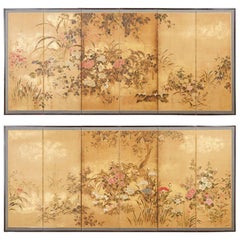
Pair of Japanese Edo Rimpa School Screens after Tawaraya Sōtatsu
Located in Rio Vista, CA
Impressive pair of 17th century Japanese Edo period Rinpa school screens made in the manner and style of Autumn Grasses by Tawaraya Sōtatsu (1570-1640). Beautifully decorated with wi...
Category
17th Century Japanese Edo Antique Gold Paintings and Screens
Materials
Gold Leaf
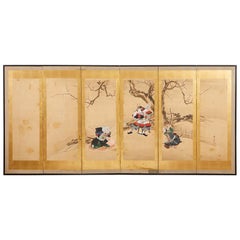
Japanese Edo Six Panel Screen Yoshitsune and Benkei
Located in Rio Vista, CA
Spectacular 19th century Japanese late Edo period six-panel byobu screen depicting Yoshitsune and Benkei, two heroes of Japanese folklore. Crafted in ink and natural color pigments on mulberry paper with thick gold leaf borders on each panel. The character Yoshitsune is seated under a blossoming cherry tree in full armor holding a fan. The warrior priest or monk Benkei is depicted kneeling on a leopard skin...
Category
19th Century Japanese Edo Antique Gold Paintings and Screens
Materials
Brass, Gold Leaf
$3,400 Sale Price
29% Off
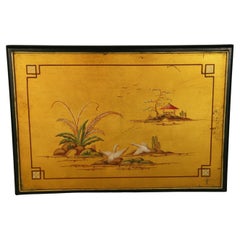
Japanese Landscape Painting on Gilt Wood Panel
Located in Douglas Manor, NY
4013 Hand painted Japanese landscape on gilt wood panel.
Category
1950s Japanese Vintage Gold Paintings and Screens
Materials
Gold Leaf
$450 Sale Price
40% Off
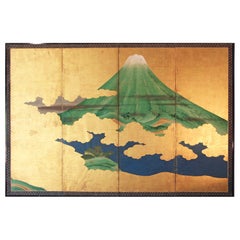
Japanese Folding Screen Gold Leaf
Located in Brescia, IT
Byobu painted with mineral pigments on gold leaf, the quality of the painting is still excellent, with no color loss or restorations.
A classic four-panel screen depicting Mount Fuji...
Category
Early 19th Century Japanese Edo Antique Gold Paintings and Screens
Materials
Gold Leaf
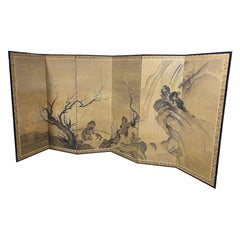
Japanese Asian Large Edo Six-Panel Folding Byobu Screen Landscape Monkeys Trees
Located in Studio City, CA
An absolutely gorgeous, wonderfully composed six-panel Japanese Byobu folding screen/room divider depicting a family of playful monkeys among the blooming trees and mountainous lands...
Category
Early 19th Century Japanese Edo Antique Gold Paintings and Screens
Materials
Gold Leaf
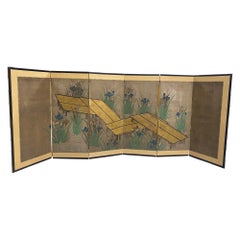
Japanese Asian Six-Panel Folding Byobu Screen Landcape Bridge with Iris Flowers
Located in Studio City, CA
A gorgeous six-panel Japanese Byobu folding screen depicting a nature lake/landscape scene with a water walkway/angular bridge and blossoming iris flowers - perhaps an homage to the famed Irises screens...
Category
19th Century Japanese Edo Antique Gold Paintings and Screens
Materials
Gold Leaf
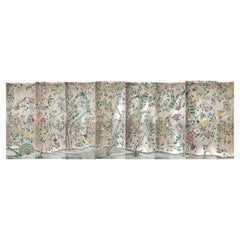
Peacock Chinoiserie Wallpaper Hand Painted Wallpaper on Champagne Metallic
Located in Wuxi, 32
If you love the look of De Gournay wallpaper but not the price, this is for you. Measures: 36" wide x 91" height
The colorways in this sections present our latest colorways, which c...
Category
21st Century and Contemporary Chinese Gold Paintings and Screens
Materials
Gold Leaf
$648 Sale Price
28% Off
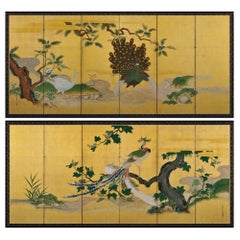
Japanese Screen Pair, circa 1730, Peacocks and Phoenix, Kano School
Located in Kyoto, JP
Phoenix and Peacocks.
A pair of six-panel Japanese folding screens by Tsunetake Yotei (n.d.)
First half of the 18th century.
The signature reads 67 year old Tsunetake.
The seals read:
-Tsunetake no in,
-Yotei,
-Seishin
Dimensions:
Each screen – H. 69” x W. 149” (176 cm x 378 cm)
A pair of Kano Grand Picture (Waga) screens depicting phoenix and peacocks rich with symbolic meaning. Dating to the first half of the 18th century, from the Kobikicho Kano school in Edo, this pair of folding...
Category
Early 18th Century Asian Edo Antique Gold Paintings and Screens
Materials
Gold Leaf
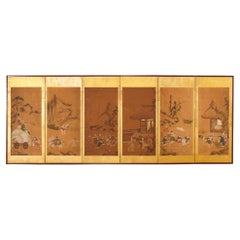
Japanese Edo Six Panel Screen Chinese Children at Play
Located in Rio Vista, CA
Amazing 19th century Japanese Edo period six panel folding byobu screen depicting Chinese children at play. The screen alludes to the 100 children theme. ...
Category
19th Century Japanese Edo Antique Gold Paintings and Screens
Materials
Gold Leaf
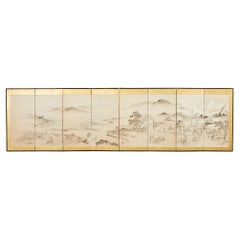
Japanese Meiji Eight Panel Screen Village Landscape with Figures
Located in Rio Vista, CA
Large 19th century Japanese Meiji period eight panel byobu screen featuring a panoramic village landscape. The serene painting depicts agricultural scenes with villagers engaged in p...
Category
19th Century Japanese Meiji Antique Gold Paintings and Screens
Materials
Gold Leaf
Pair of Japanese Meiji Screens Blossoms of Spring, Summer and Autumn
Located in Rio Vista, CA
Amazing pair of late 19th/early 20th century Japanese Meiji period byobu screens depicting flowering plants and blossoms of the spring, summer, and autumn. Painted in the Nihonga sch...
Category
19th Century Japanese Meiji Antique Gold Paintings and Screens
Materials
Brass, Gold Leaf
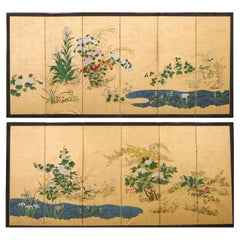
Japanese Six-Panel Screen, a Garden for All Seasons
Located in Hudson, NY
An imaginary garden with flowers from all seasons including spring lilies, summer hibiscuses, autumn chrysanthemums, and winter berries. Wild autumn grasses move in a soft breeze wit...
Category
1890s Japanese Meiji Antique Gold Paintings and Screens
Materials
Gold Leaf

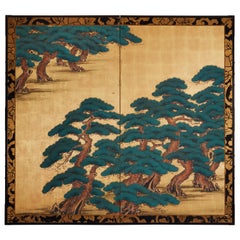
Japanese Two Panel Screen: Pine on Heavy Gold
Located in Hudson, NY
Kano School painting in mineral pigments on mulberry paper with heavy gold leaf and a silk brocade border made of antique monk's robes.
Category
Late 19th Century Japanese Antique Gold Paintings and Screens
Materials
Gold Leaf
Japanese Byobu - Japanese Folding Screen Gold Leaf
Located in Brescia, IT
Floral scene of a "Rimpa School" garden with polychrome chrysanthemum flowers.
Six-panel screen painted with pigments on golden rice paper of good size and well preserved.
Bold color...
Category
Early 19th Century Japanese Edo Antique Gold Paintings and Screens
Materials
Gold Leaf
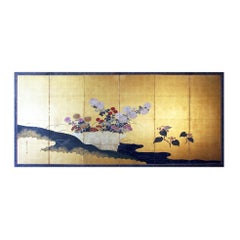
Japanese Screens: Echo of Chrysanthemums
Located in Fukuoka, JP
Echo of Chrysanthemums captures the quiet dialogue between form and reflection. Against a radiant gold-leaf ground, blooming chrysanthemums rise in graceful color harmony — white, cr...
Category
19th Century Japanese Edo Antique Gold Paintings and Screens
Materials
Gold Leaf
$5,785 Sale Price
35% Off
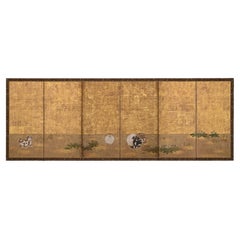
Late 17th Century Japanese Screen. Puppy and Kittens on Gold Leaf.
Located in Kyoto, JP
Anonymous
Late 17th century
Puppy & Kittens
A six-panel Japanese screen. Ink, color, gofun, gold-leaf and gold-fleck on paper.
A medium sized late 17th century Japanese screen fe...
Category
Late 17th Century Japanese Edo Antique Gold Paintings and Screens
Materials
Gold Leaf
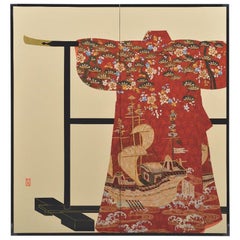
Japanese Large Red Silk Brocade Gilded Two Panel Folding Screen
Located in Takarazuka, JP
Exquisite contemporary Japanese two panel folding screen or "byobu" featuring genryoku style handcrafted silk raised kimono in cream and gold needlework on a mesmerizing red background. Tagasode is the way a genryoku kosode kimono is hung over a kimono rack...
Category
21st Century and Contemporary Japanese Gold Paintings and Screens
Materials
Gold
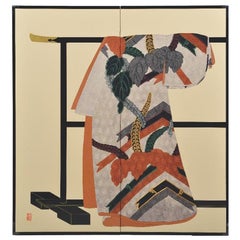
Japanese Contemporary Orange Black Silk Brocade Two-Panel Folding Screen, 3
Located in Takarazuka, JP
Extraordinary Japanese contemporary two panel "byobu" or folding screen featuring genryoku style handcrafted raised silk and brocade kimono in black, orange and gold on textured crea...
Category
21st Century and Contemporary Japanese Meiji Gold Paintings and Screens
Materials
Gold
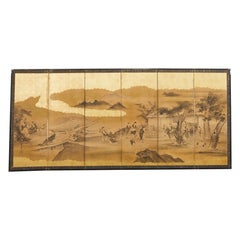
Japanese Edo Six Panel Screen Merrymaking in the Chinese Countryside
Located in Rio Vista, CA
Large 19th century Japanese Edo period six panel folding byobu screen made in the Kano school style. Beautifully crafted with signature after Kano Tan'yu. Ink and natural color pigme...
Category
19th Century Japanese Edo Antique Gold Paintings and Screens
Materials
Gold Leaf
Japanese Folding Screen Six Panels Painted on Gold Leaf
Located in Brescia, IT
Paravento a sei pannelli di scuola giapponese Kano: paesaggio con bellissime ed eleganti gru vicino al fiume, con alberi di pino e sakura.
Dipinto a mano con pigmenti minerali ed inc...
Category
Early 19th Century Japanese Edo Antique Gold Paintings and Screens
Materials
Gold Leaf
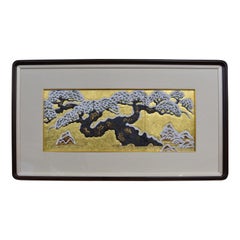
Japanese Contemporary Gold Leaf Brown Framed Porcelain Panel by Master Artist, 3
Located in Takarazuka, JP
Exquisite museum quality Japanese contemporary framed porcelain panel art work consisting of three pieces intricately hand-painted showcasing a wintry ...
Category
21st Century and Contemporary Japanese Meiji Gold Paintings and Screens
Materials
Gold Leaf
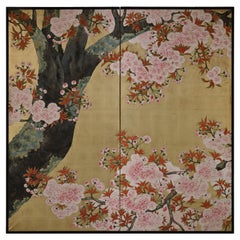
Early 20th Century Japanese Cherry Blossom Screen by Kano Sanrakuki
Located in Kyoto, JP
Cherry Blossoms
Kano Sanrakuki (1898-1981)
Showa period, circa 1930
2-panel Japanese Screen
Color, gofun and gold leaf on paper
Against a backdrop of gold-leafed ground, the lichen covered trunk and branches of the life-sized cherry blossom tree reach out and beyond the confines of the pictorial surface. The overall composition has a feeling of flatness which draws emphasis to the surface and the three-dimensionality of the cherry blossoms. Painstakingly built-up layers of thickly applied shell-white gofun detail the voluminous blossoms and cover large areas of this tour-de-force of Japanese Nihonga painting. By simplifying the background, minimizing the number of colors and depicting the blossoms with such heavy relief, the artist has emphasized the stunning presence of the cherry tree. The type of tree depicted is the Yae-Zakura; a double-layered type of cherry blossom famed for its beauty and strength. When we think of Japanese cherry blossoms, the first thing that comes to mind is Somei Yoshino variety, which has a single flower with five almost white petals. This type is fragile and easily blown away by strong wind or rain. Most of the double-flowered cherry blossoms begin to bloom when the Somei-Yoshino falls, and the flowering period lasts longer than that of the Somei-Yoshino.
Kano Sanrakuki originally studied painting at the Kyoto City Arts and Crafts School under the tutelage of Yamamoto Shunkyo...
Category
Early 20th Century Japanese Showa Gold Paintings and Screens
Materials
Gold Leaf
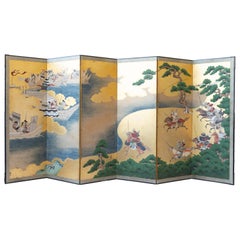
18th Century Six Panel japanese Screen with Samurai on Horses
Located in New York, NY
A spectacular six-panel Japanese screen dating to the 18th century. The screen depicts samurai warriors from the Tairo and Minamoto clans, who fought for control of Japan in the 12t...
Category
Late 18th Century Japanese Antique Gold Paintings and Screens
Materials
Gold Leaf
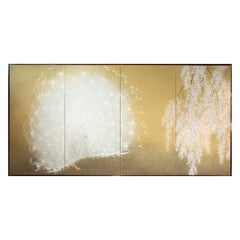
A four-panel folding screen depicting a white peacock, signed Yukihiko Kurihara
Located in Milano, IT
An unusual four-panel folding screen depicting a majestic white peacock and a flowering cherry tree, painted on paper with gold powder ground. The scene shows the peacock, rendered w...
Category
Mid-20th Century Japanese Gold Paintings and Screens
Materials
Gold Leaf
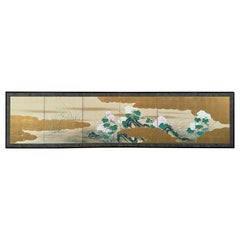
Japanese Six-Panel Folding Screen with Floral Landscape
Located in Fukuoka, JP
Elegant Japanese six-panel byōbu depicting a tranquil landscape with blooming flowers set against softly rendered hills and stylized clouds. The composition is balanced and serene, w...
Category
20th Century Japanese Showa Gold Paintings and Screens
Materials
Gold Leaf
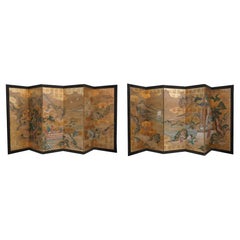
Japanese Asian Pair of Large Six-Panel Folding Byobu Screens Mythical Landscape
Located in Studio City, CA
A beautiful, alluring, wonderfully composed and engaging hand-painted large pair of six-panel Japanese/Asian Byobu folding screens depicting an almost magical/ mythical village scene...
Category
18th Century Japanese Meiji Antique Gold Paintings and Screens
Materials
Gold Leaf
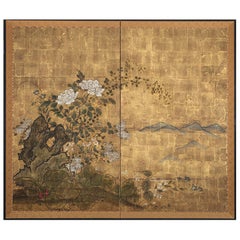
Japanese Two-Panel Screen, Floral Garden on Gold
Located in Hudson, NY
Peonies, marigolds and pinks next to a garden stone with soft mountain peaks in the background. Late Edo (1603 - 1868) period painting in mineral pigmen...
Category
Early 19th Century Japanese Edo Antique Gold Paintings and Screens
Materials
Gold Leaf
Japanese Screen mid Edo gold leaf
Located in Brescia, IT
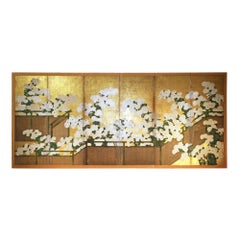
This 18th century six-panel screen is truly special. The author is unknown, but his singular genius in portraying dozens of chrysanthemum flowers created with the white of the "gofun...
Category
Mid-18th Century Japanese Edo Antique Gold Paintings and Screens
Materials
Gold Leaf
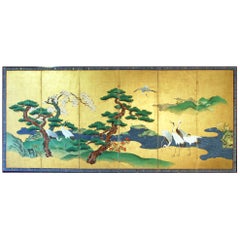
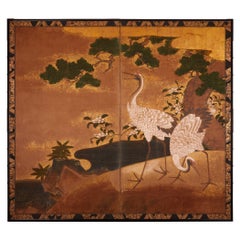
Japanese Two-Panel Screen: Cranes on Gold
Located in Hudson, NY
Early Kano School painting of pine trees overlooking two beautifully painted cranes and floral design in a natural setting by water’s edge. Mineral pig...
Category
Late 18th Century Japanese Antique Gold Paintings and Screens
Materials
Gold, Gold Leaf
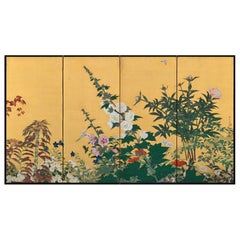
Early 20th Century Japanese Screen. Flowers of the Four Seasons.
Located in Kyoto, JP
Anonymous
Flowers of the Four Seasons
A four-panel Japanese screen. Ink, gofun and pigments on gold leaf.
This Japanese screen is a rich visual celebration of the flowers of the fo...
Category
Early 20th Century Japanese Taisho Gold Paintings and Screens
Materials
Gold Leaf
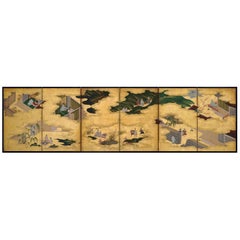
Japanese Screen Painting, Circa 1700
Tales of Ise
by Tosa Mitsusuke
By Tosa Mitsusuke 1
Located in Kyoto, JP
A six-fold Japanese screen by Tosa Mitsusuke (1675-1710), Japan 17th-18th century, Edo period.
The signature reads Shoroku-i ge Tosa sa Konoe Shogen Mit...
Category
Late 17th Century Japanese Edo Antique Gold Paintings and Screens
Materials
Gold Leaf
Japanese Two Panel Screen: Young Bamboo on Gold
Located in Hudson, NY
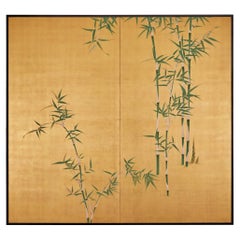
Symbolizing the Sun, gold is often used in shrines and temples in Japan. Gold has been extensively recognized to represent wealth, while bamboo is said to bring good luck due to its ability to regenerate in the forest. A beautiful composition of the two together...
Category
Late 19th Century Japanese Antique Gold Paintings and Screens
Materials
Gold
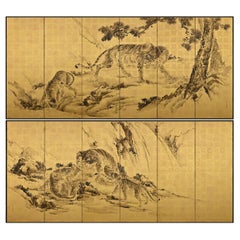
Japanese Screen Pair, Tigers by Kishi Renzan, Late Edo Period
Located in Kyoto, JP
Kishi Renzan (1804-1859)
Tigers
Pair of six-panel Japanese screens.
Ink and gold-leaf on paper.
In this monochromatic pair of six-fold Japanese screens painted on gold-leaf, Kishi Renzan has created a breathtaking composition of a family of tigers. The screens are filled with a sense of drama which is conveyed by both the subject matter and the wet, expressive brushwork. The running mountain stream and the towering waterfall allude to refreshment during the summer months and we feel the tiger families familiarity and security within their environment. Renzan’s master, Kishi Ganku...
Category
Mid-19th Century Asian Edo Antique Gold Paintings and Screens
Materials
Gold Leaf
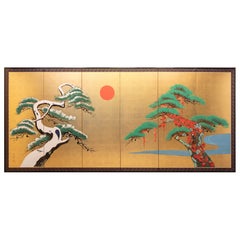
A six-panel folding screen with pine trees beneath the red sun
Located in Milano, IT
A six-panel folding screen with a gold-leaf ground, depicting two pine trees with a red sun at the center.
On the left, a snow-covered pine is shown with a sinuous, knotted trunk and...
Category
Late 19th Century Japanese Antique Gold Paintings and Screens
Materials
Gold Leaf
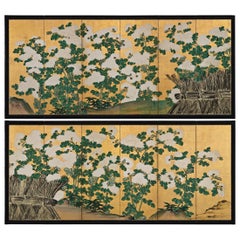
Mid-18th Century Japanese Screen Pair, One Hundred Flowers, Chrysanthemums
Located in Kyoto, JP
Omori Soun (b. 1704)
Chrysanthemums - One Hundred Flowers
A Pair of Six-fold Japanese Screens. Ink, color, gofun and gold leaf on paper.
Dating ...
Category
Mid-18th Century Japanese Edo Antique Gold Paintings and Screens
Materials
Gold Leaf
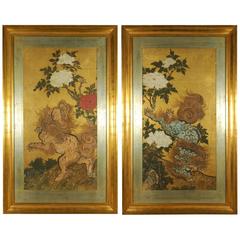
Pair of Antique Japanese Paintings of Karashishi, Edo Period, 18th Century
Located in Prahran, Victoria
A rare pair of antique Japanese Karashishi paintings in a landscape of rocks and peony flowers on gold leaf ground in fine handmade frames, Edo period, early 18th century. The Karash...
Category
Early 18th Century Japanese Edo Antique Gold Paintings and Screens
Materials
Gold Leaf
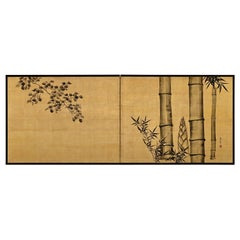
19th Century Japanese Screen for Tea-Ceremony, Ink Bamboo and Plum on Gold Leaf
Located in Kyoto, JP
Three Friends of Winter
Nakajima Raisho (1796-1871)
Late Edo period, circa 1850
Ink and gold leaf on paper.
This is a double-sided Japanese Furosaki or tea-ceremony screen from the mid 19th century; bamboo and plum on the front, young pines the back. It by Nakajima Raisho, a master painter of the Maruyama school in the late Edo and early Meiji periods. In this work Raisho combines exquisite ink brushwork with large open spaces of brilliant gold-leaf to inspire the viewers imagination. Rather than naturalism, he is searching for the phycological impression of the motifs, resulting in abstraction and stylization. His simplification of the motifs the result of looking to capture the inner nature of the objects. This art motif is known as Sho Chiku Bai, or the Three Friends of Winter. Evergreen pine connotes steadfastness, bamboo suggests both strength and flexibility, while plum blossoms unfurling on snow-laden branches imply hardiness. Combined, this trio is emblematic of Japanese new year. Chinese literati were the first to group the three plants together due to their noble characteristics. Like these resilient plants flowering so beautifully in winter, it was expected of the scholar-gentleman to cultivate a strong character with which he would be able to show the same degree of perseverance and steadfastness even during times of adverse conditions.
The screen would have been placed near the hearth of a room used for the Japanese tea ceremony, shielding the fire from draughts and also forming a stimulating and decorative backdrop behind the tea utensils. It would have been used in the Hatsugama, or first tea-ceremony of the new year.
Nakajima Raisho (1796-1871) originally studied under Watanabe Nangaku before entering the school of Maruyama Ozui. He was the highest ranking Maruyama school painter at the end of the Edo period and was known as one of the ‘Four Heian Families’ along with Kishi...
Category
Mid-19th Century Japanese Edo Antique Gold Paintings and Screens
Materials
Gold Leaf
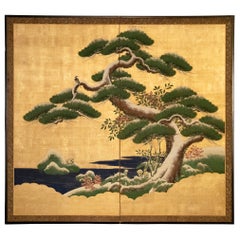
Japanese Two Panel Screen: Pine in Snow
Located in Hudson, NY
Kano School, Mineral pigments on gold leaf with silk brocade border and lacquer wood trim.
Category
Mid-19th Century Japanese Antique Gold Paintings and Screens
Materials
Gold Leaf
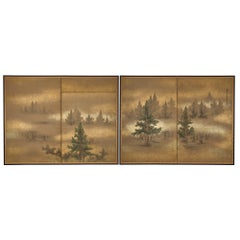
Pair of Japanese Two Panel Screens: Misty Cedar Forest
Located in Hudson, NY
Enchanting grove of cedar trees in the mist with beautifully applied gold dust and mineral pigments on paper. Silk brocade border and black lacquer trim. Originally fusuma (sliding d...
Category
Mid-18th Century Japanese Antique Gold Paintings and Screens
Materials
Gold
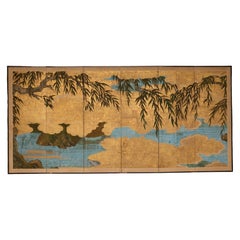
Japanese antique screen - EDO period - Willow over a stream
Located in Prahran, Victoria
Antique Japanese 6 panel screen from the early Edo period (C1650). One of a pair (both available). This magnificent golden screen shows...
Category
1650s Japanese Edo Antique Gold Paintings and Screens
Materials
Gold Leaf
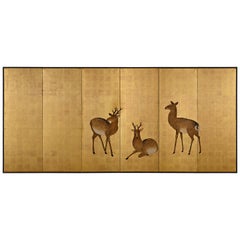
19th Century Japanese Screen, Deer in Spring, Maruyama Shijo School
Located in Kyoto, JP
A six-panel Japanese folding screen from the leading Maruyama-Shijo artist Okamoto Toyohiko (1773-1845). Simply featuring three deer and a few sprigs of foliage on a sumptuous gold-leaf background this work emphasizes naturalistic expression and a masterful use of negative space. Reduced to its most basic elements, the blank spaces inspire imagination and evoke the smells, sounds and even the weather of the scene. Whilst deer are traditionally depicted in association with autumn, here the green growth on the tops of the foliage indicates the season of spring. The work references Maruyama Okyo’s two-panel deer screen...
Category
Early 19th Century Japanese Edo Antique Gold Paintings and Screens
Materials
Gold Leaf
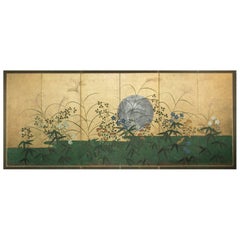
19th Century Japanese Six Panel Screen: Silver Moon Rising Over Summer Field
Located in Hudson, NY
Japanese Six Panel Screen: Silver Moon Rising Over Summer Field. Rimpa Style painting of a moon rising over summer flowers and grasses, including cockscomb and blue bellflowers. Pa...
Category
Late 19th Century Japanese Meiji Antique Gold Paintings and Screens
Materials
Gold Leaf
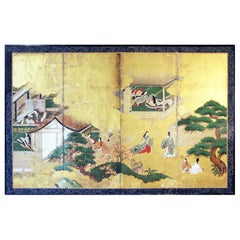
18°th Century Japanese Gold Leaf Screen
Located in Brescia, IT
Four-panel folding screen depicting the famous legend of Hikaru Genji, a nobleman of extraordinary grace and beauty, and his gallant adventures at court.
The novel Genji Monogatari, ...
Category
18th Century Japanese Edo Antique Gold Paintings and Screens
Materials
Gold Leaf
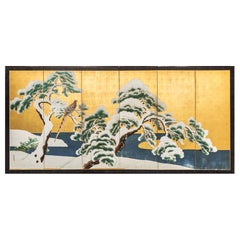
Japanese Six Panel Screen: Snow Scene
Located in Hudson, NY
Kano school painting of a pheasant in a snowy pine. Artist signature reads: Hokkyo Shunyo. Mineral pigments on gold leaf with silk brocade border.
Category
Early 19th Century Japanese Antique Gold Paintings and Screens
Materials
Gold Leaf
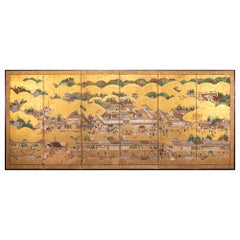
Japanese Six Panel Screen: Scenes in and Around Kyoto,
Rakuchu Rakugai-Zu
Located in Hudson, NY
The left two panels is the intersection of the Tokaido (an important and historical road that connects Kyoto with Tokyo) at Sanjo (Sanjo translates to "Third Street" and is the main ...
Category
18th Century Japanese Antique Gold Paintings and Screens
Materials
Gold Leaf
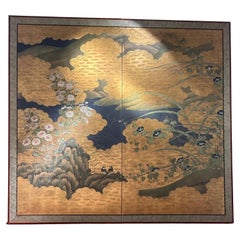
Japanese two panels screen
Located in Brussel, BE
Breathtaking Japanese two panels screen. Flowers and birds painted on paper and gold leafs. Hugely decorative as a screen or hanging on a wall. Unique pi...
Category
Late 19th Century Japanese Japonisme Antique Gold Paintings and Screens
Materials
Gold Leaf
$21,599
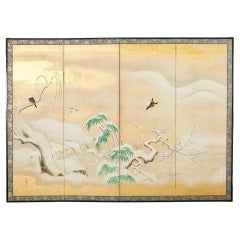
Japanese Showa Four Panel Screen Snowy Winter Landscape
Located in Rio Vista, CA
Impressive large scale Japanese Showa period four panel byobu screen depicting a serene snowy winter landscape with willow, prunus, and bamboo. The screen features an amazing backgro...
Category
20th Century Japanese Showa Gold Paintings and Screens
Materials
Brass, Gold Leaf
Early Edo Period Chinese-Inspired Screen
Located in Fukuoka, JP
This remarkable screen from the early Edo period, circa the 17th century, showcases the influence of early Chinese art forms with its intricate ink work on a gold leafed surface. The...
Category
17th Century Japanese Edo Antique Gold Paintings and Screens
Materials
Gold Leaf
$3,496 Sale Price
56% Off
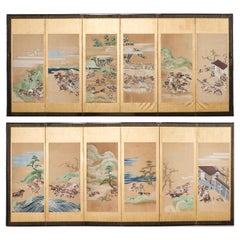
Pair of Japanese Edo/Tokugawa Screens Tale of Heiki
Located in Rio Vista, CA
Monumental pair of late 18th century Japanese Edo/Tokugawa period byobu screens depicting the battles between Taira and Minamoto. The screens have six panels each with individual sce...
Category
19th Century Japanese Edo Antique Gold Paintings and Screens
Materials
Brass, Gold Leaf
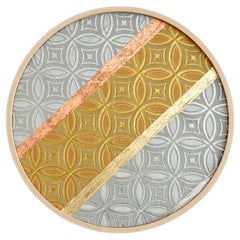
Early 20th Century kimono textile art "Flower of Life ~Bonds~" by ikasu Japan
By Kimono ikasu
Located in Setagaya City, JP
[Story behind the work]
This artwork uses two pieces - front and reverse sides of same vintage obi (sash for kimono) fabric, united in a symbol of bonds and unity in Eastern culture ...
Category
1960s Japanese Japonisme Vintage Gold Paintings and Screens
Materials
Gold Leaf
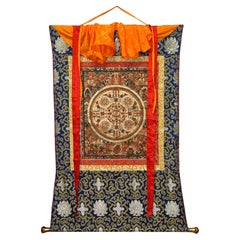
Tibetan Thangka of Celebration Hand Painted Gilded
Located in Somis, CA
An exquisite hand painted Tibetan Thangka depicting 63 Buddhas with consorts and 5 protector Vajrabhairavas. Buddha seated dhyana asana on lotus throne at the center of the mandala i...
Category
2010s Nepalese Gold Paintings and Screens
Materials
Gold Leaf
$1,100 Sale Price
51% Off
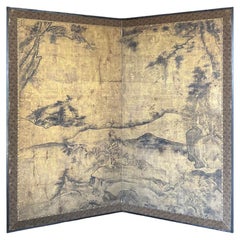
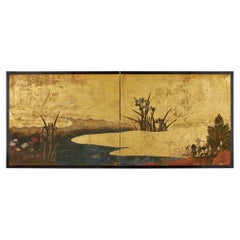
Japanese Two Panel Screen: Iris By Rivers Edge
Located in Hudson, NY
Mineral pigments and gold leaf on mulberry paper with black lacquer trim.
Category
Early 19th Century Japanese Antique Gold Paintings and Screens
Materials
Gold Leaf
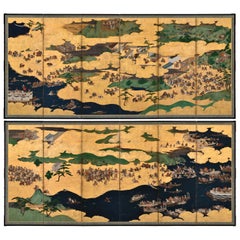
Late 17th Century Japanese Screen Pair. Battle of Ichi-no-tani and Yashima.
Located in Kyoto, JP
Anonymous
Late 17th Century
Battle of Ichi-no-tani & Yashima
Dimensions: Each Screen: H. 175 cm x W. 385 cm (69” x 151.5”)
This pair of Japanese screens depict two significant battles from the Genpei War (1180–85), as recounted in the Tale of the Heike, a semi-historical epic chronicling the conflict between rival clans for control of Japan, written in the early 1200s.
Each screen portrays a single battle through a series of small episodes, framed by gold clouds, landscape elements, and architectural features. True to the style of many screens inspired by The Tale of the Heike, the scenes are rendered in lavish colors and gold, downplaying the brutality of the warfare. Although based on real events, these narratives often glorified and romanticized the heroic feats of the warriors. Viewers at the time would have been familiar with the story’s details, leading to a proliferation of paintings on folding screens inspired by this theme from the late Muromachi to the early Edo periods.
On the right screen, we see the Minamoto’s attack on the Taira, who have retreated from the capital, Kyoto, toward the sea. The central building represents the temporary Taira headquarters, where Taira soldiers are holding the young Emperor Antoku. The Minamoto plan to launch a surprise attack from the rear after descending the steep cliff known as Ichi-no-tani, depicted at the top center. This scene highlights the tactical brilliance of Minamoto commander Yoshitsune and the courage of his men.
The left screen captures moments from the Battle of Yashima...
Category
Late 17th Century Japanese Edo Antique Gold Paintings and Screens
Materials
Gold Leaf
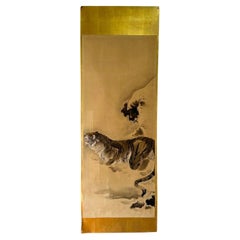
Late 19th century (Meiji period) painting depicting tiger
Located in Fukuoka, JP
Antique Tiger Painting on Paper – Meiji Period
A striking depiction of a tiger, painted on paper and signed by the artist. This work was originally part of a Japanese byobu folding ...
Category
Late 19th Century Japanese Meiji Antique Gold Paintings and Screens
Materials
Gold Leaf
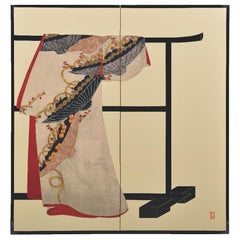
Japanese Contemporary Silk Red Black Cream Hand-Crafted Two Panel Folding Screen
Located in Takarazuka, JP
Exceptional Japanese contemporary two panel "byobu" or folding screen featuring genryoku style handcrafted silk raised kimono Japanese decorative art in crimson red, cream and gold o...
Category
21st Century and Contemporary Japanese Meiji Gold Paintings and Screens
Materials
Gold
Byobu- Japanese Folding Screen Gold Leaf
Located in Brescia, IT
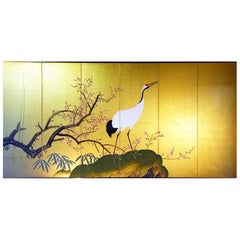
Japanese six-panel screen from the Kano school: Japanese landscape with an elegant crane.
Hand painted with mineral pigments and gold leaf inks.
The pure gold leaf is laid with great...
Category
Late 19th Century Japanese Meiji Antique Gold Paintings and Screens
Materials
Gold Leaf
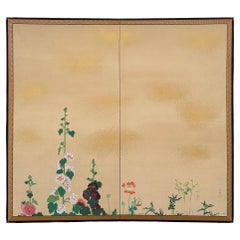
Showa Golden Mallow Screen
Located in Fukuoka, JP
This exquisite two-panel screen from the Showa period features a lush depiction of mallows in vibrant hues set against a luxurious golden background. The mallow flower, known in Japa...
Category
20th Century Japanese Showa Gold Paintings and Screens
Materials
Gold Leaf
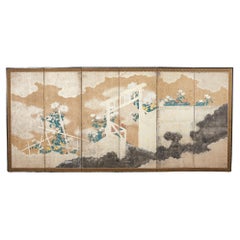
Japanese Meiji Six Panel Screen Brushwood Gate with Chrysanthemums
Located in Rio Vista, CA
Gorgeous Japanese early 20th century Meiji period six-panel byobu screen featuring a brushwood gate and fence with flowering chrysanthemums. The large screen is crafted with ink and ...
Category
20th Century Japanese Meiji Gold Paintings and Screens
Materials
Brass, Gold Leaf, Silver Leaf
Still Thinking About These?
All Recently ViewedMore Ways To Browse
Chinese Woodblock Print
Fusuma Doors
Japanese Screen Kano School
Japanese Tiger Screen
Ogata Korin
Painted Panel Screen Birds
Antique Chinese Black Lacquer Screen
Antique Falconry
Carved Stone Panel
Chinese Carved Hardwood Screen
Chinese Folding Silk Screen Art
Chinese Paint Brushes
Chinese Pearl And Lacquer Screen
Gold Screen Crane
Japanese 4 Panel Screen
Japanese Autumn Screen
Japanese Calligraphy Screen
Japanese Cherry Blossom Screen