Gold Paintings and Screens
to
22
147
28
229
18
2
1
50
123
56
20
19
14
3
2
1
2
6
1
12,656
782
765
730
535
242
234
220
13
5
249
242
246
16
8
2
1
1
Material: Gold
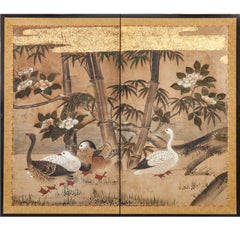
Japanese Two Panel Screen: Mandarin Ducks and Geese Among Bamboo and Flowers
Located in Hudson, NY
Japanese Two Panel Screen: Mandarin Ducks and Geese Among Bamboo and Flowers, Edo period painting (c. 1850) of mandarin ducks and geese on a grassy sh...
Category
Mid-19th Century Japanese Edo Antique Gold Paintings and Screens
Materials
Gold
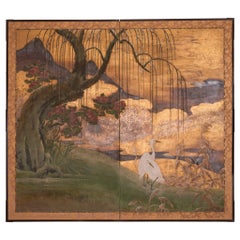
Japanese Two Panel Screen: Egrets on Rivers Edge
Located in Hudson, NY
Late winter scene of egret, willow and daffodil in mineral pigments on gold leaf with accents of gold dust. Silk brocade border and black lacquer trim. Kano School Panting.
Category
Early 19th Century Japanese Antique Gold Paintings and Screens
Materials
Gold Leaf
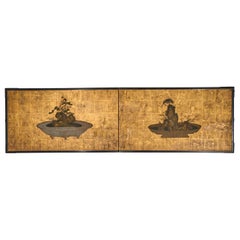
Japanese Two Panel Screen: Bonsai
Located in Hudson, NY
Very unusual 16th century furosaki byobu (screen used for tea ceremony). Painting of two Usubata (bronze containers) displaying bonsai. Mineral pigments on very heavy gold leaf with ...
Category
16th Century Japanese Antique Gold Paintings and Screens
Materials
Bronze, Gold Leaf
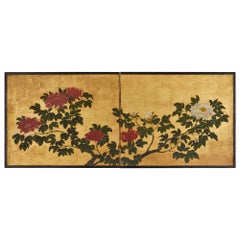
Japanese Two Panel Screen – Summer Peonies in Bloom
Located in Hudson, NY
Mineral pigments and gold leaf on mulberry paper with black lacquer trim.
Category
Late 19th Century Japanese Antique Gold Paintings and Screens
Materials
Gold Leaf
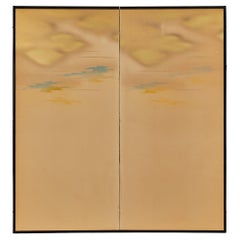
Japanese Two Panel Screen: Clearing Skies
Located in Hudson, NY
Cloud formation in gold with blue skies in mineral pigments on mulberry paper with black lacquer trim.
Category
Early 20th Century Japanese Gold Paintings and Screens
Materials
Gold
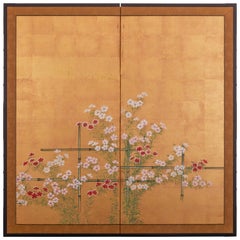
Japanese Two Panel Screen: Nadeshiko on Bamboo Trellis
Located in Hudson, NY
Nadeshiko, also known as fringed pinks is a flowering plant native to Japan. Ink, mineral pigments and 18th century gold leaf, with good veining, on mulbe...
Category
18th Century Japanese Antique Gold Paintings and Screens
Materials
Gold, Bronze, Gold Leaf
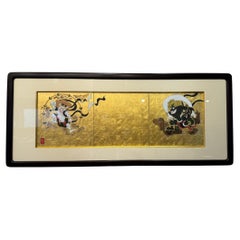
Japanese Three Panel Framed Gold Black White Porcelain Artwork by Master Artist
Located in Takarazuka, JP
Extraordinary Japanese contemporary three-panel framed porcelain artwork in gold, black and white. This is a masterpiece by a third generation master porcelain artist in the Imari-Arita region of Japan who is the descendant of an extended family of prolific porcelain and ceramic artists. The artist's profile is available upon request.
The kiln started in the 19th century with traditional kinrande techniques (gold enameled porcelain), but in accordance with the philosophy of the kiln’s founder, each subsequent generation pioneered in a field of the master’s choosing. Thus, the second generation is known for its yuri-kinsai (gold foil underglaze) and the third generation for its haku-yui (intertwining of precious-metal foils).
Yuri-kinsai was termed in the 1950s as a new glazing technique. The main feature is a highly transparent overglaze on the gilded porcelain, cutting out stencils of gold foil for underglaze decorations.
In this exceptional work, the artist has used gold leaf, black and white for expressing the dramatic scene of Tawaraya Sotatsu's influential "Wind God and Thunder God" that is considered a Japanese National Treasure. It is a pair of two-folded screens using...
Category
21st Century and Contemporary Japanese Meiji Gold Paintings and Screens
Materials
Gold Leaf
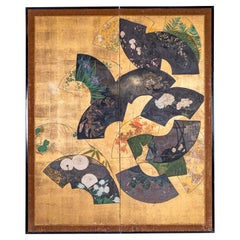
Japanese Two Panel Screen: Painted Fans on Gold Leaf
Located in Hudson, NY
Mineral pigments on gold leaf with brocade border. Calligraphy and sketching on back paper.
Category
Late 19th Century Japanese Antique Gold Paintings and Screens
Materials
Gold Leaf
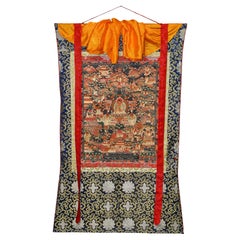
Tibetan Thangka of Amitabha Buddha Hand Painted Gilded
Located in Somis, CA
One of our finest hand painted Tibetan Thangkas from Nepal. This extraordinary Thangka depicts 108 Buddhas with consorts in celestial court witnessing Amitabha's achievement of nirva...
Category
2010s Nepalese Gold Paintings and Screens
Materials
Gold Leaf

$1,125 Sale Price
50% Off
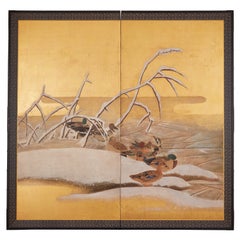
Japanese Two Panel Screen: Mandarin Ducks in Winter
Located in Hudson, NY
Fine painting of a variety of waterfowl in rich mineral pigments on gold leaf with a silk brocade border.
Category
19th Century Japanese Antique Gold Paintings and Screens
Materials
Gold Leaf
Japanese Two Panel Screen: Trees in Floral Landscape
Located in Hudson, NY
Japanese Two Panel Screen: Trees in Floral Landscape, Edo period painting (mid 19th century) of pine and other trees amongst flowers, with bamboo shoots on the right panel, and white...
Category
Mid-19th Century Japanese Antique Gold Paintings and Screens
Materials
Gold Leaf

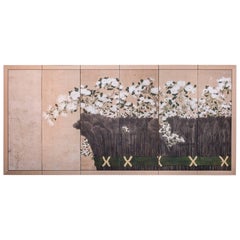
Japanese Six-Panel Screen, Chrysanthemums and Twig Fence With Gold Flakes
Located in Hudson, NY
Rimpa School painting in mineral pigments with gofun and gold flakes on mulberry paper with a silk brocade border.
Category
19th Century Japanese Antique Gold Paintings and Screens
Materials
Gold
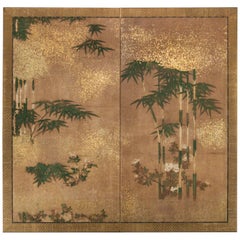
Japanese Two Panel Screen: Bamboo Grove on Mulberry Paper with Gold Dust
Located in Hudson, NY
Kano School painting of a bamboo grove with blooming flowers and gold dust mists. Painted in mineral pigments on mulberry paper with gold dust and a silk brocade border.
Category
Early 19th Century Japanese Edo Antique Gold Paintings and Screens
Materials
Gold
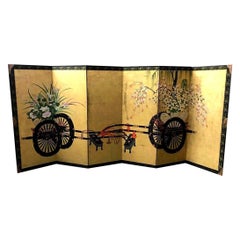
Japanese Asian Large Six-Panel Folding Byobu Flower Cart Screen, 19th Century
Located in Studio City, CA
A gorgeous six-panel Japanese Byobu folding screen. Listing as Meiji period but could very possibly Edo period. Decorated with peonies, irises and...
Category
19th Century Japanese Meiji Antique Gold Paintings and Screens
Materials
Gold Leaf
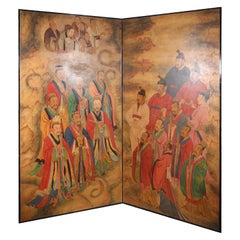
Japanese Chinese Asian Two-Panel Byobu Folding Screen Ancestral Immortal Figures
Located in Studio City, CA
A gorgeous, quite large, boldly colored, and alluring hand-painted two-panel Chinese/Japanese/Asian Byobu folding screen depicting 18 exquisitely clad male ancestral or immortal figu...
Category
20th Century Gold Paintings and Screens
Materials
Gold Leaf
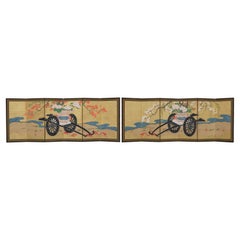
Pair of Japanese hinagata byôbu 雛形屏風 (small folding screens) with flower carts
Located in Amsterdam, NL
An amazing pair of six-panel hinagata byôbu (doll festival folding screens) with a continuous painting on gold leaf showcasing flower carts (hana’guruma) at the edge of a winding river.
Both laden with a large bamboo basket...
Category
Early 19th Century Japanese Antique Gold Paintings and Screens
Materials
Gold Leaf
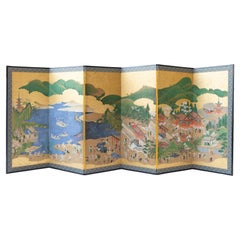
19th Century Japanese Screen with Sumiyoshi Shrine on Gold Leaf
Located in New York, NY
This is a beautiful antique six-fold Japanese screen. The design is beautifully detailed with buildings, people and animals, among gold leaf clouds. The clouds have raised gofun gess...
Category
Late 18th Century Japanese Antique Gold Paintings and Screens
Materials
Gold Leaf
Edo Period Seasonal Transition Screen
Located in Fukuoka, JP
Edo Period Seasonal Transition Screen
Period: Edo
Size: 368 x 153 cm
This exquisite six-panel screen, adorned with golden flakes, beautifully portrays the seamless transitio...
Category
19th Century Japanese Edo Antique Gold Paintings and Screens
Materials
Gold Leaf
$3,208 Sale Price
61% Off
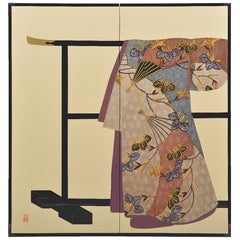
Japanese Contemporary Orange Black Cream Silk Two-Panel Folding Screen, 4
Located in Takarazuka, JP
Extraordinary Japanese contemporary two panel "byobu" or folding screen featuring genryoku style handcrafted silk raised kimono Japanese decorative art in Purple, blue, black and ora...
Category
21st Century and Contemporary Japanese Meiji Gold Paintings and Screens
Materials
Gold
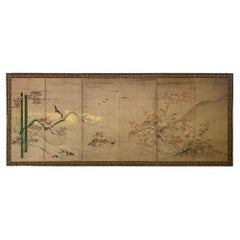
Japanese Two Panel Screen: Plum Blossom in the Mist
Located in Hudson, NY
Plum blossom, baby pine and bamboo painted in mineral pigments on heavy gold leaf on paper. Silk brocade border with black lacquer trim and bronze hardware.
Category
Early 1800s Japanese Antique Gold Paintings and Screens
Materials
Bronze, Gold Leaf

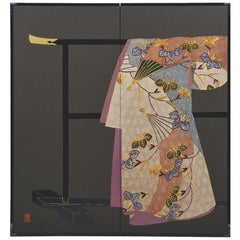
Japanese Contemporary Silk Brown Black Cream Two-Panel Folding Screen, 3
Located in Takarazuka, JP
Extraordinary contemporary Japanese two-panel "byobu" or folding screen showcasing genryoku style handcrafted raised embroidered silk brocade kimono Japanese decorative art in autumn...
Category
21st Century and Contemporary Japanese Meiji Gold Paintings and Screens
Materials
Gold
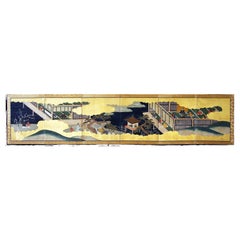
Japanese Folding Screens Gold Leaf
Located in Brescia, IT
This Japanese six-panel Byobu screen, used for tea ceremonies, is a unique size and depicts scenes from the 11th-century Japanese literary classic "The Tales of Prince Genji."
Painte...
Category
Mid-19th Century Japanese Edo Antique Gold Paintings and Screens
Materials
Gold Leaf
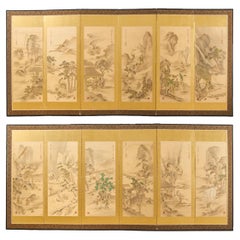
Pair of Japanese Taisho Period Screens Paragons of Filial Piety
Located in Rio Vista, CA
Impressive pair of Japanese screens from the Taisho period meiji. Each six-panel screen depicts an image from the 24 paragons of filial piety ...
Category
20th Century Japanese Taisho Gold Paintings and Screens
Materials
Brass, Gold Leaf
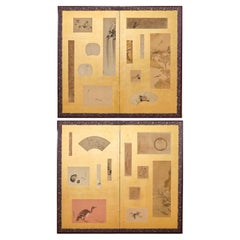
Pair of Japanese Two Panel Screens Edo Period Vignettes
Located in Rio Vista, CA
Impressive pair of Japanese two-panel byobu screens featuring late 18th-century edo period applied vignettes, poems, and paintings in various formats over a dramatic gold leaf square...
Category
18th Century Japanese Edo Antique Gold Paintings and Screens
Materials
Gold Leaf
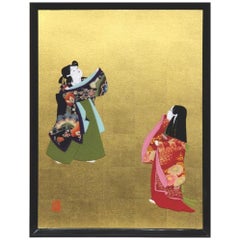
Japanese Contemporary Framed Green Red Black Gold Decorative Art
Located in Takarazuka, JP
Exquisite Japanese contemporary framed three-dimensional decorative art piece in Japanese silk kimono fabric in vivid red, green and black on gold leaf Japanese paper, recreating a s...
Category
21st Century and Contemporary Japanese Meiji Gold Paintings and Screens
Materials
Gold Leaf
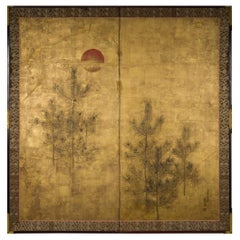
Japanese Two Panel Screen Pine and Red Sun on Gold
Located in Hudson, NY
Mineral pigments on gold leaf. Signature and seal read: Anei H-eishin Boshun ga, dated: late spring 1766 with a dedication to Okyo (Maruyama).
Category
Mid-18th Century Japanese Antique Gold Paintings and Screens
Materials
Gold Leaf
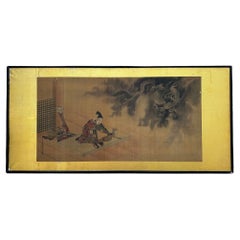
Elegant Edo period painting by Reizei Tamechika (1823-1864) 冷泉為恭
Located in Fukuoka, JP
Elegant Edo period painting by Reizei Tamechika (1823-1864)
Period: Edo
Size: 113x53 cm
Indulge in the elegance of the Edo period with our superb painting on silk, a masterpiece ...
Category
19th Century Japanese Edo Antique Gold Paintings and Screens
Materials
Gold Leaf
$2,600 Sale Price
38% Off
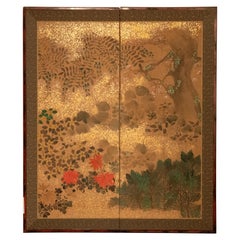
Japanese Two Panel Screen: Rimpa Flowers
Located in Hudson, NY
with gold flake design. Mineral pigments on mulberry paper, with silk brocade border, and red negoro style lacquer trim.
Category
Early 20th Century Japanese Gold Paintings and Screens
Materials
Gold
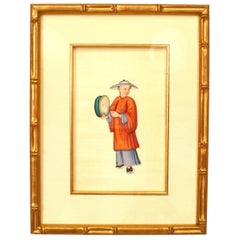
Set of 8 Chinese Gouache Traditional Figure Paintings
Located in Queens, NY
Set of 8 Asian Chinese (19th century) gouache paintings of traditionally clad figures framed in modern gilt faux bamboo frames.
Category
19th Century Chinese Antique Gold Paintings and Screens
Materials
Gold Leaf
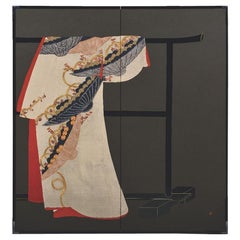
Japanese Contemporary Red Black Cream Folding Screen Silk Brocade Kimono Art, 3
Located in Takarazuka, JP
Exceptional Japanese contemporary two panel "byobu" or folding screen featuring genryoku style handcrafted silk raised kimono Japanese decorative art in crimson red, black and gold o...
Category
21st Century and Contemporary Japanese Meiji Gold Paintings and Screens
Materials
Gold
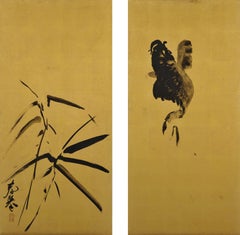
Yamamoto Shunkyo (1871-1933) Japanese Framed Painting Pair, Carp and Bamboo
Located in Kyoto, JP
Two framed panels by Yamamoto Shunkyo depicting a carp (koi) leaping from a river.
Ink and gold leaf on paper.
Instinctively brushed in a freehand s...
Category
Early 20th Century Japanese Meiji Gold Paintings and Screens
Materials
Gold Leaf
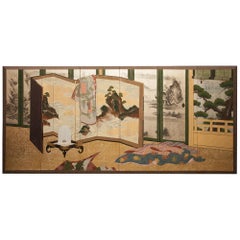
Japanese Antique Six Panel Screen: Inside the Imperial Household
Located in Hudson, NY
Kano School painting depicting an interior with finery such as a lacquer table, silk textiles, and other paintings. The fusuma doors appear to be a famous...
Category
1890s Japanese Antique Gold Paintings and Screens
Materials
Gold Leaf
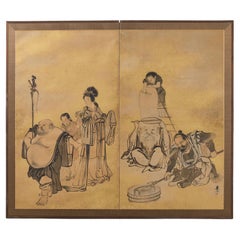
Japanese Edo Two Panel Screen Deities by Yokoyama Kazan
Located in Rio Vista, CA
Whimsical Japanese late Edo period two-panel screen circa 1800 by Yokoyama Kazan (Japanese 1784-1837). The screen depicts four of the seven Gods or deities ...
Category
19th Century Japanese Edo Antique Gold Paintings and Screens
Materials
Brass, Gold Leaf
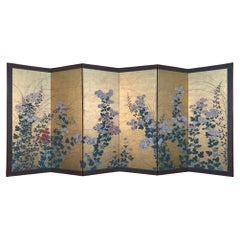
Early 19th Century Rimpa School Floral Screen
By Rimpa School
Located in Fukuoka, JP
Early 19th Century Rimpa School Floral Screen
Period: Early 19th Century
Dimensions: 367x171 cm (144.5x67.3 inches)
SKU: RJ118/2
This 6-panel gold-leafed screen is a splendid repre...
Category
Early 19th Century Japanese Edo Antique Gold Paintings and Screens
Materials
Gold Leaf
$13,260 Sale Price
25% Off
Vintage kimono textile art " Marble Story ~ Healing ~" by ikasu Grey Japan
By Kimono ikasu
Located in Setagaya City, JP
<
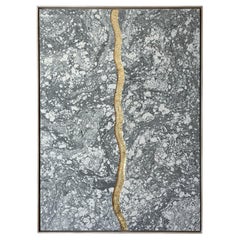
This work uses a vintage kimono fabric with marble pattern, that makes it look like a real piece of marble.
The line in the middle symbolizes “kintsugi” - concept of wabi-sabi, which values imperfection, impermanence, and the beauty of aging.
It is elegantly framed with paulownia wood originally used for kimono chest-of-drawers, and is filled with storytelling and sense of luxury.
I used pieces of kimono that could no longer be used as clothing and kiritansu chest-of-drawers that would normally be discarded to create the ultimate upcycled piece.
<< Explanation and meaning of pattern and colors
Kintsugi (金継ぎ), which translates to "golden joinery" or "golden repair," is a traditional Japanese art form of repairing broken pottery with lacquer mixed with powdered gold, silver, or platinum. I used this tecnique here to "repair" antique kimono by transforming it into art work. Beyond its literal meaning of mending broken ceramics, kintsugi carries profound philosophical and cultural significance in Japanese tradition:
・Embracing Imperfection: Kintsugi celebrates imperfection and impermanence. Rather than disguising or concealing flaws, it highlights them, treating the breakage as part of the object's history. This philosophy encourages acceptance of imperfection as an essential aspect of life, beauty, and human experience.
・Wabi-Sabi Aesthetic: Kintsugi embodies the principles of wabi-sabi, an aesthetic worldview centered on the acceptance of transience and imperfection. Wabi-sabi values simplicity, authenticity, and the beauty of things that are imperfect, impermanent, and incomplete. Kintsugi exemplifies these principles by turning what might be considered flaws into features that enhance the object's beauty and character.
・Resilience and Transformation: The act of repairing broken things with precious metals symbolizes resilience and transformation. Instead of discarding or replacing the broken object, kintsugi honors its history and transforms it into something new and valuable. This reflects broader philosophical themes of overcoming adversity, finding beauty in imperfection, and embracing change.
・Honoring the Past: Kintsugi preserves and honors the history of the object. Rather than erasing or ignoring its past, it acknowledges and celebrates it. This aspect of kintsugi can be seen as a metaphor for honoring our own personal histories, including the challenges and setbacks we have faced, and recognizing how they have shaped us into who we are today.
・Spiritual and Philosophical Symbolism: Kintsugi has spiritual and philosophical implications, reflecting concepts such as the interconnectedness of all things, the cycle of life and death, and the pursuit of harmony and balance. The process of repairing broken objects with precious metals is seen as a metaphor for spiritual growth, enlightenment, and the journey towards wholeness.
Overall, kintsugi represents not only a practical technique for repairing ceramics but also a profound philosophical and cultural perspective on life, beauty, and the human experience. It embodies values such as resilience, acceptance, and the transformative power of embracing imperfection.
<< Characteristics of the fabric
This vintage textile is hand-painted with a traditional painting technique where the colors are added on wet surface, which creates an effect of marble.
<< About the frame
Kiritansu - chest-of-drawers for kimono, is traditionally made from paulownia wood, a uniquely Japanese material closely tied to the world of kimonos.
Paulownia wood is known as the lightest wood in Japan, prased for its natural luster, resistance to moisture, and resilience against cracking. Since ancient times, it has been used in crafting furniture, chests, and musical instruments.
During the Edo period, it became customary to store cherished kimonos in paulownia chests...
Category
1960s Japanese Japonisme Vintage Gold Paintings and Screens
Materials
Gold Leaf
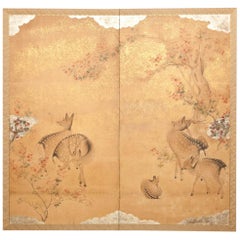
Japanese Two Panel Screen Nara Deer in Gentle Yoshino Landscape
Located in Hudson, NY
Japanese two panel screen: Nara Deer in Gentle Yoshino Landscape. Yoshino is in the Nara Prefecture, an area famous for these small and tame deer native to J...
Category
Early 1900s Japanese Meiji Antique Gold Paintings and Screens
Materials
Gold Leaf, Silver Leaf
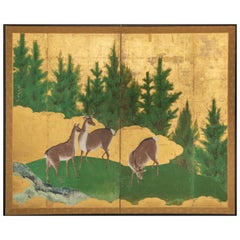
Japanese Two-Panel Screen, Deer in Cedar Landscape
Located in Hudson, NY
Originally fusuma doors, three deer stand in a clearing in a pine forest with gold leaf mist. Mid Edo period painting in mineral pigments on gold leaf wi...
Category
18th Century Japanese Edo Antique Gold Paintings and Screens
Materials
Gold
Chinoiserie Palm Oval Paintings
Located in Sturminster Marshall, Dorset
A pair of carved giltwood Chippendale crossed palm frames, with inset hand-painted chinoiserie portraits of 18th century oriental nobility.
We a...
Category
21st Century and Contemporary English Chippendale Gold Paintings and Screens
Materials
Gold Leaf

$6,606 / set
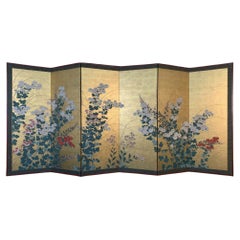
Early 19th Century Rimpa School Floral Screen
By Rimpa School
Located in Fukuoka, JP
Early 19th Century Rimpa School Floral Screen
Period: Early 19th Century
Dimensions: 367x171 cm (144.5x67.3 inches)
SKU: RJ118
This 6-panel gold-leafed screen is a splendid represe...
Category
Early 19th Century Japanese Edo Antique Gold Paintings and Screens
Materials
Gold Leaf
$13,260 Sale Price
25% Off
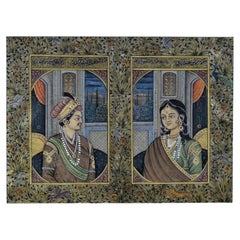
Mughal miniature portrait depicting Emperor Akbar and Jodha Bai, 19th Century
Located in Islamabad, PK
The Mughal miniature portrait, created with a single-hair brush on delicate rice paper and embellished with 24k gold water, depicts the noble Mughal Emperor Akbar and his esteemed consort, Jodha Bai. This exquisite artwork exemplifies the pinnacle of Mughal artistry, renowned for its intricate detail and luxurious use of materials.
At the center of the composition, Emperor Akbar is portrayed with an air of majestic authority and wisdom. He is dressed in regal attire, featuring rich textiles adorned with elaborate patterns. The gold water applied to his garments and accessories adds a shimmering, ethereal quality, highlighting the emperor's status and the richness of his attire. His turban is prominently adorned with a jeweled ornament, enhancing his royal presence. Akbar's expression is composed and contemplative, reflecting his reputation as a wise and benevolent ruler.
Beside him stands Jodha Bai, exuding grace and elegance. Her attire is a masterpiece of Mughal textile...
Category
Mid-19th Century Indian Anglo Raj Antique Gold Paintings and Screens
Materials
Gold Leaf
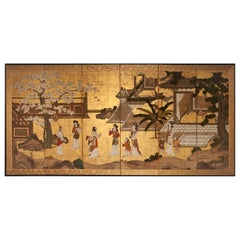
Japanese Six-Panel Screen Women of the Court in the Garden
Located in Hudson, NY
Japanese six-panel screen: Women of the Court in the Garden. Edo period (circa 1700) painting of an early Kano school subject matter: nobility socializing in a coutryard garden. Deta...
Category
Early 1700s Japanese Edo Antique Gold Paintings and Screens
Materials
Gold Leaf
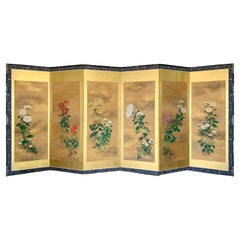
Meiji Chrysanthemum Masterpiece
Located in Fukuoka, JP
Step into a world of timeless beauty with our exceptional six-panel screen from the Edo-Meiji period. In impeccable condition, each panel features stunning paintings of chrysanthemum...
Category
19th Century Japanese Meiji Antique Gold Paintings and Screens
Materials
Gold
$4,624 Sale Price
40% Off
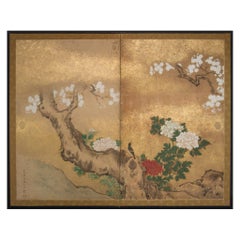
Japanese Two-Panel Screen Peony and Cherry
Located in Hudson, NY
Japanese two-panel screen: Peony and Cherry, Edo period (circa 1800) painting, formerly fusuma (Japanese sliding doors), executed in the Kano school style, featuring a cherry tree in...
Category
Early 1800s Japanese Edo Antique Gold Paintings and Screens
Materials
Gold Leaf
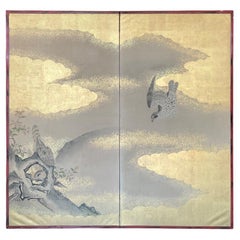
Majestic Hawks Edo Screen by Tosa School
Located in Fukuoka, JP
Majestic Hawks Edo Screen
Period: Edo
Size: 150x168 cm (59x66 inches)
SKU: PTA93
Step back in time to the Edo period with our superb Tosa school screen d...
Category
19th Century Edo Antique Gold Paintings and Screens
Materials
Gold Leaf
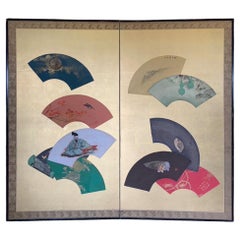
Taisho Golden Fan Screen
Located in Fukuoka, JP
Taisho Golden Fan Screen
Period: Meiji
Size: 190x171 cm
Step into a world of elegance with our exquisite two-panel Taisho screen adorned in gold, depicting fans adorned with vario...
Category
20th Century Japanese Taisho Gold Paintings and Screens
Materials
Gold Leaf
$2,540
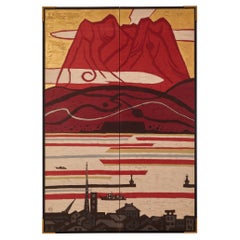
Japanese Two-Panel Screen, Harbor Scene in a Modernist View
Located in Hudson, NY
Bountiful mountain overlooking a city, divided by an occupied river. The shapes and colors that make up this unique painting allow for an unconventional take on a modern harbor view....
Category
Early 20th Century Japanese Gold Paintings and Screens
Materials
Gold, Brass
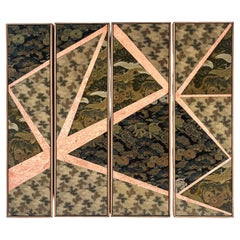
19th Century obi textile art " Pine forest ~ Longivety ~ " by ikasu Green Japan
By Kimono ikasu
Located in Setagaya City, JP
<< Story behind the work
Obi fabric I used for this artwork is taken from three different over 100-years-old antique sashes, and is framed in wood taken from antique ...
Category
Early 20th Century Japanese Japonisme Gold Paintings and Screens
Materials
Gold Leaf
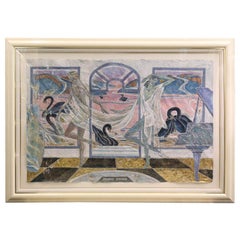
"View from the Terrace, " Mixed-Media by Yamin Young
By Yamin Young
Located in Houston, TX
Well listed Chinese Artist Yamin Young. "View from the Terrace". Mixed-media on handmade rice paper, mounted to the fabric base, protected by the plexiglas...
Category
Late 20th Century Chinese Other Gold Paintings and Screens
Materials
Gold Leaf
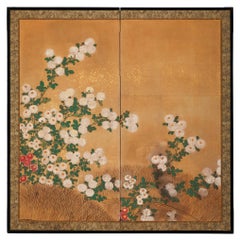
Japanese Two Panel Screen: Chrysanthemums Over Twig Fence
Located in Hudson, NY
Mineral pigment and gold dust on mulberry paper. Silk brocade border and black lacquer trim. From the collection of Moke Mokotoff
Category
Late 19th Century Japanese Antique Gold Paintings and Screens
Materials
Gold
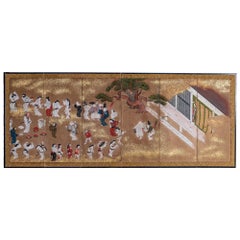
Japanese Six Panel Screen: Tosa School Painting of Theatre Scene
Located in Hudson, NY
with thought to be Izumo no Okuni (1578-1613). Mineral pigments and gold dust on mulberry paper with silk brocade border.
Category
18th Century Japanese Antique Gold Paintings and Screens
Materials
Gold
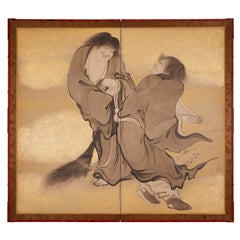
Japanese Two Panel Screen: Kanzan and Jittoku
Located in Hudson, NY
Prominent figures in Japanese folklore. The Chinese poet-sage Kanzan is depicted with his scroll, and the Daoist sage Jittoku with his broom. Painting bears two seals of Nakanuma Sho...
Category
Late 19th Century Japanese Antique Gold Paintings and Screens
Materials
Gold
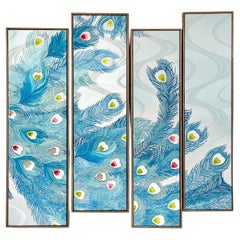
Antique kimono textile art " Peacock Feathers ~ Royalty ~" by ikasu Blue Japan
By Kimono ikasu
Located in Setagaya City, JP
This work uses an antique furisode (festive kind of kimono with long sleeves) with peacock feathers - a symbol of royalty and prosperity. Can be used both vertically and horizontall...
Category
Early 20th Century Japanese Japonisme Gold Paintings and Screens
Materials
Gold Leaf, Silver Leaf
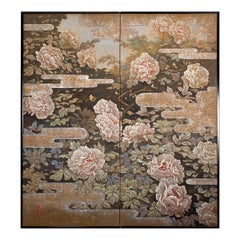
Japanese Two Panel Screen Peonies In the Mist
Located in Hudson, NY
Japanese Two Panel Screen: Peonies In the Mist. Showa period (1926 - 1945) painting in oil on canvas of peonies with gold and silver dust clouds. Signature reads, Seishu.
Category
1930s Japanese Showa Vintage Gold Paintings and Screens
Materials
Gold Leaf, Silver Leaf
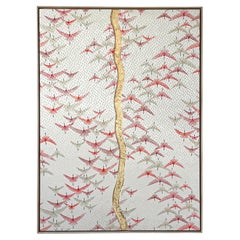
Vintage kimono textile art " Cranes ~ Kintsugi ~ " by ikasu White Red Gold Japan
By Kimono ikasu
Located in Setagaya City, JP
<
The frame for this work is made of paulownia wood taken from antique Kiritansu - chest-of-drawers for kimono.
I use antique kiritansu that can’t be used as furniture anymore to create basis and frames for my works. It adds them even more authentic atmosphere of traditional wabisabi spirit. Can you feel it?
The piece uses the concept of "kintsugi" - it "unites" the pieces of antique kimono back together with golden leaf to give it a second wind as art work.
<< Period / Story
The kimono used in this piece was originally crafted during the late Showa period (1960-80ies).
<< Explanation and meaning of pattern and colors
The Japanese saying goes, "A crane lives a thousand years, a tortoise lives ten thousand years," making cranes a symbol of longevity.
Cranes are also known for staying with the same partner for their entire lives, which is why they are often used at weddings and other celebrations to symbolize "marital bliss" and the desire for harmony between husband and wife.
On this particular piece, cranes are flying through snow woven on the fabric, as if they are overcoming all the disasters to get to their beloved ones.
The color scarlet, or deeply dyed red, used for the most of the cranes here, has long been associated with the meaning of "warding off evil." It is believed to possess the power to repel malevolent forces and invite good fortune.
During the Heian period, scarlet was reserved for sacred buildings and ceremonial objects that held great significance. Ordinary people were prohibited from wearing scarlet-red kimonos, which made it a highly special color.
<< Characteristics of the fabric
Cranes, going up and down, are generously decorated by kimpaku here. "Kimpaku" (金箔) refers to gold leaf/foil in Japanese. Gold leaf is a traditional material used in various aspects of Japanese culture, including art, crafts, and even in culinary applications.
In traditional Japanese art, gold leaf is often applied to religious objects, sculptures, paintings, and lacquerware to create a luxurious and decorative effect. The use of gold leaf in art dates back centuries and is associated with a sense of wealth, prestige, and the divine.
Traditional kimpaku technique is used here to make an accent decoration in the middle.
<< About the frame
This artwork frame is crafted from paulownia wood, a uniquely Japanese material closely tied to the world of kimonos, and it serves to convey the refined beauty of Japanese nature.
Paulownia wood is known as the lightest wood in Japan, prased for its natural luster, resistance to moisture, and resilience against cracking. Since ancient times, it has been used in crafting furniture, chests, and musical instruments.
Paulownia wood is closely linked to kimono culture. During the Edo period, it became customary to store cherished kimonos in paulownia chests...
Category
Late 20th Century Japanese Japonisme Gold Paintings and Screens
Materials
Gold Leaf
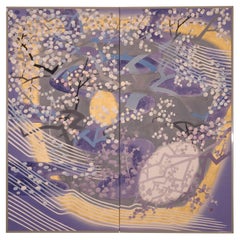
Japanese Two Panel Screen: Yozakura (Cherry Blossom Viewing at Night)
Located in Hudson, NY
Unusual subject matter of cherry blossoms in the moonlight on dyed silk and applied gold in a grey lacquer trim. Signature and seal read: Adachi Masakazu. ...
Category
20th Century Japanese Gold Paintings and Screens
Materials
Gold
Japanese Two-Panel Screen, Rimpa Style Chrysanthemums on a Twig Fence
Located in Hudson, NY
Detailed painting of varieties of chrysanthemums behind a bound-twig garden fence rendered in silvered, raised gofun. Stylized low-hanging gold mist clouds. Rimpa-style painting in m...
Category
Late 19th Century Japanese Antique Gold Paintings and Screens
Materials
Gold
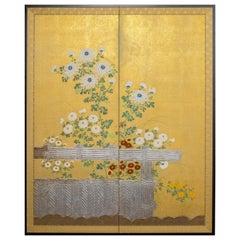
Japanese Two Panel Screen: Simple Chrysanthemums on Gold
Located in Hudson, NY
Mineral pigments on gold leaf. Not signed, by: Baikei Hitsu.
Category
1880s Japanese Antique Gold Paintings and Screens
Materials
Gold Leaf
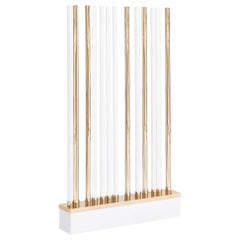
Fade-Resistant Acrylic and Stainless Steel Outdoor Divider
By Myface
Located in Santo Tirso, PT
Houdini - Outdoor screen
The Houdini Screen is a modular partition that blends privacy with striking design. Composed of customizable panels in stainle...
Category
21st Century and Contemporary Portuguese Modern Gold Paintings and Screens
Materials
Gold Plate, Stainless Steel
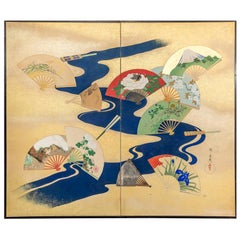
Japanese Two-Panel Screen, Deco Landscape with River Fans
Located in Hudson, NY
Japanese two-panel screen, deco landscape with river fans. Modern scene of a 12th century festival in Kyoto in which fans are sent down the Kamo River and caught downstream. Taisho (...
Category
Early 20th Century Japanese Taisho Gold Paintings and Screens
Materials
Gold Leaf
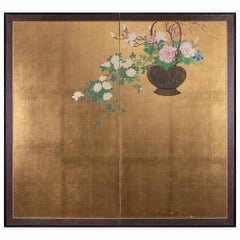
Japanese Two-Panel Screen Ikebana on Gold
Located in Hudson, NY
Japanese two-panel screen: Ikebana on gold. Meiji period (1868-1912) painting of a basket with beautifully arranged spring flowers in the style of ikebana (Japanese traditional flowe...
Category
Late 19th Century Japanese Meiji Antique Gold Paintings and Screens
Materials
Gold Leaf
Still Thinking About These?
All Recently ViewedMore Ways To Browse
Chinese Woodblock Print
Fusuma Doors
Japanese Screen Kano School
Japanese Tiger Screen
Ogata Korin
Painted Panel Screen Birds
Antique Chinese Black Lacquer Screen
Antique Falconry
Carved Stone Panel
Chinese Carved Hardwood Screen
Chinese Folding Silk Screen Art
Chinese Paint Brushes
Chinese Pearl And Lacquer Screen
Gold Screen Crane
Japanese 4 Panel Screen
Japanese Autumn Screen
Japanese Calligraphy Screen
Japanese Cherry Blossom Screen