18th Century and Earlier Figurative Sculptures
to
167
1,153
1,153
3,778
9,360
2,632
2,273
3,260
2,143
306
163
561
571
259
538
553
702
401
279
251
111
32
12
12
10
6
2
1
643
265
236
213
91
629
490
838
405
173
145
99
Height
to
Width
to
1,153
1,153
1,153
72
19
9
8
5
Period: 18th Century and Earlier
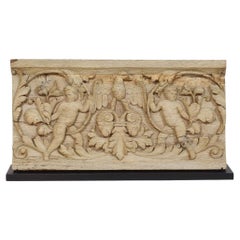
18th Century French Carved Oak Panel Depicting Two Angels And An Eagle
Located in Buisson, FR
Beautiful weathered oak panel depicting two baroque angels and an eagle standing on rams heads .
Weathered and small losses, most likely it was once part of a larger panel.
France ci...
Category
French Baroque Antique 18th Century and Earlier Figurative Sculptures
Materials
Oak

$807 Sale Price
32% Off
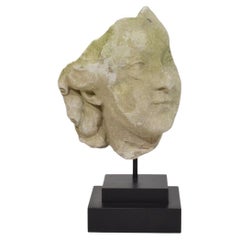
French, 18th Century Carved Stone Head Fragment
Located in Buisson, FR
Magnificent carved stone head fragment with a very beautiful and strong expression.
France, circa 1750.
Beautiful weathered and small losses.
Measurement is with the wooden base.
H:3...
Category
French Baroque Antique 18th Century and Earlier Figurative Sculptures
Materials
Stone
$1,524 Sale Price
32% Off
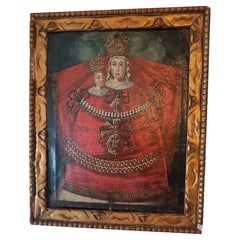
Spanish Colonial South American Painting Virgin folk art 18th C
Located in London, GB
A Spanish colonial South American folk art style painting of the Virgin and child
South American Peru or Bolivia school 18th century or earlier
Oil on canvas, framed size 40 x ...
Category
Peruvian Antique 18th Century and Earlier Figurative Sculptures
Materials
Paint
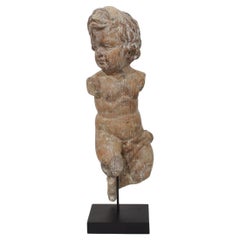
Spanish 18th Century Hand Carved Wooden Baroque Angel
Located in Buisson, FR
Wonderful hand carved baroque angel figure. .
Spain, circa 1750-1800
Weathered. small losses and old repair.
Measurement here below includes the wooden base.
H:57cm W:18cm D:20,5cm
Category
Spanish Baroque Antique 18th Century and Earlier Figurative Sculptures
Materials
Wood
$1,070 Sale Price
52% Off
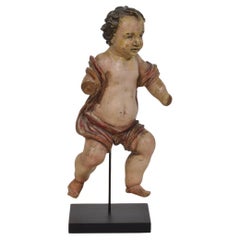
Spanish 18th Century Hand Carved Wooden Baroque Angel
Located in Buisson, FR
Beautiful hand carved Baroque angel. Unique period piece with traces of its old paint .
Spain, circa 1750
Weathered. Several small losses and old repair.
Measurement here below in...
Category
Spanish Baroque Antique 18th Century and Earlier Figurative Sculptures
Materials
Wood
$807 Sale Price
47% Off
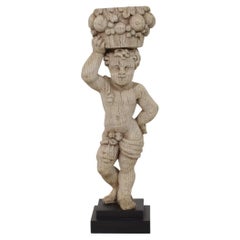
French 18th Century Baroque Hand Carved Oak Caryatid Figure
Located in Buisson, FR
Wonderful period piece. Beautiful weathered baroque hand carved oak caryatid figure carrying a fruit basket.
Weathered. France circa 1750
Measurements include the wooden base.
H:45c...
Category
French Baroque Antique 18th Century and Earlier Figurative Sculptures
Materials
Oak
$1,070 Sale Price
49% Off
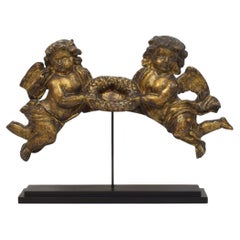
Spanish 18th Century Carved Wooden Baroque Angel Fragment
Located in Buisson, FR
Beautiful hand carved wooden ornament depicting two angel holding a laurel wreath. Unique period piece .
Spain, circa 1700-1750
Weathered. Small losses and old repairs.
Measurement ...
Category
Spanish Baroque Antique 18th Century and Earlier Figurative Sculptures
Materials
Wood
$1,166 Sale Price
38% Off
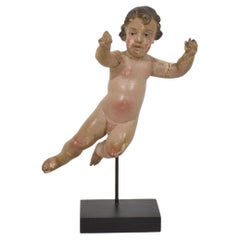
Small Italian 18th Century Carved Wooden Baroque Angel
Located in Buisson, FR
Beautiful small Baroque angel with glass eyes. Unique period piece made out of wood . Hand-carved
Italy, circa 1700- 1750
Weathered, small losses and old repairs
Measurement here b...
Category
Italian Baroque Antique 18th Century and Earlier Figurative Sculptures
Materials
Glass, Wood
$950 Sale Price
48% Off
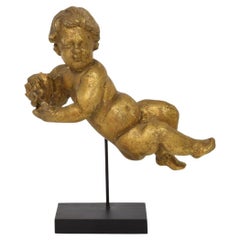
Italian 18th Century Carved Wooden Baroque Angel
Located in Buisson, FR
Beautiful Baroque angel. Unique period piece made out of wood . Hand-carved
Italy, circa 1750
Weathered.
Measurement here below includes the wooden base.
H:25,5cm W:23cm D:7,5cm
Category
Italian Baroque Antique 18th Century and Earlier Figurative Sculptures
Materials
Wood
$807 Sale Price
41% Off
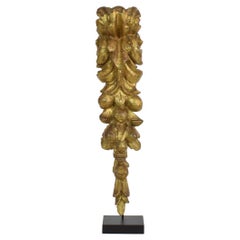
Italian 17th/ 18th Century Giltwood Baroque Ornament
Located in Buisson, FR
Beautiful carved giltwood baroque ornament.
Italy, 17/18th century. Weathered and small losses.
Measurement includes the wooden base.
Category
Italian Baroque Antique 18th Century and Earlier Figurative Sculptures
Materials
Wood
$544 Sale Price
53% Off
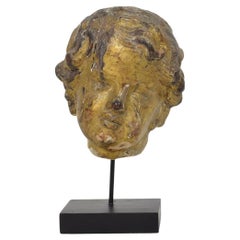
Italian 17th 18th Century Carved Giltwood Baroque Angel Head
Located in Buisson, FR
Beautiful giltwood angelhead.
Italy, circa 1650-1750
Weathered and small losses.
Measurement here below inclusive the wooden base.
H:18,5cm W:11cm D:11,5cm
Category
Italian Baroque Antique 18th Century and Earlier Figurative Sculptures
Materials
Wood
$388 Sale Price
45% Off
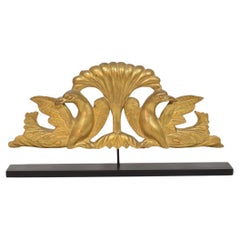
Italian 18th/ 19th Century Carved Giltwood Neo Classical Ornament With Birds
Located in Buisson, FR
Beautiful handcarved giltwoodornament depicting two birds.
Italy circa 1780-1820 . Weathered and small losses
Measurements individual and include the wooden base.
H:28,5cm W:56cm D...
Category
Italian Neoclassical Antique 18th Century and Earlier Figurative Sculptures
Materials
Wood
$592 Sale Price
49% Off
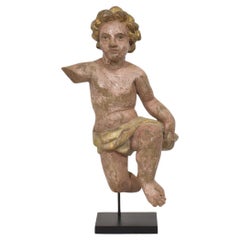
Italian 18th Century Hand Carved Wooden Baroque Angel Fragment
Located in Buisson, FR
Beautiful hand carved Baroque angel fragment. Unique period piece with traces of its old color .
Italy, circa 1750
Weathered. small losses.
Measurement here below includes the wood...
Category
Italian Baroque Antique 18th Century and Earlier Figurative Sculptures
Materials
Wood
$891 Sale Price
44% Off
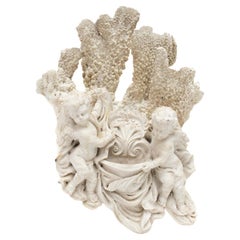
18th Century Italian Holy Water Font with Angels Framed with Fossil Coral
By Interi
Located in Dublin, Dalkey
18th century Italian holy water font with two angels framed with polished agate coral wings on fossil coral.
The Italian holy water front is from a historical Italian church and is...
Category
Italian Rococo Antique 18th Century and Earlier Figurative Sculptures
Materials
Agate, Coral
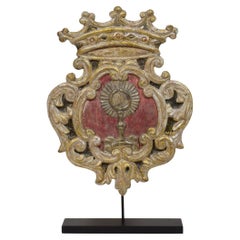
Italian 18th century baroque Carved Wooden Silvered Panel / Coat Of Arms
Located in Buisson, FR
Amazing baroque panel depicting a crowned reliquary . Beautiful weathered with traces of its original silver, gilding and colour.
Italy circa 1750
Weathered, small losses .
Measureme...
Category
Italian Baroque Antique 18th Century and Earlier Figurative Sculptures
Materials
Wood
$1,046 Sale Price
44% Off
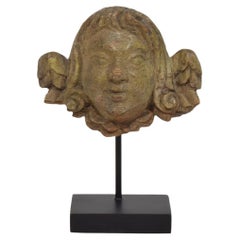
French 16th/ 17th Century Weathered Oak Renaissance Angel Fragment
Located in Buisson, FR
Beautiful weathered oak winged angel head Renaissance ornament.
France, 16/ 17th century. Weathered
Measurements include the wooden pedestal.
Category
French Renaissance Antique 18th Century and Earlier Figurative Sculptures
Materials
Oak
$269 Sale Price
47% Off
Petite Indian Bronze Ganesha Shrine, c. 1700
Located in Chicago, IL
Well-loved and richly worn, this petite bronze traveling shrine from North India depicts the Hindu god Ganesha. Attributed to 17th century or later, the palm-sized icon reveals its a...
Category
Indian Primitive Antique 18th Century and Earlier Figurative Sculptures
Materials
Bronze

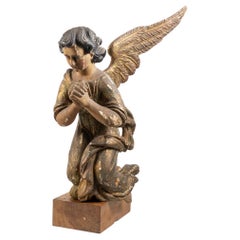
17th-Century Carved Wooden Angel – Polychrome and Gilded Sculpture
Located in TEYJAT, FR
17th-Century Carved Wooden Angel – Polychrome and Gilded Sculpture (One Wing Remaining)
Height: 70 cm Width: 33 cm
A beautiful 17th-century carved wooden angel, depicted kneeling i...
Category
Italian Baroque Antique 18th Century and Earlier Figurative Sculptures
Materials
Wood
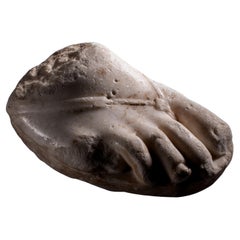
Roman Marble Foot with Sandal
Located in London, GB
This evocative Roman marble foot fragment is a timeless remnant of the overlifesized sculpture it was once part of. Sensitively carved and polished, the outer sole of the sandal rema...
Category
Classical Roman Antique 18th Century and Earlier Figurative Sculptures
Materials
Marble
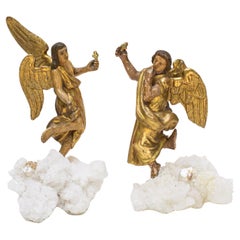
Pair of 18th Century Italian Dancing Angels with Baroque Pearls on Aragonite
By Interi
Located in Dublin, Dalkey
Pair of 18th century Italian dancing angels with coordinating baroque pearls on aragonite crystal clusters.
The dancing angels are hand-carved wood, polychromed and gilded, original...
Category
Italian Rococo Antique 18th Century and Earlier Figurative Sculptures
Materials
Rock Crystal, Gold Leaf
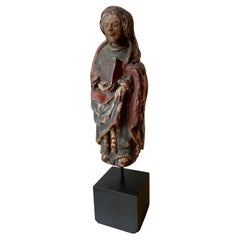
12th Century Rare Romanesque Wood Sculpture of the Virgin Mary
Located in Vero Beach, FL
12th century extremely rare romanesque wood sculpture of the Virgin Mary.
Magnificent wood hand carved sculpture of the Virgin Mary holding a book to her chest.
It is an extremely rare survivor of the 12th century. The style is European, possibly French or English. This statue is a testimony to beautiful religious art from about 1150. A truly rare Romanesque sculpture...
Category
English Medieval Antique 18th Century and Earlier Figurative Sculptures
Materials
Stone
$11,200 Sale Price
20% Off
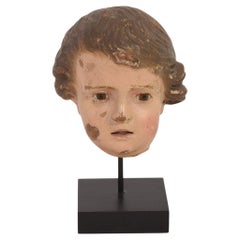
Small 18th Century Italian Carved Wooden Head with Glass Eyes
Located in Buisson, FR
Stunning handcarved wooden head fragment with beautiful expression and glass eyes,
Italy, circa 1750-1800. Beautiful example of 18th century craftsmanship.
Weathered
Measurement her...
Category
Italian Baroque Antique 18th Century and Earlier Figurative Sculptures
Materials
Glass, Wood
$508 Sale Price
46% Off
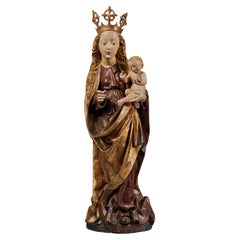
Polychrome carved wood Virgin and Child from the 15th Century
Located in Saint-Ouen, FR
POLYCHROME CARVED WOOD VIRGIN AND CHILD FROM THE 15TH CENTURY
ORIGIN: SOUTH GERMANY, SWABIA, NUREMBERG REGION
PERIOD: 15th CENTURY
Height: 94,6cm
Width : 28 cm
Depth : 18 cm
Lime wood
Original Polychromy
Good state of conservation
From 1430 onwards, sculpture underwent a profound stylistic renewal which continued until 1530, the so-called late Gothic period. In the Germanic countries, original sculptures flourished in an expressive and sensitive vein.
This renewal was inspired by the art of Nicholas of Leiden, who was active in Strasbourg in the 1460's. His style broke with the refined and delicate art of the international Gothic style in force throughout Europe around 1400. The figures became more authentic and realistic. The bodies became denser. Clothes are animated by deep, broken folds, the fabrics are heavy and have a great decorative value. In addition, the polychromy is intended to be illusionistic. The painting makes it possible to restore the texture of the materials, the richness of the textiles and the natural skin tone of the characters.
The dissemination of images through engraving and the great mobility of the artists led to the success of this style, which conquered the Upper Rhine, Swabian, Tyrolean and Franconian regions, contributing to the formation of a common stylistic identity in these regions. The economic boom in the flourishing German cities was conducive to the development of original production. Attracted by this prosperity, numerous workshops were set up in order to meet the orders of religious communities, the Church and the laity, including a clientele of middle-class rockers.
This precious Virgin and Child is depicted standing on a crescent moon, her head encircled by a crown of tall flowers. Her long wavy hair spreads over her shoulders, framing her beautiful oval face. Under fine eyebrows drawn with a brushstroke, her almond-shaped, slightly drooping eyes look at the Child with infinite softness. She is dressed in a long red dress with a rounded neckline, belted under the chest. The heavy fabric of her dress spreads out in broken folds at her feet. On her shoulders she wears a golden cloak. The drapery has deep folds. She holds out her right hand while she holds the Christ Child with her left.
Christ, with his well-defined hair, is naked. His cheeks are highlighted with red, he holds an apple in his left hand and with the other hand makes a sign of blessing towards the faithful.
Virgins with Child on a crescent moon were very popular in the second half of the 15th century, especially as the central subject of altarpieces in southern Germany and Austria. The crescent moon on which Mary is standing is reminiscent of the Woman of the Apocalypse. Often equated with the Virgin Mary.
This episode is taken from the Book of Revelation (12:1-6)
1 Then a great sign appeared in heaven: a woman clothed with the sun, with the moon under her feet and a crown of twelve stars on her head. ; 2 She was pregnant, and she cried out because she was in labor, in pain from giving birth. ; 3 Then another sign appeared in heaven: it was a great fiery red dragon, with seven heads and ten horns, and seven royal crowns on his heads. ; 4 His tail swept down a third of heaven's stars and threw them to the earth. The dragon stood in front of the woman who was about to give birth so that when she gave birth, he might devour her child. ; 5 She gave birth to a son, a male child who is to rule all the nations with an iron rod. Her child was snatched up to God and his throne. ; 6 Then the woman fled into the desert, where God has prepared a place for her. There she will be taken care of for one thousand two hundred sixty days.
Some theologians see in this woman a reference to the Virgin Mary and in the child, Jesus.
This remarkable work is a very fine example of sculpture from Swabian workshops in the last decades of the 15th century. It presents all the characteristic stylistic elements: a highly girdled silhouette, an abundant drapery with angular folds, but also a great physical presence accentuated by the polychromy that restores the anatomical details. This group is made of a wooden log. The deep folds of the drapery highlight the movement of the Virgin holding the child.
Bibliography :
Sophie Guillot de Suduiraut, Dévotion et Séduction, Sculptures souabes des musées de France, vers 1460-1530, Paris musée du Louvre-Éditions somogy, 2015
“Revelation 12 - Common English Bible...
Category
German Gothic Antique 18th Century and Earlier Figurative Sculptures
Materials
Wood
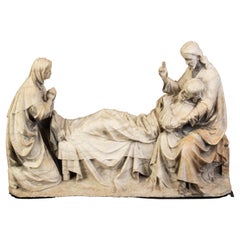
Large Medieval 15th Century Religious Hand Carved Marble Sculpture Group
Located in Nottingham, GB
A large and rare second half of 15th century religious marble sculpture group, hand carved, mounted on bronze base for display. This sculpture group depicts the death of Saint Joseph...
Category
French Antique 18th Century and Earlier Figurative Sculptures
Materials
Marble
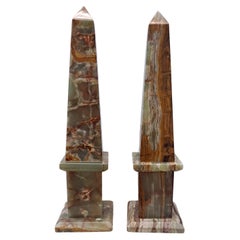
Beautiful Pair of Grand-Tour Style Polished Onyx Obelisks
Located in San Francisco, CA
Beautiful pair of Grand Tour Style polished onyx obelisks. Offered as a pair consisting of two items.
Category
Pakistani Grand Tour Antique 18th Century and Earlier Figurative Sculptures
Materials
Onyx
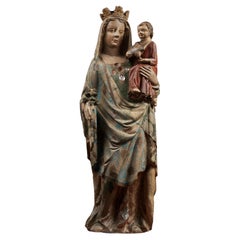
Important 14th Century Polychrome Limestone Virgin from Lorraine
Located in Saint-Ouen, FR
Provenance :
- Kunsthaus Heinrich Hahn, Frankfurt am Main, sale 16, June 17, 1930, lot 16.
- Sotheby's, Amsterdam, Feb. 26, 2006, lot 201.
HISTORIC
Located between Moselle valley and Meuse valley, framed by the Vosges Mountains on the south side and the duchy of Luxembourg on the north side, the duchy of Lorraine is the result of several partitions. It starts with the 9th century when the Carolingian empire is divided, with Lothar 1st inheriting Lotharingia. In 959 this territory was in turn divided in two; Lower and Upper Lotharingia, the latter being the forebear of the duchy of Lorraine. This duchy was under the rule of the Holy Roman Germanic Empire until 1736 when it was absorbed by the kingdom of France.
All along its history the duchy of Lorraine has found itself in the midst of many conflicts. Alliances and feuds marking European history were always particularly sensible in Lorraine where instability was frequent. Because of its geographic position the duchy of Lorraine was also an artistic crossroad.
Hence the duchy of Lorraine becomes from the 13th century onwards an important artistic centre where a particular type of Virgin and Child appears. According to professor J. A. Schmoll the characteristics of Lorraine sculpture burgeon around 1280-1300 in the Aube region. It presents “vigorous volumes, restrained movements, rare but solemn gestures and a strong interiorised and stern expression”. Those Virgins look similar with a wide forehead, a shield- or oval-shaped face, large neck, small lips and a cleft chin.
This model is particularly in favour during the 13th century because of the revival for Marial worship and for the theme of the Virgin and Child. It bears witness to a new religious sensibility with a more intimate vision of religious practice.
DESCRIPTION
The important 14th century Virgin we present to you is one of the most beautiful examples of sculptural art from Eastern France, with her fascinating distant gaze.
Her contrapposto posture is induced by the weight of the child she carries high on her left side. The child has a chubby face framed by blond hair with well defined curls and he wears a long red V-collared tunic from which emerge his feet. The fabric is animated by long folds. The position of the right foot turned to the back is a detail we can notice on several Virgins from Lorraine. He holds a bird that seems to be pecking his thumb.
“The bird /held by the child in his hands/ has been read as a reference to an episode from Christ’s childhood when he has moulded sparrows with clay before giving them life. It appears in the apocryphal gospel of Pseudo-Matthew (ch. 27) and later in the Quran (III, 43, v. 110). However the iconography seems to be more influenced by the concept of Redemption or of Eucharist, the bird symbolising the soul of the Christian about to be redeemed or revitalised.”
Mary wears a long dress with two rock crystal cabochons remaining from the original five. She is covered by a red cloak enriched with old-gold motifs draped as an apron falling in long pleats along her left hip. The relief treatment and the volume of the cloak developing a network of concentric pleats contrast with the the flat pleating of her dress. They nevertheless suggest the curve of her bent right leg.
She wears a floret crown securing a short thin veil carved in very low relief. From it emerges her blond curled hair characteristic of the 13th century. The large face with almond-shaped eyes, straight nose, small lips and cleft chin casts its gaze afar in a fashion typical of 13th century Virgins.
In her right hand she holds a lily flower. In a very refined manner the artist has carved a band on her right ring-finger.
In the back, carefully sculpted, spreads the minutely detailed short veil.
COMPARATIVE STUDIES
This sculpture of great quality presents obvious similarities with Virgins from Lorraine, designated by William Forsythe...
Category
French Gothic Antique 18th Century and Earlier Figurative Sculptures
Materials
Limestone
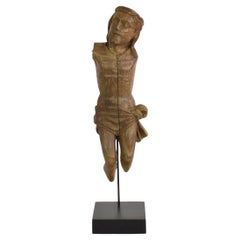
French 17th Century Weathered Carved Oak Christ Fragment
Located in Buisson, FR
Very nice carved oak fragment of a Christ figure with a strong expression. Beautiful weathered , France circa 1600-1700. Weathered, and losses. Measurement with the base
Category
French Antique 18th Century and Earlier Figurative Sculptures
Materials
Oak
$831 Sale Price
49% Off
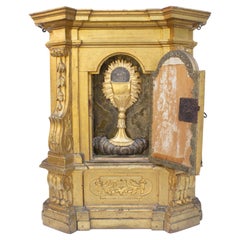
18th Century Italian Gilded Tabernacle with a Hand-Carved Chalice Fragment
By Interi
Located in Dublin, Dalkey
18th century Italian gilded and hand-carved tabernacle adorned with an 18th century Italian gilt chalice and Sabina Faye Braxton gaufrage fabric. This tabernacle once belonged in a h...
Category
Italian Rococo Antique 18th Century and Earlier Figurative Sculptures
Materials
Gold Leaf
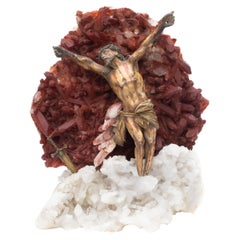
Sculptural 18th Century Italian Figure of Christ on Red and White Crystal Quartz
By Interi
Located in Dublin, Dalkey
Sculptural 18th century Italian figure of Christ and metal sword with large red and white crystal quartz clusters and phantom quartz.
The figure of Christ was originally part of a c...
Category
Italian Rococo Antique 18th Century and Earlier Figurative Sculptures
Materials
Crystal, Rock Crystal, Metal
18th Century Italian Double-Mounted Cross on Hematite with Pyrite Inclusions
By Interi
Located in Dublin, Dalkey
Sculptural 18th century Italian gilded double-mounted cross on hematite with pyrite inclusions and adorned with pyrite rosettes. A matching smaller cross is mounted onto the bigger cross...
Category
Italian Rococo Antique 18th Century and Earlier Figurative Sculptures
Materials
Quartz, Rock Crystal, Pyrite
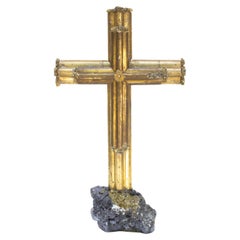
Standing Buddha Thailand, Ayuthaya Period, Early 18th Century
Located in Miami Beach, FL
This bronze standing Buddha mounted on a turned wood base has his right palm held outward in the abhaya mudra position, a gesture of fearlessness and reassurance.
Category
Thai Tribal Antique 18th Century and Earlier Figurative Sculptures
Materials
Bronze

$2,000 Sale Price
42% Off
Pair of Chinese Ming Sancai Chiwen Roof Tiles, c. 1650
Located in Chicago, IL
These monumental Chinese roof tiles were once installed as part of the elaborate roof of a Ming-dynasty temple or grand courtyard home. Dated to the 17th century or earlier, the scul...
Category
Chinese Ming Antique 18th Century and Earlier Figurative Sculptures
Materials
Earthenware
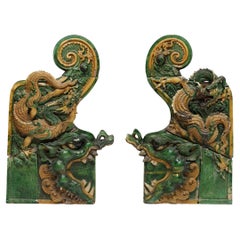
Pair 18th Century Hand-Carved Polychromed Wood Angels
Located in Dallas, TX
Pair 18th Century Hand-Carved Polychromed Wood Angels are amazingly well preserved and perfect for any devotional display. Sculpted from solid blocks of walnut, each features amazin...
Category
French Baroque Revival Antique 18th Century and Earlier Figurative Sculptures
Materials
Walnut, Paint
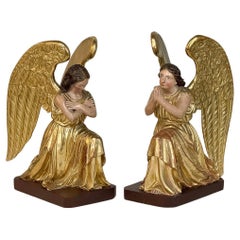
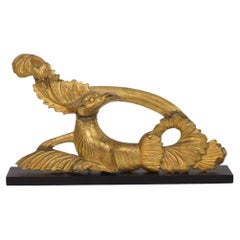
Italian 18th/ 19th Century Carved Giltwood Neo Classical Style bird Ornament
Located in Buisson, FR
Beautiful handcarved giltwood bird ornament.
Italy circa 1780-1820 . Weathered and small losses and old repairs
Measurements include the wooden base.
H:23cm W:41cm D:6,5cm
Category
Italian Neoclassical Antique 18th Century and Earlier Figurative Sculptures
Materials
Wood
$472 Sale Price
50% Off
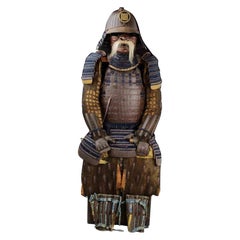
A Tosei Gusoku (Samurai
s Armour), 17th Century
Located in Roma, IT
Belonging to the period 1603-1867, most likely between the end of 17th and the beginning of 18th Century, this beautiful armour is a 32-plate suji kabuto made of brown-lacquered iron...
Category
Japanese Antique 18th Century and Earlier Figurative Sculptures
Materials
Metal, Iron
$20,093 Sale Price
30% Off
15th Century Burgundian Low-Relief Depicting Scenes of the Nativity
Located in Saint-Ouen, FR
Provenance : In the same private collection for several generations, Burgundy.
The canonical Gospels describe briefly the episode of the Nativity. It comprises three parts :
• The Preludes : the Journey to Bethlehem, the Census
• The Nativity
• The Announce to the Shepherds and the Adoration of the Magi
Only the Gospel according to Matthew (2, 1-12) speaks about the Adoration of the Magi. Staying vague about their number it does say they brought the newborn gold, incense and myrrh. The apocryphals, the fathers of the Church and many other authors have filled in the gaps of the evangelic tale. The sobriety and symbolic of the story have been a huge inspiration to artists. Although one of the oldest depictions of the Adoration of the Magi dates from the 2nd century the theme became very popular in Christian art during the late 14th century. One of the reasons explaining this success is that it celebrates both the Virgin and Christ at the same time.
This important walnut panel is carved in a strong relief and depicts the different steps of the story of Jesus’ birth.
On the left, the donkey and ox that have accompanied Mary and Joseph from Bethlehem are depicted behind a trough. On the thatch roof appears the star that would guide the magi to the place of birth of Jesus.
Mary is wearing a veil and is seating on a bed. She holds her baby at arm’s length to present him to the magi. Saint Joseph is by her side. The old man is holding a cane in his left hand while from the right hand he seems to uncover himself to greet the visitors.
A woman assists to the scene.
In front of the holy family the three magi stand behind one another to pay their homage to the newborn.
The first magi has a pointed beard. He is already kneeling out of deference and has placed his crown to his feet. He gives the baby a hanap filled with gold coins. This is Melchior as the legend describes him with white hair and a long beard.
Caspar, the second magi bears a cup of incense. He is looking at the third magi and with his right hand he points to the star that has guided them there. He has a short beard and wears crakow shoes, breeches and a wide sleeved doublet.
Finally Balthazar, the elegant last magi proceeds proudly towards the holy family with his one hand on the saber’s hilt and the other holding a cup. He brings the divine child the myrrh. He probably just dismounted as the horse can be seen behind him.
The scene is set in a very detailed and narrative decor. In the right part of the panel the shepherd receive the announce of Jesus’ birth. An angel comes down from heaven with a scroll bearing the good news in his hands. The herding dog sleeps peacefully while sheeps graze. At the top of the cliff we notice the gilded sheeps enclosure.
The panel’s moulded frame is carved with a foliated decor. In it’s centre appears a coat-of-arms. It is the alliance of the three magi’s arms. Indeed as it was common for legendary figures the three of them received imaginaries coat-of-arms. Thus, on a field of azure stands a star for Melchior, a crescent for Caspar and a pennon for Balthazar.
This high-relief panel is undeniably the work of a very skilled and imaginative artist. This key moment in the New Testament is transposed to a contemporary environment thanks to the figures’ clothing and the rural daily life scene. This way the universal dimension of the episode is highlighted allowing a better understanding for the contemporaries.
The sculptor has represented the episodes of the Adoration of the Magi and the Announce to the Shepherd with great talent and numerous details giving life to a picturesque and narrative scene. The important traces of polychromy give those already very animated scenes a stronger pictorial power and a rich dynamism.
Because of the picturesque and familiar realism so dear to the artists of the late Medieval era, of the didactic function of this type of panel as well as the quality of the sculpture this piece is an astounding example of Burgundian art of the 15th century.
Literature
Louis Réau, Iconographie de l’Art chrétien...
Category
French Gothic Antique 18th Century and Earlier Figurative Sculptures
Materials
Walnut
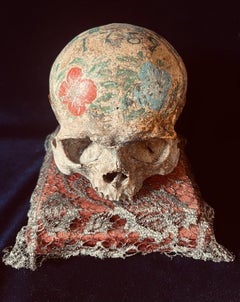
Antique Painted Memento Mori Skull, Dated 1769 Birth Year of Napoleon I
Located in Doha, QA
A truly extraordinary and evocative object: an 18th century hand-carved wooden skull, richly hand-painted and inscribed with the date 1769. This rare Memento Mori was created as a me...
Category
French Baroque Antique 18th Century and Earlier Figurative Sculptures
Materials
Wood, Paint
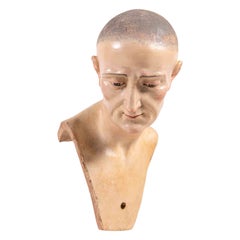
Head of Man, Italy, 18th Century
Located in Roma, IT
Head of man is a sculpture realized in polychrome ceramic with glass eyes.
Neaples, 18th Century.
Very good condition.
Category
Italian Antique 18th Century and Earlier Figurative Sculptures
Materials
Ceramic
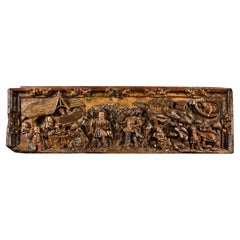
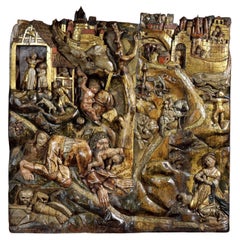
Wood Low-Relief Depicting a Werewolf and Saint George
Located in Saint-Ouen, FR
Exceptional polychrome wood low-relief depicting a werewolf and saint george after a woodcut by lucas cranach (“DER WERWOLF” 1512)
Provenance :
collection Brimo de Laroussihle
colle...
Category
German Renaissance Antique 18th Century and Earlier Figurative Sculptures
Materials
Wood
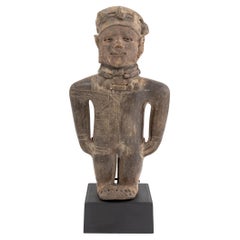
Pre-Columbian Standing Male Nude Figure
Located in Astoria, NY
Pre-Columbian Standing Male Nude Figure, probably Aztec, black burnished terracotta, mounted on ebonized wood base. 14.5" H x 7" W x 4.5" D. Provenance: From an Upper East Side Colle...
Category
Central American Pre-Columbian Antique 18th Century and Earlier Figurative Sculptures
Materials
Terracotta
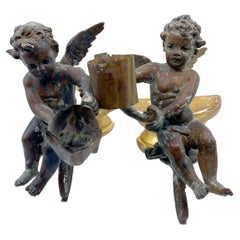
Pair Antique Bronze Patinated Putti Angel Sconces
Located in New York, NY
Pair antique bronze patinated angel putti sconces. Italian late 17th century bronze putti with exceptional modeling seated on scrolled arms each ex...
Category
Italian Baroque Antique 18th Century and Earlier Figurative Sculptures
Materials
Bronze
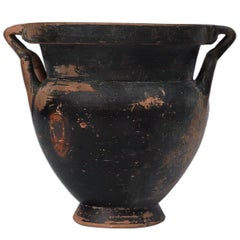
Greek Black Glazen Column Krater (4th Century BC)
Located in Soho, London, GB
Black Glazen Column Krater
mid-4th century BC, Apulia
With broad avoid body on a short echinus foot and thick mouth.
The two handles form loops around the...
Category
Italian Classical Greek Antique 18th Century and Earlier Figurative Sculptures
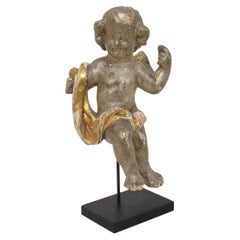
18th Century Italian Baroque Angel Figure
Located in Buisson, FR
Wonderful angel figure
Italy, circa 1750. Weathered , losses
Measurement includes the wooden base.
Treated against woodworm.
H:36cm W:19cm D:19cm
Category
Italian Baroque Antique 18th Century and Earlier Figurative Sculptures
Materials
Wood
$807 Sale Price
45% Off
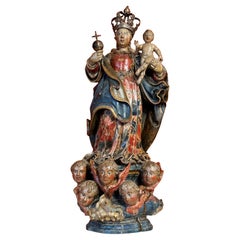
Baroque Virgin and Child in Polychrome Wood with Silver Crown, Spain, 17th Centu
Located in Madrid, ES
Baroque Virgin and Child in Polychrome Wood with Silver Crown, Spain, 17th Century
An important Spanish Baroque sculpture of the Virgin and Child, datable to the 17th century, made ...
Category
Spanish Baroque Antique 18th Century and Earlier Figurative Sculptures
Materials
Silver
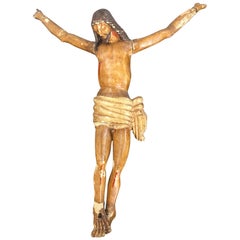
18th Century Carved Wooden Representing Christ on the Cross
Located in Miami, FL
Carved wooden representing Christ on the cross.
Category
Spanish Neoclassical Antique 18th Century and Earlier Figurative Sculptures
Materials
Wood, Paint
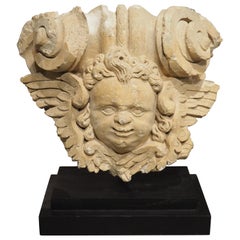
A 17th Century Mounted French Limestone Carving of a Winged Angel
Located in Dallas, TX
Originally part of a larger architectural from a French building in the 1600s, this hand-carved limestone fragment of a winged angel has been mounted more recently to a painted black...
Category
French Baroque Antique 18th Century and Earlier Figurative Sculptures
Materials
Stone, Limestone, Metal
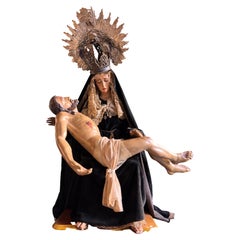
Amazing Spanish Baroque Pietà in Polychrome Wood with Silver Crown, 18th Century
Located in Madrid, ES
Amazing Spanish Baroque Pietà in Polychrome Wood with Silver Crown, 18th Century
Impressive large-format Spanish Pietà, carved in wood and polychromed, datable to the late 18th cent...
Category
Spanish Baroque Antique 18th Century and Earlier Figurative Sculptures
Materials
Silver
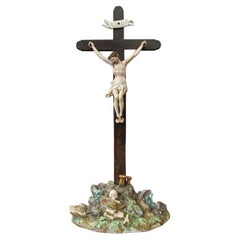
SECOND HALF OF THE 18th CENTURY MEISSEN PORCELAIN CRUCIFIX
Located in Firenze, FI
Beautiful polychrome porcelain crucifix from the Meissen factory, one of the oldest and most prestigious European porcelain manufacturers. The brand...
Category
Italian Antique 18th Century and Earlier Figurative Sculptures
Materials
Porcelain, Wood, Paint
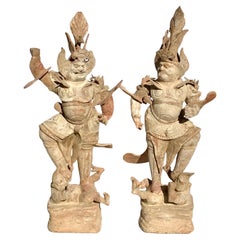
Large Tang Dynasty Pottery Painted Lokapalas Sculptures 28 Inches
Located in Dallas, TX
Tang Dynasty Pair of Painted Pottery Lokapalas
Tang Dynasty (618-907),
Height: 27.25 x 11.5 x 7" each
PROVENANCE: Weisbrod Chinese Art, Ltd., New York
Condition: Losses and resto...
Category
Chinese Tang Antique 18th Century and Earlier Figurative Sculptures
Materials
Pottery
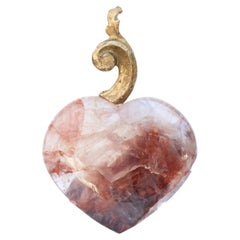
18th Century Italian Scroll Fragment on a Red and White Hematoid Quartz Heart
By Interi
Located in Dublin, Dalkey
18th century Italian gilded scroll fragment mounted on a polished red and white hematoid quartz heart. The piece is inspired by "The Sacred Heart" in Catholic art history which symbo...
Category
Italian Rococo Antique 18th Century and Earlier Figurative Sculptures
Materials
Quartz, Rock Crystal, Gold Leaf
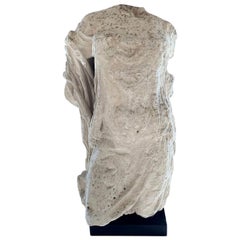
16th Century Stone Classical Roman Style Torso
Located in Vosselaar, BE
A wonderful 16th century draped female torso in classical style. Made in France under Italian Renaissance influence this female torso is finely sculpted with great detail to the stol...
Category
French Renaissance Antique 18th Century and Earlier Figurative Sculptures
Materials
Sandstone
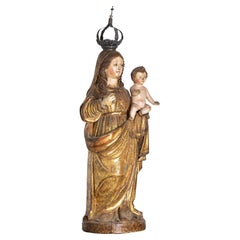
Portuguese Baroque Madonna and Child Religious Sculpture, 17th Century Statue
Located in Lisbon, PT
This late 17th-century Portuguese Baroque figure in polychromed wood depicts the Madonna holding the Christ Child, carved with exquisite detail and spiritual grace.
The Virgin is p...
Category
Portuguese Baroque Antique 18th Century and Earlier Figurative Sculptures
Materials
Gold Leaf
$17,659 Sale Price
20% Off
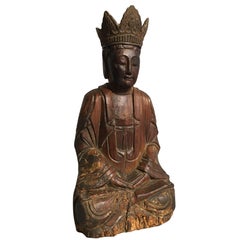
Chinese Carved Wood Bodhisattva Guanyin, Late Ming Dynasty, 17th Century
Located in Austin, TX
An attractive carved wood figure of the Bodhisattva Avalokiteshvara, known as Guanyin in China, late Ming Dynasty, early 17th century, China.
Guanyi...
Category
Chinese Ming Antique 18th Century and Earlier Figurative Sculptures
Materials
Gesso, Wood
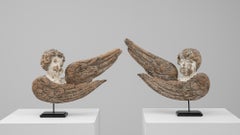
Pair of 18th Century French Wood Patinated Angels on Metal Stand
Located in High Point, NC
This pair of 18th Century French carved wooden angels embodies the charm and poetry of ecclesiastical art from the period. Each figure is depicted as a winged seraph, with expressive...
Category
French Antique 18th Century and Earlier Figurative Sculptures
Materials
Metal
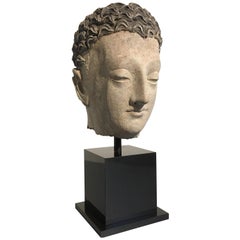
Gandharan Stucco Head of the Buddha, 3rd-5th Century
Located in Austin, TX
A sublime Greco-Buddhist stucco head of the Buddha, ancient region of Gandhara, circa 3rd-5th century.
A fragment of a larger statue, the Buddha's face...
Category
Pakistani Antique 18th Century and Earlier Figurative Sculptures
Materials
Stucco
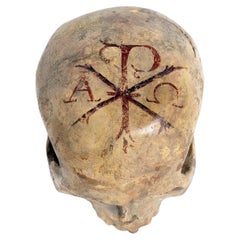
A Memento Mori in wood with Chrismon, monogram of Christ, Italy circa 1600.
Located in Milan, IT
A Memento Mori in wood with Chrismon, monogram of Christ. Valuable sculpture in fruit wood in almost true-to-life measurements, sculpted with art and finished with a wealth of detail...
Category
Italian Antique 18th Century and Earlier Figurative Sculptures
Materials
Wood
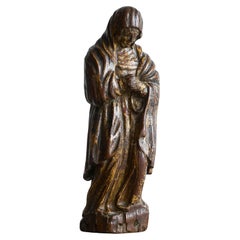
16th Century Mary Magdalene in Polychromed Carved Walnut
Located in Meer, VAN
Mary Magdalene in Polychromed Carved Walnut 16th Century
Devotional figure in carved wood, depicting Mary Magdalene. Walnut, most probably Flemish and from the 16th century.
It de...
Category
European Medieval Antique 18th Century and Earlier Figurative Sculptures
Materials
Walnut
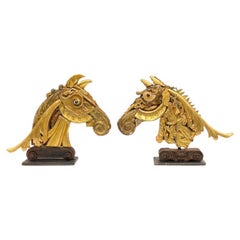
Pair of 18th Century Italian Gilt Fragment Horse Head Sculptures
By Interi
Located in Dublin, Dalkey
Pair of 18th century Italian gold-leaf fragment horse head sculptures.
The pair is made of 18th century Italian water-gilt fragments mounted on scroll wood bases. The fragments come...
Category
Italian Rococo Antique 18th Century and Earlier Figurative Sculptures
Materials
Gold Leaf
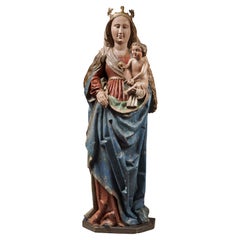
Important 15th Century Polychrome Wood Virgin and Child
Located in Saint-Ouen, FR
Important 15th century polychrome wood virgin and child
Origin: Southern Germany
Period: Late 15th Century, Ca. 1480-1490
Height : 125 cm
Polychrome limewood
Good condition
Provenance : Private collection, Alsace, France.
As soon as 1430, sculpture starts a major and deep stylistic evolution than will unfold over a century, until around 1530. We call it the International Gothic. This production is particularly interested in a quest for realism.
This important Virgin and Child wears a long red dress with a round gilded neckline. A delicate golden belt...
Category
Antique 18th Century and Earlier Figurative Sculptures
Materials
Wood
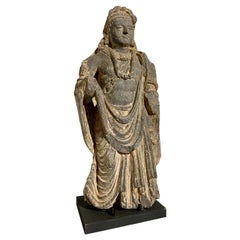
Gandharan Standing Bodhisattva Maitreya, Carved Black Schist, 2nd-4th Century
Located in Austin, TX
An impressive and well carved Gandharan figure of the Bodhisattva Maitreya, the Buddha of the Future, carved black schist, ancient Kingdom of Gand...
Category
Pakistani Antique 18th Century and Earlier Figurative Sculptures
Materials
Schist
Still Thinking About These?
All Recently ViewedMore Ways To Browse
Thai Musician
The Dying Gaul
Torso Brass
Vintage Pin Holder
War Statue
Water Maiden
Winged Cherubs Sculpture
Winged Mercury
Woman Ceramic Figurine
15th Century Angel
1880s Bronze Sculptures
1960s Mannequin
African Bronze Figure
Alabaster Head Sculpture
Alabaster Plinth
Alexandra Feodorovna
Andrea Del Verrocchio
Antique German Gnomes