1860s Furniture
to
276
1,641
782
2,470
627
76
46
34
29
28
27
25
18
13
8
7
6
4
3
1
40,482
136,134
538,647
287,129
85,757
258,274
124,778
12,644
5,519
18,579
22,833
19,212
53,747
71,082
60,921
21,652
9,457
1,050
709
396
262
242
1,689
688
600
497
143
2,470
2,470
2,470
29
20
14
10
10
Period: 1860s
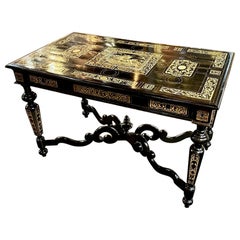
Italian Ebony and Ivory Inlaid Center Table
Located in Dallas, TX
Rare 19th century Italian ebony and ivory inlaid center table. Circa 1860. Sure to make a statement!
Category
Antique 1860s Furniture
Materials
Ivory, Wood
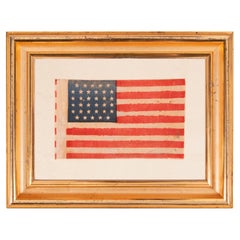
34 Star Antique American Parade Flag, Kansas Statehood, ca 1861-1863
Located in York County, PA
34 STAR ANTIQUE AMERICAN FLAG WITH A LINEAL ARRANGEMENT THAT I HAVE TERMED "GLOBAL ROWS, WITH EXCEPTIONAL COLOR AND CRUDE YET BEAUTIFUL FEATURES, OPENING TWO YEARS OF THE CIVIL WAR, ...
Category
American Antique 1860s Furniture
Materials
Cotton

Price Upon Request
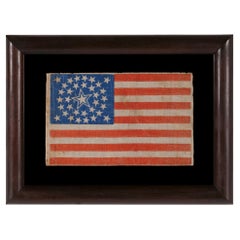
34 Star Antique American Flag with Hourglass Medallion Stars, ca 1861-1863
Located in York County, PA
EXTRAORDINARY 34 STAR ANTIQUE AMERICAN FLAG WITH AN ACCORDION OR HOURGLASS MEDALLION CONFIGURATION THAT SURROUNDS A PENTAGON OF STARS IN THE CENTER; MADE OF FINE SILK AND ENTIRELY HAND-SEWN; MADE DURING THE OPENING YEARS OF THE CIVIL WAR (1861-63), IN A TINY SIZE AMONG ITS COUNTERPARTS OF THE PERIOD; REFLECTS THE ADDITION OF KANSAS AS THE 34TH STATE
34 star flag of the Civil War period with an array of rare, beautiful, and otherwise desirable features. Extremely small among flags of this period with pieced and sewn construction, the flag displays a star pattern that is not only highly unusual, but unique to this particular example. This consists of a single star in the very center, surrounded by a pentagon of stars, flanked by angular bracket of three stars to either side. Above and below are rows of 5 stars, followed by rows of 6 that line the top and bottom of the canton. The resulting configuration is what I have termed an “accordion medallion,” though “hourglass medallion” or “standing bow tie” would be perfectly acceptable.
When rotated 90 degrees, to view the harder-to-identify, bow tie formation, students of early star patterns may note the visual similarity between this and what I call “Starburst” or “Crosshatch” medallions. The pattern, however, conspicuously lacks the crosses of St. Andrew (a saltire) and St. George (roman cross), that would allow it to be more accurately categorized as such.
Entirely hand-sewn, the canton and stripes of the flag are made of fine silk. The hemming of this was accomplished with great skill. The top and bottom edges are selvedge. These are so similar in nature as to have come from the same maker. There is a white, silk binding along the hoist, in the form of an open sleeve, through which a length of braided hemp rope was passed, expertly looped and re-braided into itself at the top and bottom for strength.
The stars are made of white, polished cotton. These were stitched to both sides (double-appliqued). Note how the edges of the fabric were not turned under, providing evidence of the fact that the maker was not especially skilled in appliqueing. This was common, as applique work was far more difficult than producing French seams.
In the 19th century, most flags with pieced and sewn construction were 8 feet long and larger. A six-footer was considered small. Even military battle flags, carried on foot, measured 6’ x 6.5’, which translates into approximately 7’ x 7.5’ after framing, about the size of an average quilt and larger than can comfortably fit on a wall in a house with 8-foot ceilings and average width baseboard. Flags smaller than this were produced both commercially and at home, but the smaller they are, the more unusual they are. At just 26.5 x 46.5 inches, this flag is extremely small for a Civil war period flag with sewn construction.
Silk was both beautiful and lightweight, which made it elegant for military unit colors and preferable for flags meant to be carried on foot. Most outdoor use flags...
Category
American Antique 1860s Furniture
Materials
Silk
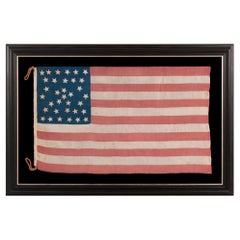
34 Star Antique American Parade Flag, Kansas Statehood, ca 1861-1863
Located in York County, PA
34 STARS IN A MEDALLION CONFIGURATION ON AN ANTIQUE AMERICAN PARADE FLAG WITH A LARGE, HALOED CENTER STAR; CIVIL WAR PERIOD, KANSAS STATEHOOD, 1861-1863
34 star American national pa...
Category
American Antique 1860s Furniture
Materials
Cotton
Price Upon Request
34 STAR AMERICAN FLAG, CIVIL WAR, 1861-63, KANSAS STATEHOOD, 2nd KY CAVALRY
Located in York County, PA
34 STAR ANTIQUE AMERICAN FLAG OF THE CIVIL WAR PERIOD (1861-63), IN A TINY SCALE AMONG PIECED-AND-SEWN FLAGS OF THE PERIOD, WITH A TRIPLE-WREATH CONFIGURATION, AN ELONGATED FORMAT, AND ENTIRELY HAND-SEWN; FOUND WITH A LETTER FROM JOHN W. RUDE OF THE 2ND KENTUCKY VETERAN VOLUNTEER CAVALRY (UNION):
34 star flag of the Civil War period with a variety of extremely desirable features, handed down with a letter written by John W. Rude on November 8th, 1864, while encamped with the Army’s 1st Brigade, 3rd Division, as a member of the 2nd Regiment of Veteran Volunteer Cavalry. Tiny in scale among pieced and sewn examples, the flag displays a star pattern that consists of a three consecutive wreaths, with a single star in the very center. Because it lacks a single star in each corner, outside the basic pattern—usually present in flags of this design made during the mid-late 19th century—this is something I classify as a “snowball medallion.” Entirely hand-sewn throughout, note the square format of the blue canton, with its beautiful, circular star arrangement, and how interesting this combination is when paired with the elongated format of the flag itself. The stars are double-appliqued, meaning that they are applied to both sides. These are fat in shape and inconsistent in size. Note how the lowest star in the outermost ring actually dips into the white stripe below.
Made of plain weave cotton, there is a narrow binding along the hoist, red in color, with three sets of cotton ties. Those at the top and bottom are made of fine, braided hemp or hemp and cotton cord, stitched into place, while the one in the center, looped around the binding and tied, is made of lightweight, twisted, cotton thread. Note how the 5th, 6th, and 7th red stripes are pieced from two lengths of cotton fabric, which reflects that the maker was being conscious of conserving available fabric.
In the 19th century, most flags with pieced and sewn construction were 8 feet long and larger. A six-footer was considered small. Even military battle flags, carried on foot, measured 6’ x 6.5’, which translates into approximately 7’ x 7.5’ after framing, about the size of an average quilt and larger than can comfortably fit on a wall in a house with 8-foot ceilings and average width baseboard. Flags smaller than this exist, but the smaller they get, the more unusual they are. At just 1.5’ x 3’, this is about as small as one will ever encounter in a sewn flag of the Civil War era.
The flag appears to have likely been hand-carried. I expect that it probably saw military use of some sort as a camp flag...
Category
American Antique 1860s Furniture
Materials
Cotton
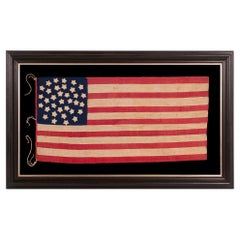
36 Star Antique American Parade Flag, with Canted Stars, ca 1864-1867
Located in York County, PA
36 STAR ANTIQUE AMERICAN PARADE FLAG WITH CANTED STARS IN DANCING ROWS, ON A BEAUTIFUL, CORNFLOWER BLUE CANTON; CIVIL WAR ERA, NEVADA STATEHOOD, 1864-1867
36 star antique American f...
Category
American Antique 1860s Furniture
Materials
Cotton
Price Upon Request
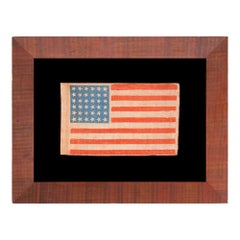
36 Star Antique American Flag, Cornflower blue Canton, circa 1864-1867, Nevada
Located in York County, PA
Antique American Flag With 36 Stars On A Cornflower Blue Canton, Civil War Era, 1864-1867, Reflects The Addition Of Nevada As The 36th State; A Great Folk Exaple With Haphazard Rows Of Starfish-like Stars:
36 star American national flag of the Civil War era with outstanding collector traits. Haphazard rows of fat, starfish-shaped stars fill most of the confines of a brilliant, cornflower blue canton. Note the crude piecing of the thirteen, red and white stripes, joined in an ill-planned manner that results in great variation in width, as well as general irregularity. The 4th red stripe actually falls slightly below the canton, and the height of each does not line up with the corresponding stripe on the reverse. This can clearly be seen at the fly end, which is is turned back and bound to repair obvious extended use in an outdoor environment. Clearly the maker lacked experience in seam work. Lining up the necessary components, so that they could be viewed on both sides, presented a challenge they may have not previously faced. This is also evident in the sewing of the stars, which do not line up on the obverse and reverse sides, as they typically would in a flag sewn by an experienced flag-maker. That said, this is just this kind of homemade charm that fuels interest in early American flags...
Category
American Antique 1860s Furniture
Materials
Cotton
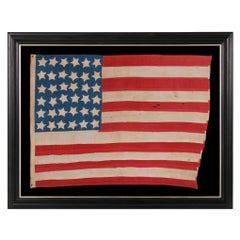
34 Stars in an Outstanding Oval Medallion Configuration, Civil War Period
Located in York County, PA
34 STARS IN AN OUTSTANDING OVAL MEDALLION CONFIGURATION, ON A NARROW CANTON THAT RESTS ON THE 6TH STRIPE, ON A HOMEMADE, ANTIQUE AMERICAN FLAG OF THE CIVIL WAR PERIOD, ENTIRELY HAND-...
Category
American Antique 1860s Furniture
Materials
Cotton
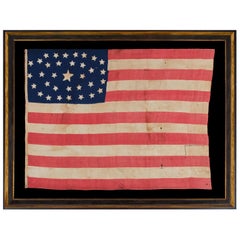
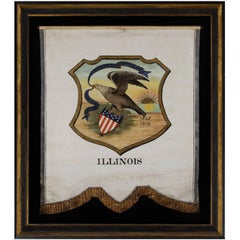
Hand-Painted 19th Century Banner with the 1867 Proposed Seal of Illinois
Located in York County, PA
HAND-PAINTED 19TH CENTURY BANNER WITH AN 1867 VERSION OF THE SEAL OF THE STATE OF ILLINOIS, PROPOSED IN THAT YEAR BY THE SECRETARY OF STATE, BUT IN A VARIATION NEVER FORMALLY ADOPTED
Banner with the Illinois State Seal, in a rare variation of the design, never adopted. In 1867 Illinois Secretary of State Sharon Tyndale proposed that the phrases in the state motto be reversed. In the wake of the Civil War, (which ended in 1865,) Tyndale suggested that the verbiage be changed from "State Sovereignty--National Union" to "National Union--State Sovereignty,” which made sense given the recent secession of the Southern States, which placed their own interests first. Illinois' own Abraham Lincoln had worked hard to preserve national interests, echoed here in the altering of the language. Though Tyndale’s suggestion was rejected, he was nonetheless charged with creating a new design, which he did and was soon adopted. This displayed the dates of "1818," when Illinois became a state, and "1868," when the seal was officially changed. Interestingly enough, Tyndale did manage to send a message in the new version by turning the word “sovereignty” upside-down , with the surmised explanation that this fit accordingly with the orientation / position of the streamer.
The banner is beautifully hand-painted on muslin and retains its original staff. The shape is beautifully scalloped at the bottom edge, which is painted to look as if there is an applied fringe. Most of the elements are congruent with the 1868 version, but there are various differences. Set within a shield-shaped medallion—usually circular—is the expected eagle in a side view, spread wing pose with beak uplifted. The eagle is supposed to be perched upon a rock with one talon, while gripping a Federal shield in the other. Here there is no rock and both talons grip the shield, which displays 13 stars. Note the date of "1867" and Tyndale's preferred order of the wording on the billowing ribbon in the eagle's beak. The foreground of the official design is all grass. Here there are olive branches—a peacetime reference appropriate for a country recovering from war—on a grassy area, set upon a sandy shore before Lake Michigan, with a rising sun on the horizon.
Mounting: The banner was mounted and framed within our own conservation department, which is led by masters degree trained staff. We take great care in the mounting and presentation of flags and have preserved thousands of examples; more than anyone worldwide.
The background is 100% cotton twill, black in color. The mount was placed in a black-painted, hand-gilded and distressed Italian molding. A shadowbox was created to accommodate the staff. The glazing is U.V. protective plexiglass. Feel free to contact us for more details.
Banner - 49" x 56.5"
Frame - 67.75" x 59.25"
About Jeff R. Bridgman Antiques, Inc.:
As an advisor to top museums and collectors alike, Jeff Bridgman is the world's leading expert and source for antique American flags and political textiles...
Category
American Antique 1860s Furniture
Materials
Cotton
Price Upon Request
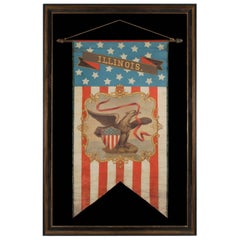
Hand-Painted Patriotic Banner With The Seal of the State of Illinois
Located in York County, PA
HAND-PAINTED PATRIOTIC BANNER WITH THE SEAL OF THE STATE OF ILLINOIS AND GREAT FOLK QUALITIES PROBABLY MADE FOR THE 1868 DEMOCRAT NATIONAL CONVENTION...
Category
North American Antique 1860s Furniture
Materials
Canvas
Price Upon Request
Still Thinking About These?
All Recently ViewedMore Ways To Browse
Blue And White Lidded Temple Jars
Blue Uranium Glass
Blue White Clock
Blue Yellow Pottery
Boffi Kitchen
Bombay Chest Italy
Book Table Stand
Boudoir Set
Brands Of Vintage Glass
Brass Heron Sculpture
Bread Cabinet
Bronze Lalanne
Bronze Spoons
Burl Bedside Chests
Burled Walnut Desk
Burnished Bamboo
Butter Table
Cabinet Dowel