Pennsylvania - Art

to
130
1,903
1,199
994
611
543
Overall Width
to
Overall Height
to
8
175
2,682
2,385
113
169
291
283
254
269
130
98
74
77
6
1,536
586
88
86
42
20
12
10
6
5
5
5
4
2,569
1,547
560
2,883
1,674
1,455
767
631
546
368
333
328
278
272
220
209
202
189
166
158
153
143
129
3,551
1,914
1,370
1,245
1,222
216
120
106
86
84
2,331
157
228,985
155,607
Item Ships From: Pennsylvania
Like Sand Through the Hourglass
By Kelly Kozma
Located in Philadelphia, PA
This piece titled "Like Sand Through the Hour Glass" is an original artwork made from collage, hand embroidery, and latex paint on canvas by Kelly Kozma. This piece is shipped in the...
Category

21st Century and Contemporary Contemporary Pennsylvania - Art

Materials

Thread, Paper

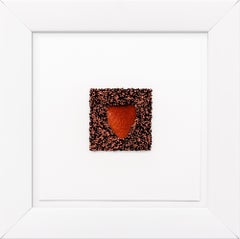
My Jam
By Kelly Kozma
Located in Philadelphia, PA
This piece titled "My Jam" is an original artwork made from collage, hand embroidery, and latex paint on canvas by Kelly Kozma. This piece is shipped in the pictured white frame and ...
Category

21st Century and Contemporary Contemporary Pennsylvania - Art

Materials

Thread, Paper

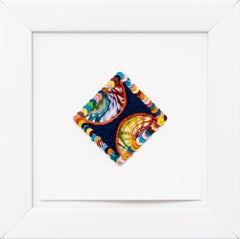
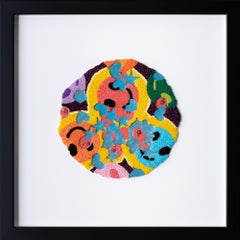
Whirly Pop
By Kelly Kozma
Located in Philadelphia, PA
This piece titled "Whirly Pop" is an original artwork made from collage, hand embroidery, and latex paint on canvas by Kelly Kozma. This piece is shipped in the pictured white frame ...
Category

21st Century and Contemporary Contemporary Pennsylvania - Art

Materials

Thread, Paper

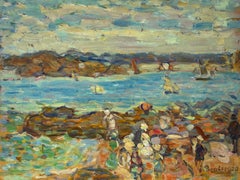
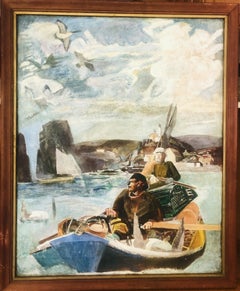
Study St. Malo
Located in Bryn Mawr, PA
Provenance The Artist; Charles Prendergast (acquired from the above in 1924); Mrs. Charles Prendergast (thence by descent from theabove in 1948); Kraushaar Galleries, New York; Mr...
Category

Early 1900s Post-Impressionist Pennsylvania - Art

Materials

Oil, Wood Panel

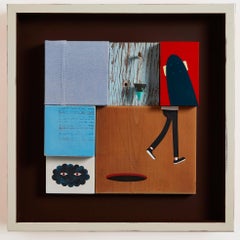
"A FLATNESS IN THE EYES", Assemblage Wall-Hanging, Found Objects, Threat, Paint
By Jim Houser
Located in Philadelphia, PA
This artwork "A FLATNESS IN THE EYES" is an original assemblage artwork by Jim Houser. Incorporating various dimensional elements and techniques, such as painting and found objects, ...
Category

2010s Contemporary Pennsylvania - Art

Materials

Thread, Found Objects, Acrylic

Home Plate 12
By Lauren Rinaldi
Located in Philadelphia, PA
This piece titled "Home Plate 12" is an original artwork made from oil paint and acrylic on panel by Lauren Rinaldi. This piece is freestanding and measures...
Category

21st Century and Contemporary Contemporary Pennsylvania - Art

Materials

Oil, Acrylic, Wood Panel

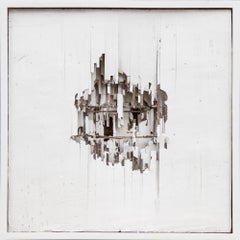
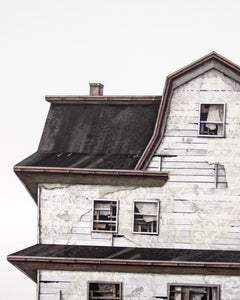
"Lath Study II", deteriorating architecture, framed wall-hanging white sculpture
By Seth Clark
Located in Philadelphia, PA
"Lath Study II" is an original wood, joint compound, and white paint sculpture by Seth Clark measuring 24”h x 24”w x 2.75”d. This piece ships ready-to-hang framed as pictured. "My ...
Category

21st Century and Contemporary Contemporary Pennsylvania - Art

Materials

Wood, House Paint

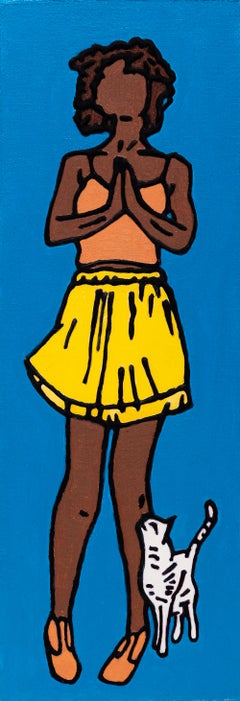
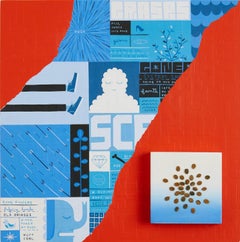
Superpowers
By Kelly Kozma
Located in Philadelphia, PA
This fabric work titled "Squeaking By" is an original artwork by Kelly Kozma made of hand embroidery, stickers, glitter paper and acrylic paint on paper. The piece measures 13”h by 1...
Category

21st Century and Contemporary Pennsylvania - Art

Materials

Fabric, Thread, Found Objects

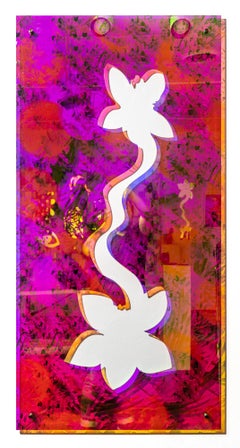
Orchid Panel
By Roxana Azar
Located in Philadelphia, PA
This Mixed Media piece titled "Orchid Panel" is an original artwork by Roxana Azar made of a digital print on acrylic. The piece measures 47.5”h x 23.5”w x 1”d. Roxana Azar’s work ...
Category

21st Century and Contemporary Contemporary Pennsylvania - Art

Materials

Digital, Lucite, Pigment

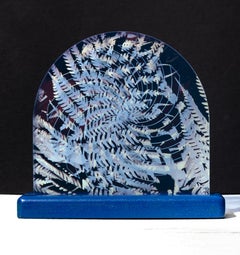
"Fern Spiral Series 3" Iridescent, Dichroic material, Botanical, sculpture
By Roxana Azar
Located in Philadelphia, PA
This Mixed Media piece titled "Fern Spiral Series 3" is an original artwork by Roxana Azar made of an etched fluorescent acrylic. The piece measure...
Category

21st Century and Contemporary Contemporary Pennsylvania - Art

Materials

Mixed Media, Lucite, Pigment

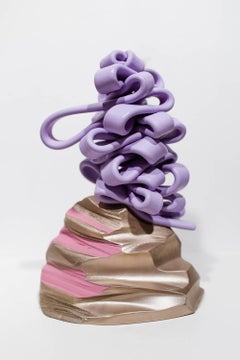
Fuzzy Memories
By John Oliver Lewis
Located in Philadelphia, PA
"Fuzzy Memories" is an original, painted ceramic sculpture by John Oliver Lewis measuring 7.5”h x 5”w x 3.5”d. ABOUT // Originally from Wisconsin, John Oliver Lewis currently lives ...
Category

21st Century and Contemporary Abstract Pennsylvania - Art

Materials

Ceramic, Acrylic

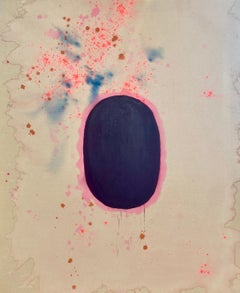
Holi powder Tantra painting #2 - Colorful abstract tantric stain painting
Located in Philadelphia, PA
'Holi powder Tantra painting #2' acrylic painting by contemporary artist Elisa Niva 36”x44” Acrylic and powder on cotton canvas One of the main inspir...
Category

2010s Abstract Pennsylvania - Art

Materials

Acrylic, Cotton Canvas

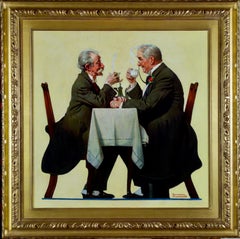
Men Drinking Coffee
By Norman Rockwell
Located in Fort Washington, PA
Signed by Artist Lower Right Maxwell House Coffee
Category

1920s Pennsylvania - Art

Materials

Oil

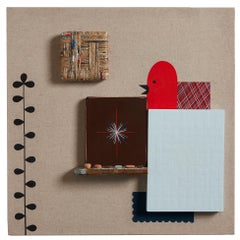
KINDS OF PLANTS
By Jim Houser
Located in Philadelphia, PA
"KINDS OF PLANTS" is an original assemblage artwork by Jim Houser measuring 18" x 18". Jim Houser was born in 1973 in Philadelphia, Pennsylvania, the city where he currently reside...
Category

21st Century and Contemporary Contemporary Pennsylvania - Art

Materials

Wood, Found Objects, Acrylic

No Longer Listening
By Jedediah Morfit
Located in Philadelphia, PA
This figurative sculpture titled "No Longer Listening" is an original artwork by Jedediah Morfit made of sculpamold, wood, resin, foam, wood, hardware, acrylic, tape. This piece meas...
Category

21st Century and Contemporary Contemporary Pennsylvania - Art

Materials

Foam, Resin, Wood, Tape, Acrylic

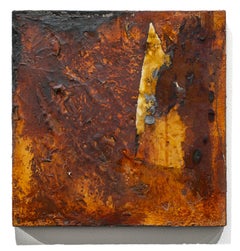
"Salvaged", Mixed Media on Panel, Abstract, Texture
By Lorena Sferlazza
Located in Philadelphia, PA
This orange, brown, and yellow abstract artwork titled "Salvaged" is an original artwork by Lorena Sferlazza made of mixed media on panel. The ...
Category

21st Century and Contemporary Contemporary Pennsylvania - Art

Materials

Panel

Untitled 171215
By Ryan Beck
Located in Philadelphia, PA
"Untitled 171215" is an original acrylic and acrylic transfer on panel painting by Ryan Beck measuring 16"h x 16"w. Ryan Beck works in an abstract style that aims to link contempora...
Category

21st Century and Contemporary Abstract Pennsylvania - Art

Materials

Acrylic, Panel

"House Studies Series V", Layered Paper and Drawing Collage, Architectural
By Seth Clark
Located in Philadelphia, PA
This layered paper and drawing collage titled "House Studies Series V" is an original artwork by Seth Clark made of paper, charcoal, pastel, graphite, and acrylic on wood. Through a ...
Category

21st Century and Contemporary Contemporary Pennsylvania - Art

Materials

Wood, Paper, Charcoal, Pastel, Mixed Media, Acrylic, Graphite

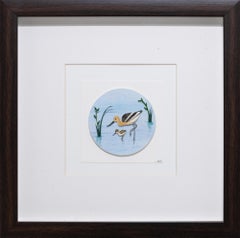
American Avocet with chick
By Nayan and Venus
Located in Philadelphia, PA
"American Avocet with chick" is an original watercolor and layered hand-cut paper artwork by Nayan and Vaishali measuring 10.25”h x 10.25”w framed
....
Category

21st Century and Contemporary Pennsylvania - Art

Materials

Paper, Watercolor

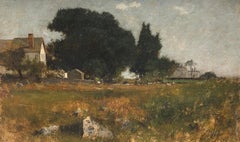
New England Farmhouse
By Robert Swain Gifford
Located in Bryn Mawr, PA
Provenance The artist; By descent in the family to the artist's great-grandaughter, until 2023 Born on a small island near Martha's Vineyard, R. Swain Gifford and his family moved t...
Category

Late 19th Century Barbizon School Pennsylvania - Art

Materials

Canvas, Oil

Strange Terrain, Contemporary Oil Landscape Painting by Matt Higgins
Located in Philadelphia, PA
This piece was created with generous brushstrokes of oil paint, loosely referencing a desert landscape. The title Strange Terrain comes from the nature of the painting being in an i...
Category

2010s Contemporary Pennsylvania - Art

Materials

Oil

Dead King 11 [12th Century Polish Lord]
By Kate Glasheen
Located in Philadelphia, PA
"Dead King 11 [12th Century Polish Lord]" is an original ink drawing on archival paper by Kate Glasheen measuring 20.75”h x 16.75”w when framed. The piece sh...
Category

21st Century and Contemporary Contemporary Pennsylvania - Art

Materials

Ink, Archival Paper

Dead King 29 [18th Century Polynesian King]
By Kate Glasheen
Located in Philadelphia, PA
This wall-hanging artwork titled "Dead King 29 [18th Century Polynesian King]" is an original artwork by Kate Glasheen made of pen and ink on archival paper....
Category

21st Century and Contemporary Contemporary Pennsylvania - Art

Materials

Ink, Archival Paper, Pen

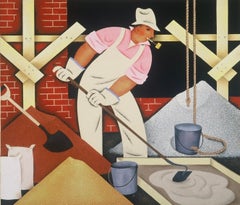
House Beautiful Cover Proposal. American Scene Social Realism Industrial WPA
By Antonio Petruccelli
Located in New York, NY
House Beautiful Cover Proposal. American Scene Social Realism Industrial WPA Antonio Petruccelli (1907 – 1994) Mixing Mortar 12 1/2 X 14 3/4 inche...
Category

1930s American Modern Pennsylvania - Art

Materials

Gouache, Board

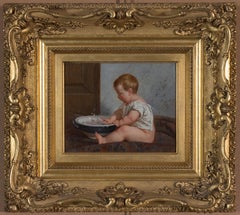
"Tempest in a Teapot" a charming painting of a baby playing with a bowl of water
By Timoleon Marie Lobrichon
Located in Philadelphia, PA
Timoleon Lobrichon (1831-1914) French Tempest in a Teapot Oil on canvas, 6 1/2 x 8 1/4 inches FRAMED: 16 1/2 x 15 inches Signed at lower left: [indistinct] This work is a related to...
Category

Late 19th Century Realist Pennsylvania - Art

Materials

Canvas, Oil

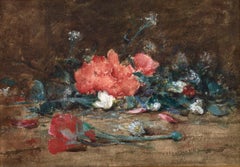
Flowers
By Julian Alden Weir
Located in Bryn Mawr, PA
Flowers, 1882 Gouache and watercolor on paper 14 x 20 1/8 inches (35.6 x 51.1 cm) Framed dimensions: 23 x 29 1/4 inches Signed and dated lower right: J. Alden Weir / '82 Signed lowe...
Category

1880s American Impressionist Pennsylvania - Art

Materials

Paper, Watercolor, Gouache

Untitled 190705
By Ryan Beck
Located in Philadelphia, PA
"Untitled 190705" is an original acrylic and acrylic transfer on canvas artwork by Ryan Beck measuring 18"h x 15"w. Ryan Beck works in an abstract style that aims to link contempora...
Category

2010s Contemporary Pennsylvania - Art

Materials

Canvas, Acrylic

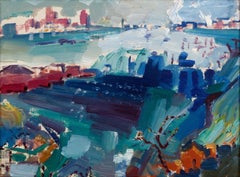
Weehawken Sequence
By John Marin
Located in Bryn Mawr, PA
Weehawken Sequence, c. 1910-16 Oil on canvas board, 9 x 12 inches (22.9 x 30.5 cm) Framed dimensions: 13 3/8 x 16 1/4 inches John Marin’s long and prolific career is best marked by ...
Category

20th Century American Modern Pennsylvania - Art

Materials

Canvas, Oil, Board

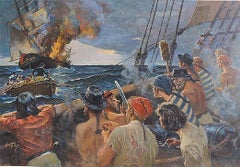
Pirates Destroying Ship
By Norman Mills Price
Located in Fort Washington, PA
Medium: Oil on Board Signature: Signed Lower Right Subject matter features pirates watching a ship burn from a distance a small rowboat with a figure returning to the ship after set...
Category

20th Century Pennsylvania - Art

Materials

Oil, Board

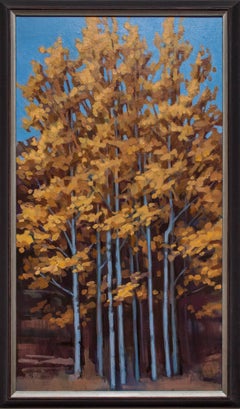
Brilliance
By Katherine Fraser
Located in Philadelphia, PA
"Brilliance" is an original oil painting by Katherine Fraser in a handmade wood frame measuring 29.75”h x 17.75”w, as pictured. This piece was originally on display at Paradigm Gallery + Studio in Katherine Fraser's solo exhibition "Far from the Tree." Bio // Katherine Fraser's artwork has been exhibited in galleries and museums throughout the United States. She is a graduate of the Pennsylvania Academy of the Fine Arts and of the University of Pennsylvania. As a student she received the Thomas Eakins Painting prize, the Cecelia Beaux Portrait prize, and the William Emlen Cresson Memorial Travel Award, among others. Since graduating in 2002, she has received awards including the Lucy Glick...
Category

21st Century and Contemporary Contemporary Pennsylvania - Art

Materials

Canvas, Oil

GRASPS
By Jim Houser
Located in Philadelphia, PA
"GRASPS" is an original dimensional, wall-hanging, assemblage work by Jim Houser measuring 12in x 12in. ABOUT // Jim Houser was born in 1973 in Philadelphia, Pennsylvania, the city...
Category

21st Century and Contemporary Contemporary Pennsylvania - Art

Materials

Paper, Acrylic, Wood Panel

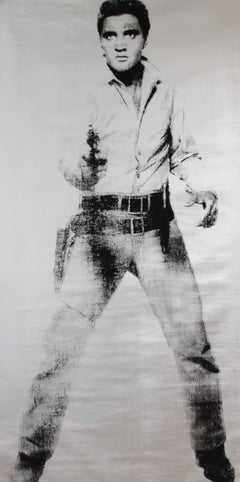
"Elvis", Denied Andy Warhol Silver Black Pop Art Painting by Charles Lutz
By Charles Lutz
Located in Brooklyn, NY
Elvis, Metallic Silver and Black Full Length Silkscreen Painting by Charles Lutz Silkscreen and silver enamel painted on vintage 1960's era linen with Artist's Denied stamp of the Andy Warhol Art Authentication Board. 82" x 40" inches 2010 Lutz's 2007 ''Warhol Denied'' series gained international attention by calling into question the importance of originality or lack thereof in the work of Andy Warhol. The authentication/denial process of the [[Andy Warhol Art Authentication Board]] was used to create value by submitting recreations of Warhol works for judgment with the full intention for the works to be formally marked "DENIED". The final product of the conceptual project being "officially denied" "Warhol" paintings authored by Lutz. Based on the full-length Elvis Presley paintings by Pop Artist Andy Warhol in 1964, this is likely one of his most iconic images, next to Campbell's Soup Cans and portraits of Jackie Kennedy, Marilyn Monroe, Liz Taylor, and Marlon Brando. This is the rarest of the Elvis works from the series, as Lutz sourced a vintage roll of 1960's primed artist linen which was used for this one Elvis. The silkscreen, like Warhol's embraced imperfections, like the slight double image printing of the Elvis image. Lutz received his BFA in Painting and Art History from Pratt Institute and studied Human Dissection and Anatomy at Columbia University, New York. Lutz's work deals with perceptions and value structures, specifically the idea of the transference of values. Lutz's most recently presented an installation of new sculptures dealing with consumerism at Frank Lloyd Wright's Fallingwater House in 2022. Lutz's 2007 Warhol Denied series received international attention calling into question the importance of originality in a work of art. The valuation process (authentication or denial) of the Andy Warhol Art Authentication Board was used by the artist to create value by submitting recreations of Warhol works for judgment, with the full intention for the works to be formally marked "DENIED" of their authenticity. The final product of this conceptual project is "Officially DENIED" "Warhol" paintings authored by Lutz. Later in 2013, Lutz went on to do one of his largest public installations to date. At the 100th Anniversary of Marcel Duchamp's groundbreaking and controversial Armory Show, Lutz was asked by the curator of Armory Focus: USA and former Director of The Andy Warhol Museum, Eric Shiner to create a site-specific installation representing the US. The installation "Babel" (based on Pieter Bruegel's famous painting) consisted of 1500 cardboard replicas of Warhol's Brillo Box (Stockholm Type) stacked 20 ft tall. All 1500 boxes were then given to the public freely, debasing the Brillo Box as an art commodity by removing its value, in addition to debasing its willing consumers. Elvis was "the greatest cultural force in the Twentieth Century. He introduced the beat to everything, and he changed everything - music, language, clothes, it's a whole new social revolution." Leonard Bernstein in: Exh. Cat., Boston, The Institute of Contemporary Art and traveling, Elvis + Marilyn 2 x Immortal, 1994-97, p. 9. Andy Warhol "quite simply changed how we all see the world around us." Kynaston McShine in: Exh. Cat., New York, Museum of Modern Art (and traveling), Andy Warhol: Retrospective, 1996, p. 13. In the summer of 1963 Elvis Presley was just twenty-eight years old but already a legend of his time. During the preceding seven years - since Heartbreak Hotel became the biggest-selling record of 1956 - he had recorded seventeen number-one singles and seven number-one albums; starred in eleven films, countless national TV appearances, tours, and live performances; earned tens of millions of dollars; and was instantly recognized across the globe. The undisputed King of Rock and Roll, Elvis was the biggest star alive: a cultural phenomenon of mythic proportions apparently no longer confined to the man alone. As the eminent composer Leonard Bernstein put it, Elvis was "the greatest cultural force in the Twentieth Century. He introduced the beat to everything, and he changed everything - music, language, clothes, it's a whole new social revolution." (Exh. Cat., Boston, The Institute of Contemporary Art (and traveling), Elvis + Marilyn 2 x Immortal, 1994, p. 9). In the summer of 1963 Andy Warhol was thirty-four years old and transforming the parameters of visual culture in America. The focus of his signature silkscreen was leveled at subjects he brilliantly perceived as the most important concerns of day to day contemporary life. By appropriating the visual vernacular of consumer culture and multiplying readymade images gleaned from newspapers, magazines and advertising, he turned a mirror onto the contradictions behind quotidian existence. Above all else he was obsessed with themes of celebrity and death, executing intensely multifaceted and complex works in series that continue to resound with universal relevance. His unprecedented practice re-presented how society viewed itself, simultaneously reinforcing and radically undermining the collective psychology of popular culture. He epitomized the tide of change that swept through the 1960s and, as Kynaston McShine has concisely stated, "He quite simply changed how we all see the world around us." (Exh. Cat., New York, Museum of Modern Art (and traveling), Andy Warhol: Retrospective, 1996, p. 13). Thus in the summer of 1963 there could not have been a more perfect alignment of artist and subject than Warhol and Elvis. Perhaps the most famous depiction of the biggest superstar by the original superstar artist, Double Elvis is a historic paradigm of Pop Art from a breath-taking moment in Art History. With devastating immediacy and efficiency, Warhol's canvas seduces our view with a stunning aesthetic and confronts our experience with a sophisticated array of thematic content. Not only is there all of Elvis, man and legend, but we are also presented with the specter of death, staring at us down the barrel of a gun; and the lone cowboy, confronting the great frontier and the American dream. The spray painted silver screen denotes the glamour and glory of cinema, the artificiality of fantasy, and the idea of a mirror that reveals our own reality back to us. At the same time, Warhol's replication of Elvis' image as a double stands as metaphor for the means and effects of mass-media and its inherent potential to manipulate and condition. These thematic strata function in simultaneous concert to deliver a work of phenomenal conceptual brilliance. The portrait of a man, the portrait of a country, and the portrait of a time, Double Elvis is an indisputable icon for our age. The source image was a publicity still for the movie Flaming Star, starring Presley as the character Pacer Burton and directed by Don Siegel in 1960. The film was originally intended as a vehicle for Marlon Brando and produced by David Weisbart, who had made James Dean's Rebel Without a Cause in 1955. It was the first of two Twentieth Century Fox productions Presley was contracted to by his manager Colonel Tom Parker, determined to make the singer a movie star. For the compulsive movie-fan Warhol, the sheer power of Elvis wielding a revolver as the reluctant gunslinger presented the zenith of subject matter: ultimate celebrity invested with the ultimate power to issue death. Warhol's Elvis is physically larger than life and wears the expression that catapulted him into a million hearts: inexplicably and all at once fearful and resolute; vulnerable and predatory; innocent and explicit. It is the look of David Halberstam's observation that "Elvis Presley was an American original, the rebel as mother's boy, alternately sweet and sullen, ready on demand to be either respectable or rebellious." (Exh. Cat., Boston, Op. Cit.). Indeed, amidst Warhol's art there is only one other subject whose character so ethereally defies categorization and who so acutely conflated total fame with the inevitability of mortality. In Warhol's work, only Elvis and Marilyn harness a pictorial magnetism of mythic proportions. With Marilyn Monroe, whom Warhol depicted immediately after her premature death in August 1962, he discovered a memento mori to unite the obsessions driving his career: glamour, beauty, fame, and death. As a star of the silver screen and the definitive international sex symbol, Marilyn epitomized the unattainable essence of superstardom that Warhol craved. Just as there was no question in 1963, there remains still none today that the male equivalent to Marilyn is Elvis. However, despite his famous 1968 adage, "If you want to know all about Andy Warhol, just look at the surface of my paintings" Warhol's fascination held purpose far beyond mere idolization. As Rainer Crone explained in 1970, Warhol was interested in movie stars above all else because they were "people who could justifiably be seen as the nearest thing to representatives of mass culture." (Rainer Crone, Andy Warhol, New York, 1970, p. 22). Warhol was singularly drawn to the idols of Elvis and Marilyn, as he was to Marlon Brando and Liz Taylor, because he implicitly understood the concurrence between the projection of their image and the projection of their brand. Some years after the present work he wrote, "In the early days of film, fans used to idolize a whole star - they would take one star and love everything about that star...So you should always have a product that's not just 'you.' An actress should count up her plays and movies and a model should count up her photographs and a writer should count up his words and an artist should count up his pictures so you always know exactly what you're worth, and you don't get stuck thinking your product is you and your fame, and your aura." (Andy Warhol, The Philosophy of Andy Warhol (From A to B and Back Again), San Diego, New York and London, 1977, p. 86). The film stars of the late 1950s and early 1960s that most obsessed Warhol embodied tectonic shifts in wider cultural and societal values. In 1971 John Coplans argued that Warhol was transfixed by the subject of Elvis, and to a lesser degree by Marlon Brando and James Dean, because they were "authentically creative, and not merely products of Hollywood's fantasy or commercialism. All three had originative lives, and therefore are strong personalities; all three raised - at one level or another - important questions as to the quality of life in America and the nature of its freedoms. Implicit in their attitude is a condemnation of society and its ways; they project an image of the necessity for the individual to search for his own future, not passively, but aggressively, with commitment and passion." (John Coplans, "Andy Warhol and Elvis Presley," Studio International, vol. 181, no. 930, February 1971, pp. 51-52). However, while Warhol unquestionably adored these idols as transformative heralds, the suggestion that his paintings of Elvis are uncritical of a generated public image issued for mass consumption fails to appreciate the acuity of his specific re-presentation of the King. As with Marilyn, Liz and Marlon, Warhol instinctively understood the Elvis brand as an industrialized construct, designed for mass consumption like a Coca-Cola bottle or Campbell's Soup Can, and radically revealed it as a precisely composed non-reality. Of course Elvis offered Warhol the biggest brand of all, and he accentuates this by choosing a manifestly contrived version of Elvis-the-film-star, rather than the raw genius of Elvis as performing Rock n' Roll pioneer. A few months prior to the present work he had silkscreened Elvis' brooding visage in a small cycle of works based on a simple headshot, including Red Elvis, but the absence of context in these works minimizes the critical potency that is so present in Double Elvis. With Double Elvis we are confronted by a figure so familiar to us, yet playing a role relating to violence and death that is entirely at odds with the associations entrenched with the singer's renowned love songs. Although we may think this version of Elvis makes sense, it is the overwhelming power of the totemic cipher of the Elvis legend that means we might not even question why he is pointing a gun rather than a guitar. Thus Warhol interrogates the limits of the popular visual vernacular, posing vital questions of collective perception and cognition in contemporary society. The notion that this self-determinedly iconic painting shows an artificial paradigm is compounded by Warhol's enlistment of a reflective metallic surface, a treatment he reserved for his most important portraits of Elvis, Marilyn, Marlon and Liz. Here the synthetic chemical silver paint becomes allegory for the manufacture of the Elvis product, and directly anticipates the artist's 1968 statement: "Everything is sort of artificial. I don't know where the artificial stops and the real starts. The artificial fascinates me, the bright and shiny..." (Artist quoted in Exh. Cat., Stockholm, Moderna Museet and traveling, Andy Warhol, 1968, n.p.). At the same time, the shiny silver paint of Double Elvis unquestionably denotes the glamour of the silver screen and the attractive fantasies of cinema. At exactly this time in the summer of 1963 Warhol bought his first movie camera and produced his first films such as Sleep, Kiss and Tarzan and Jane Regained. Although the absence of plot or narrative convention in these movies was a purposely anti-Hollywood gesture, the unattainability of classic movie stardom still held profound allure and resonance for Warhol. He remained a celebrity and film fanatic, and it was exactly this addiction that so qualifies his sensational critique of the industry machinations behind the stars he adored. Double Elvis was executed less than eighteen months after he had created 32 Campbell's Soup Cans for his immortal show at the Ferus Gallery, Los Angeles in July and August 1962, and which is famously housed in the Museum of Modern Art, New York. In the intervening period he had produced the series Dollar Bills, Coca-Cola Bottles, Suicides, Disasters, and Silver Electric Chairs, all in addition to the portrait cycles of Marilyn and Liz. This explosive outpouring of astonishing artistic invention stands as definitive testament to Warhol's aptitude to seize the most potent images of his time. He recognized that not only the product itself, but also the means of consumption - in this case society's abandoned deification of Elvis - was symptomatic of a new mode of existence. As Heiner Bastian has precisely summated: "the aura of utterly affirmative idolization already stands as a stereotype of a 'consumer-goods style' expression of an American way of life and of the mass-media culture of a nation." (Exh. Cat., Berlin, Neue Nationalgalerie (and traveling), Andy Warhol: Retrospective, 2001, p. 28). For Warhol, the act of image replication and multiplication anaesthetized the effect of the subject, and while he had undermined the potency of wealth in 200 One Dollar Bills, and cheated the terror of death by electric chair in Silver Disaster # 6, the proliferation of Elvis here emasculates a prefabricated version of character authenticity. Here the cinematic quality of variety within unity is apparent in the degrees to which Presley's arm and gun become less visible to the left of the canvas. The sense of movement is further enhanced by a sense of receding depth as the viewer is presented with the ghost like repetition of the figure in the left of the canvas, a 'jump effect' in the screening process that would be replicated in the multiple Elvis paintings. The seriality of the image heightens the sense of a moving image, displayed for us like the unwinding of a reel of film. Elvis was central to Warhol's legendary solo exhibition organized by Irving Blum at the Ferus Gallery in the Fall of 1963 - the show having been conceived around the Elvis paintings since at least May of that year. A well-known installation photograph shows the present work prominently presented among the constant reel of canvases, designed to fill the space as a filmic diorama. While the Elvis canvases...
Category

21st Century and Contemporary Pop Art Pennsylvania - Art

Materials

Enamel

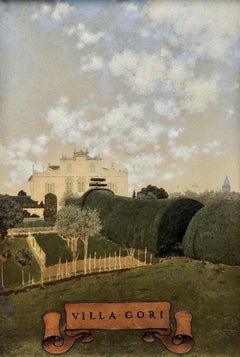
La Palazzina (Villa Gori), Siena, for the book Italian Villas and Their Gardens
By Maxfield Parrish
Located in Fort Washington, PA
By the time Maxfield Parrish painted his Italian Villa series in 1903, he was already acknowledged as one of America’s most successful artists. Edith Wharton was commissioned to writ...
Category

Early 1900s Pennsylvania - Art

Materials

Paper, Oil

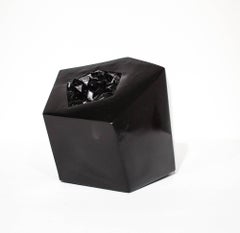
"Obsidian Geode" Geometric Sculpture by Street Artist "A Common Name"
By Paige Smith (A Common Name)
Located in Philadelphia, PA
"Obsidian Geode" is an original work from Paige Smith's ongoing series of geode sculptures. The piece is solid resin cast by the artist and painted. This work measures 8in x 7in x ...
Category

21st Century and Contemporary Abstract Geometric Pennsylvania - Art

Materials

Acrylic, Resin, Silicone

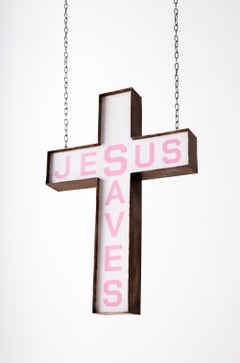
"Jesus Saves" Painted Paper and Chain Cross Church Sign by Drew Leshko
By Drew Leshko
Located in Philadelphia, PA
This piece titled "Jesus Saves" is original artwork made from paper, inkjet print, enamel, wire, chain, aluminum tube, pastel by Drew Leshko. This piece measures approx. 18”h x 12.75...
Category

21st Century and Contemporary Contemporary Pennsylvania - Art

Materials

Metal, Enamel, Wire

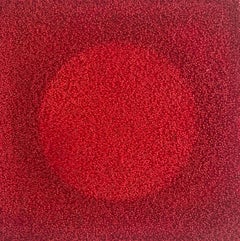
Tantra 87: abstract India spiritual mandala circle sculpture painting, red beads
By Antonio Puri
Located in Bryn Mawr, PA
Antonio Puri's "Tantra" sculptural painting is one of 100 intimately-scaled minimalist round mandala circles built from tiny seed beads adhered to canvas in a range of red hues, crea...
Category

2010s Abstract Pennsylvania - Art

Materials

Canvas, Mixed Media, Acrylic

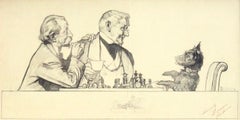
Gentlemen and Scottie dog at Chess Board, Study for Maxwell House Coffee
By Norman Rockwell
Located in Fort Washington, PA
Signature: Signed Lower Right Medium: Charcoal on Paper Sight Size 18.00" x 34.50", Framed 23.5" x 40.25" This is a preliminary drawing. It’s a masterful drawing that was mounted lo...
Category

1930s Pennsylvania - Art

Materials

Paper, Charcoal

George s Sweet Inspirations
By George Rodrigue
Located in Philadelphia, PA
George Rodrigue George's Sweet Inspirations From the rare limited edition of 150 Original serigraph on paper Hand signed and numbered 2000 20x16 inches MINT CONDITION
Category

Early 2000s Pennsylvania - Art

Materials

Lithograph, Screen

Inked Lines In A Rectangle
Located in Dallas, TX
ink on wave paper
Category

2010s Abstract Expressionist Pennsylvania - Art

Materials

Paper, Ink

Water Let in on a Field of Alfalfa
By Maxfield Parrish
Located in Fort Washington, PA
Signed with initials M.P. (lower right); inscribed Article III. "Irrigation" water let in on a field of alfalfa (in the lower margin) Written on back "February of 1902. Hot Springs,...
Category

Early 1900s Pennsylvania - Art

Materials

Oil

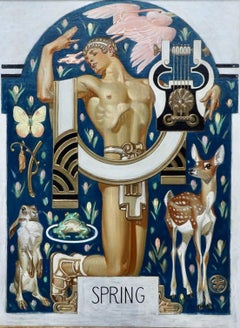
Spring- Apollo and Animals
By Joseph Christian Leyendecker
Located in Fort Washington, PA
Original cover for The Saturday Evening Post, published March 30, 1929. J.C. Leyendecker's holiday covers, particularly his iconic New Year's baby, were instrumental in driving The...
Category

1920s Pennsylvania - Art

Materials

Canvas, Oil

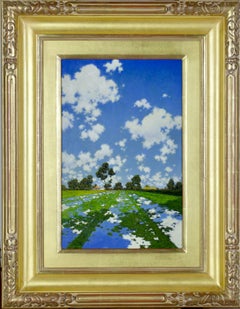
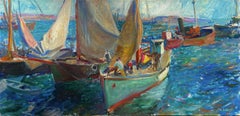
Harbor View
By John Whorf
Located in Bryn Mawr, PA
Harbor View Oil on canvas, 24 x 49 inches (61 x 124.5 cm) Signed lower right: John Whorf Provenance The artist; Collection of Ginger and Richard Beckwith, until 2021; Private collec...
Category

Mid-20th Century Impressionist Pennsylvania - Art

Materials

Canvas, Oil

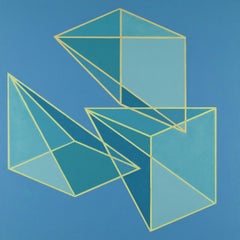
Geometric abstract Op Art Pop Art painting in blue green w/ triangles cubes
By Benjamin Weaver
Located in Bryn Mawr, PA
"Cubes Divided Equally into Three #19" -- Benjamin Weaver creates spatial tension through his use of contrasting colors arranged in a geometric framework. Imagery and color work both...
Category

2010s Abstract Pennsylvania - Art

Materials

Canvas, Acrylic

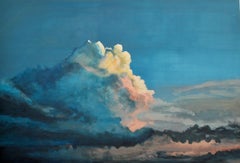
Heaven on Earth
Located in San Francisco, CA

Artist Comments
I was on a rooftop parking garage looking for the last space to park, in a hurry for a meeting with friends, when I saw this sky. Yes, I was late getting together with my friends, and my wife was patient while I recorded all the colors and shapes. After I painted this she was happy with the painting, and so was I, for it worked out as a balanced canvas of real and abstract. My friends were ok too after I bought a round. Enjoy!

About the Artist
Benjamin Thomas has been painting since the late seventies, however for most of this time he was not exhibiting his work. About twelve years ago, Benjamin and his wife were at a gallery show for a friend and as they were leaving Ben’s wife, aka “The Muse,” told him to go back in. “Your work is as good as that--maybe even better,” she said. That night, Benjamin obeyed The Muse (lucky for us!). The impressionistic sweeps of sky and cloud in Benjamin’s paintings capture more than just an atmospheric quality, but also a heavenly interpretation of the landscape. There is a classical, mature style to the paintings, reminiscent of J.M.W. Turner. Benjamin is often inspired while bicycling, walking or motorcycling, taking in the scenery of Pittsburgh, PA. He takes photos of the scene and then works out the concept back in his studio. The large scale of the work matches the impression and mood that each scene conveys, and the light and shadow are carefully balanced to capture something mercurial and nostalgic. The work feels very measured and contemplated, but also full of passion, as if each piece is in pursuit of the joy of painting and the representation of natural beauty.

Heaven on Earth...

Category

21st Century and Contemporary Impressionist Pennsylvania - Art

Materials

Acrylic

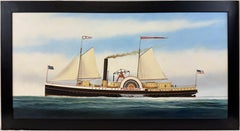
“Penobscot” Ship Portrait Sidewheeler Steamboat Paddle Steamer Oil on Canvas
Located in Yardley, PA
A wonderful realistic portrait of the Penobscot, a mid-19th century coastal sidewheel steamer, rendered in Cameron’s hallmark marine portrait style - technically meticulous, historically informed, and visually serene. Executed with crisp linework and a soft, luminous palette, the ship is shown in profile navigating calm Atlantic waters under both steam and sail, her red paddle box emblazoned boldly with her name. Commissioned in 1843 by Menemon Sanford’s Steamship Line and constructed in New York, the Penobscot was a near twin to her sister ship, the Kennebec, but became especially prized for her seaworthiness. Measuring 228 feet in length with a 48-foot beam and twin 14-foot paddlewheels, she carried schooner rigging fore and aft, providing the added stability necessary for coastal and offshore passages. Initially assigned to the Maine coastal excursion routes, she would later be reassigned to the elite New York–Philadelphia line and eventually sold and renamed Norfolk for pre-Civil War service along the southern coast. This work is oil on canvas and is signed in the lower right. It is housed in its original black frame and retains the artist’s description of the ship on the reverse. Size: 22 inches tall by 44 inches wide (painting) 26 inches tall by 48 inches wide by 1 inch deep (frame) Provenance: Private collection; Acquired from the above About the artist: A Delaware artist, Scott Cameron paints the simple elegance of the America’s Cup races, serene coastal marsh scenes, timeless landscape vistas and historic steamboats in a style reminiscent of the era in which they reigned. An admirer of Andrew Wyeth and the Brandywine School of painters, Scott has combined the detail and quiet stillness of that School in his landscapes with the Luminist School’s sense of light glowing from within. A soft gentle atmosphere seems to fall over each scene adding to the peacefulness of the setting, and a sense of a time gone by. His America’s Cup scenes capture the action at a moment in time, allowing the beauty of the wind-filled sails to become the central design element of each painting. Scott Cameron has exhibited his oil paintings in numerous national and regional shows from the Mystic Seaport Museum to solo and group shows in some of the foremost galleries throughout the Northeast and Mid-Atlantic states. Favorite painting locations are the waterways and coastal inlets of Martha’s Vineyard and Maryland’s Eastern Shore and the gentle rolling landscapes of rural Pennsylvania, Delaware and Maryland. Meticulous research is behind every historic steamboat and America’s Cup painting...
Category

Late 20th Century American Realist Pennsylvania - Art

Materials

Canvas, Oil

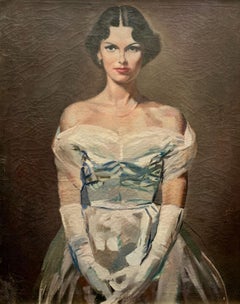
Portrait of a Woman
By Charles Ellis
Located in Fort Washington, PA
Medium: Oil Painting Signature: Unsigned Contact for dimensions.
Category

20th Century Pennsylvania - Art

Materials

Oil

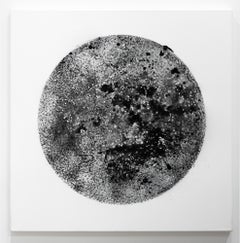
"CHONDRITE 03" Gestural abstraction, Spray paint, Splatter, Scratches
Located in Philadelphia, PA
This piece titled "CHONDRITE 03" is a one-of-a-kind original piece by Chinny Bond and is a gestural mark-making study done with acrylic, ink and aerosol on linen. This piece measures...
Category

21st Century and Contemporary Contemporary Pennsylvania - Art

Materials

Linen, Ink, Spray Paint, Acrylic

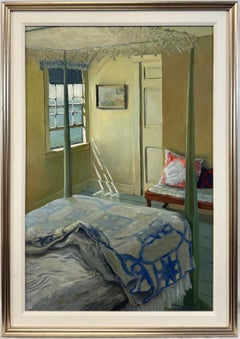
“Early Morning, 1999” by Anna Brelsford Mccoy Sunlit Bedroom Interior Oil Canvas
Located in Yardley, PA
A serene and exquisitely composed work that captures the quiet poetry of a sunlit bedroom in the early hours of daybreak. A descendant of the renowned Wyeth artistic dynasty, McCoy h...
Category

1990s American Realist Pennsylvania - Art

Materials

Canvas, Oil

“There” Seemed Far Away and Close to “Here”
By Brian Jerome
Located in Philadelphia, PA
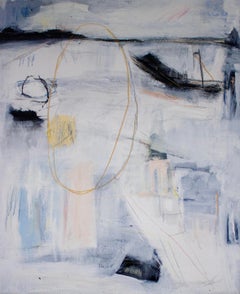
The length of time to travel to any destination, for weddings or funerals, is factual true. but once there, you are "here" even though it once was "there"
Category

2010s Abstract Pennsylvania - Art

Materials

Oil, Acrylic

Jockey on Racehorse with Well-Dressed Gentleman
By Joseph Christian Leyendecker
Located in Fort Washington, PA
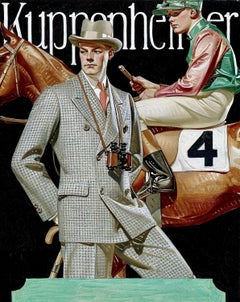
Original advertisement for Kuppenheimer Clothing, featuring a jockey on a race horse and a well-dressed gentleman in a suit This illustration for Kuppenheimer Clothes appeared in various advertisements and promotional materials in 1926 and 1927, such as the cover of a race-themed Kuppenheimer advertising booklet, as well as the interior page of the Kuppenheimer Spring & Summer 1926 brochure, where the associated caption states: “This double-breasted, with slender hips and broad Curvette shoulders, will be quite the thing with stylish young fellows this spring – especially in the new shades of Ambertone and Silvertone.” A wood-engraving of the image was completed by Jacob Sander for use in newspapers in 1926. Engravings like this were often created to eliminate the difficulties associated with half-tone production on the poor quality newspaper stock. The present work showcases the artist’s ability to capture an idealized vision of male beauty. The rich colors and textures of the fabrics applied with Leyendecker’s signature painterly technique further enhance the appeal of the clothing the picture advertises. In the early spring of 1926, in preparation for upcoming Kuppenheimer advertising projects, J.C. Leyendecker visited the Aqueduct Racetrack horse racing facility in Queens, New York. He was directed to the legendary trainer ‘Dick’ (Herbert John Thompson), who was training the horse named Bubbling Over, who would become the model or the horse pictured...
Category

1920s Pennsylvania - Art

Materials

Canvas, Oil

Marc Chagall - Bouquet for Fernand From Souvenirs de Portraits d Artistes
By Marc Chagall
Located in Philadelphia, PA
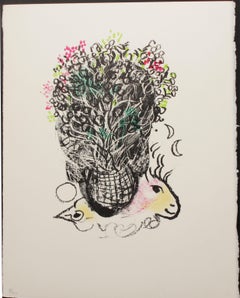
Marc Chagall Bouquet for Fernand Original lithograph in colors on paper Mourlout Souvenirs de Portraits d'Artistes 1972
Category

1970s Pennsylvania - Art

Materials

Lithograph

Overlap #2: geometric abstract Op Art painting in blue, green, aqua turquoise
By Benjamin Weaver
Located in Bryn Mawr, PA
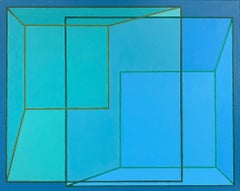
Benjamin Weaver creates spatial tension through his use of contrasting colors arranged in a geometric framework. Imagery and color work both with and against each other to create mov...
Category

2010s Abstract Pennsylvania - Art

Materials

Canvas, Acrylic

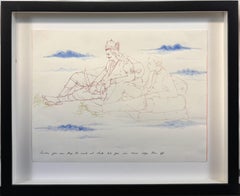
“Untitled” by N.S. Harsha (b. 1969) Contemporary Indian Ex-Christie s Signed
Located in Yardley, PA
“Untitled” by N.S. Harsha (Indian, b. 1969) This delicate watercolor by N.S. Harsha, one of the leading contemporary artists from India, is a masterclass in visual subtlety and conc...
Category

21st Century and Contemporary Contemporary Pennsylvania - Art

Materials

Paper, Ink, Watercolor

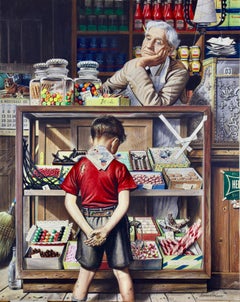
Penny Candy, The Saturday Evening Post Cover
By Stevan Dohanos
Located in Fort Washington, PA
Signed Lower Right by Artist The Saturday Evening Post Cover, September 23, 1944 A proponent of simplicity as a virtue, Stevan Dohan...
Category

1940s Pennsylvania - Art

Materials

Oil, Tempera

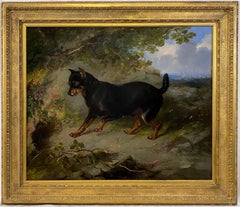
“Manchester Terrier, 1854” 19th Century Dog Portrait in Landscape Ex-Bonhams Oil
By George Armfield
Located in Yardley, PA
A fantastic example of George Armfield’s renowned portraits of dogs. This work depicts a Manchester Terrier excitedly standing outside a rabbit hole on the edge of a forest. The ter...
Category

1850s Realist Pennsylvania - Art

Materials

Canvas, Oil

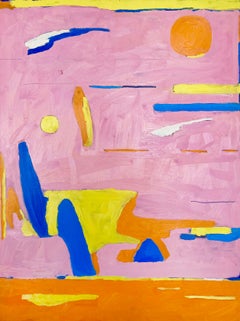
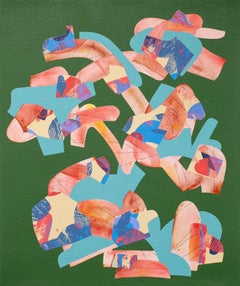
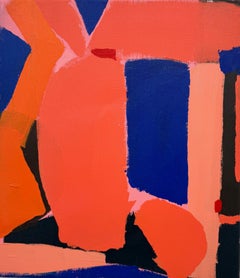
Illumination, Contemporary Abstract Painting
Located in Philadelphia, PA
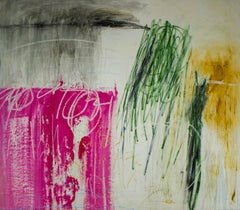
This artwork is an abstract acrylic painting on canvas, characterized by strong, interlocking shapes and a vivid, warm palette. Large coral and peach-colored forms dominate the comp...
Category

2010s Contemporary Pennsylvania - Art

Materials

Canvas, Acrylic

Everything Outside Is Staring Right at You
By Brian Jerome
Located in Philadelphia, PA
This probably deals with the subject of media, fame, guilt, internalization, rumination, capitalism, and being alive in the contemporary. I really hate ans...
Category

2010s Abstract Pennsylvania - Art

Materials

Mixed Media

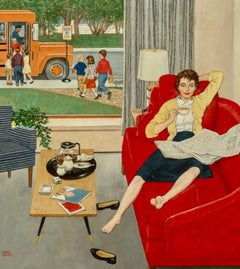
Morning Coffee Break, Saturday Evening Post Cover, 1959
By Amos Sewell
Located in Fort Washington, PA
Medium: Oil on Board Signature: Signed Lower Left Sight Size 27.00" x 23.75;" Framed 34.50" x 37.50" Original cover illustration for The Saturday Evening Post, September 12, 1959. ...
Category

1950s Pennsylvania - Art

Materials

Oil, Board

Impressive WPA Gloucester Oil Painting New England George Matthews Harding
Located in Exton, PA
Dramatic, monumental oil painting laid to Masonite by George Matthews Harding (1882-1959). Painter, illustrator and muralist, Harding was born in Philadelphia. He studied at the Pyle...
Category

1930s Modern Pennsylvania - Art

Materials

Oil

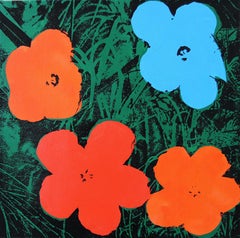
Denied Andy Warhol Flowers (RED ORANGE BLUE) Painting by Charles Lutz
By Charles Lutz
Located in Brooklyn, NY
Denied Warhol Flowers, (RED ORANGE BLUE) Silkscreen on canvas Painting by Charles Lutz Silkscreen and acrylic on linen with Denied stamp of the Andy Warhol Art Authentication Board. ...
Category

21st Century and Contemporary Contemporary Pennsylvania - Art

Materials

Acrylic, Canvas

Still Thinking About These?

All Recently Viewed