South Carolina - Prints and Multiples

to
43
323
25
1
3
Overall Width
to
Overall Height
to
151
24
18
16
13
12
7
6
1
16
13
12
12
9
10
15
324
3
4
14
76
86
75
11
11
14
5
2
6
190
154
2
172
88
83
64
47
45
25
23
22
16
16
15
14
11
10
9
9
9
8
8
105
86
74
50
28
1
51,012
36,894
Item Ships From: South Carolina
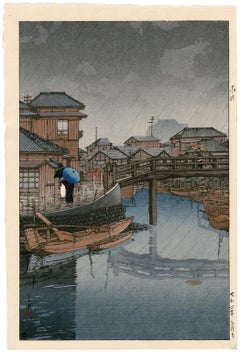
Rain at Shinagawa, Ryoshimachi — Showa-era Woodblock Print
By Kawase Hasui
Located in Myrtle Beach, SC
Kawase Hasui, 'Rain at Shinagawa, Ryoshimachi' from the series 'Selection of Views of the Tokaido', woodblock print, 1931. A very fine, atmospheric impression, with fresh colors; the...
Category

1930s Showa South Carolina - Prints and Multiples

Materials

Woodcut

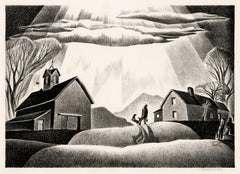
Partners — Mid-Century Modernist Regionalism
By Dale Nichols
Located in Myrtle Beach, SC
Dale Nichols, 'Partners', lithograph, edition 250, 1950. Signed in pencil. A fine, richly-inked impression, on cream wove paper; the full sheet with margins (7/8 to 1 5/8 inches); tw...
Category

1950s American Modern South Carolina - Prints and Multiples

Materials

Lithograph

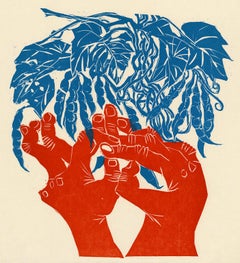
Drop of Life — from Solitude for Henry David Thoreau s Walden
Located in Myrtle Beach, SC
Naoko Matsubara, 'Drop of Life' for the portfolio 'Solitude', color woodcut, 1971. A fine impression with fresh, vivid colors, on cream laid Japan paper, the full sheet with margins,...
Category

1970s Modern South Carolina - Prints and Multiples

Materials

Woodcut

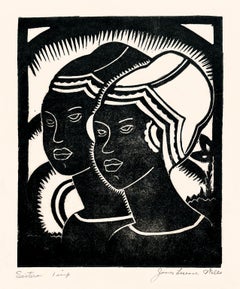
Sisters — Renowned Black American, Harlem Renaissance Artist
Located in Myrtle Beach, SC
James Lesesne Wells, 'Sisters', linocut, edition not stated but small, 1928. Signed, titled, and annotated 'imp' in pencil. A fine impression on off-white wove Japan paper, with wide margins (1 7/8 to 3 3/4 inches), in excellent condition. Printed by the artist. Very scarce. Matted to museum standards, unframed. Image size 8 3/16 x 6 3/4 inches (208 x 171 mm); sheet size 13 1/2 x 10 3/4 inches (343 x 273 mm). Exhibition and Literature: 'Narratives of African American Art and Identity: The David C. Driskell Collection,' The Art Gallery at the University of Maryland, extensive touring exhibition, 1998-2000. Collections: Pennsylvania Academy of the Fine Arts, Smithsonian Institution (Anacostia Community Museum). ABOUT THE ARTIST “Wells is more than an artist with a deep concern for his fellow man. He carries many of his themes a step further into an apocalyptic world, a world of revelation and shifting lights. … He works on large blocks in a bold free style. … His work has a vigor, therefore, that is not often used in the medium today.” —Jacob Kainen (painter, critic, and collector) from Richard J. Powell’s 1986 essay Phoenix Ascending: The Art of James Lesesne Wells. James Lesesne Wells was an American painter, printmaker, educator, and pioneering figure of the Harlem Renaissance, whose work established a vital connection between African heritage, modernist form, and African American cultural identity. Known for his innovative use of linoleum and woodblock printing, Wells played a key role in shaping 20th-century African American art and inspired countless students throughout his lengthy career as a teacher at Howard University. Born in Atlanta, Georgia, Wells' early exposure to the arts came through church and community, where African American cultural traditions were central. He pursued formal artistic training at Lincoln University in Pennsylvania (earning a B.A. in 1924), followed by studies at the Pennsylvania Academy of the Fine Arts and the Barnes Foundation, where he encountered European modernists as well as traditional African sculpture, which profoundly influenced his style. Wells moved to New York in the late 1920s, swiftly immersing himself in the lively artistic and intellectual scene of Harlem. There, he became associated with artists, writers, and thinkers of the Harlem Renaissance, contributing to the growth of Black cultural identity. Considered a mentor to many famed artists of the Harlem Renaissance, Wells served as director of a summer art workshop in Harlem where his assistants included Charles Alston, Jacob Lawrence, and Palmer Hayden...
Category

1920s American Modern South Carolina - Prints and Multiples

Materials

Linocut

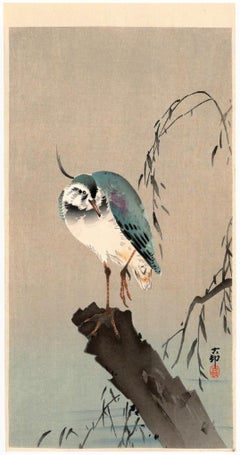
Lapwing on a Tree Stump — Japanese Woodblock kachō-ga
By Ohara Koson
Located in Myrtle Beach, SC
Ohara Koson, 'Lapwing on a Tree Stump', color woodblock, c. 1920s. Signed 'Koson' in black ink with the artist’s red seal beneath, lower right. A superb, skillfully-inked impression,...
Category

Early 1900s Showa South Carolina - Prints and Multiples

Materials

Woodcut

The House of Shango — African American artist
By Samella Lewis
Located in Myrtle Beach, SC
Samella Sanders Lewis, 'The House of Shango', lithograph, 1992, edition 60. Signed, dated, titled, and numbered '31/60' in pencil. A superb, richly-inked impression, on Arches cream wove paper; the full sheet with margins (1 1/4 to 3 1/2 inches), in excellent condition. Image size 24 x 18 inches (610 x 457 mm); sheet size 30 inches x 22 1/4 inches (762 x 565 mm). Archivally matted to museum standards, unframed. ABOUT THIS WORK “The title of this piece is an unmistakable harkening to African roots. Shango is a religious practice with origins in Yoruba (Nigerian) belief, deifying a god of thunder by the same name. Shango has been adopted in the Caribbean, most notably in Trinidad and Tobago, a fact that underscores the importance of transnationalism to Samella Lewis’s piece. Her work often grapples with issues of race in the U.S., and The House of Shango is no exception. Through a reliance on the gradual transformation of Shango—one that took place across continents and time—Lewis’s piece forms a powerful link between black Americans and their African and Caribbean counterparts. The figure depicted in the piece appears to emerge, quite literally, from the house of Shango. Given the roots and transformative process of the religion, The House of Shango can draw attention to the historical intersections to which black American culture is indebted.” —Laura Woods, Scripps College, Ruth Chander Williamson Gallery, Collection Highlights, 2018 ABOUT THE ARTIST Samella Lewis’ lifelong career as an artist, art historian, critic, curator, collector, and advocate of African American art has helped empower generations of artists in the United States and worldwide, earning her the designation “the Godmother of African American art.” Born and raised in Jim Crow era New Orleans, Lewis began her art education at Dillard University in 1941, transferring to Hampton University in Virginia, where she earned her B. A. and master's degrees. She completed her master's and a doctorate in art history and cultural anthropology at Ohio State University in 1951, becoming the first female African American to earn a doctorate in fine art and art history. Lewis taught art at Morgan State University while completing her doctorate. She became the first Chair of the Fine Arts Department at Florida A&M University in 1953. That same year Lewis also became the first African American to convene the National Conference of African American artists held at Florida A&M University. She was a professor at the State University of New York, California State University, Long Beach, and at Scripps College in Claremont, California. Lewis co-founded, with Bernie Casey, the Contemporary Crafts Gallery in Los Angeles in 1970. In 1973, she served on the selection committee for the exhibition BLACKS: USA: 1973 held at the New York Cultural Center. Samella Lewis's 1969 catalog 'Black Artists on Art', featured accomplished black artists typically overlooked in mainstream art galleries. She said of the book, "I wanted to make a chronology of African American artists, and artists of African descent, to document our history. The historians weren't doing it. It was really about the movement." From the 1960s through the 1970s, her work, which included lithographs, linocuts, and serigraphs, reflected her concerns with the values of human dignity, democracy, and freedom of expression. Between 1969 and 70, Lewis and E.J. Montgomery were consultants for a groundbreaking exhibition at the Oakland Public L designed to create greater awareness of African American history and art. Lewis was the founder of the International Review of African American Art in 1975. In 1976, she founded the Museum of African-American Art with a group of artistic, academic, business, and community leaders in Los Angeles, California. Lewis, the museum’s senior curator, organized exhibitions and developed new ways of educating the public about African American art. She celebrated African American art as an 'art of experience’ inspired by the artists’ lives. And she espoused the concept of African American art as an 'art of tradition', urging museums to explore the African roots of African American art. In 1984, Lewis produced an extensive monograph on Elizabeth Catlett, her beloved mentor at Dillard University. Lewis has been collecting art since 1942, focusing primarily on the WPA era and work created during the Harlem Renaissance. Pieces from her collection were acquired by the Hampton University Museum in Virginia, the world’s earliest collection of African American fine art...
Category

1990s Realist South Carolina - Prints and Multiples

Materials

Lithograph

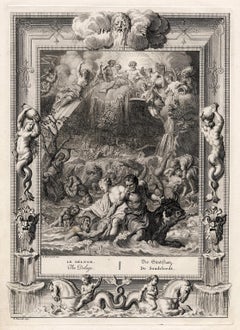
The Deluge from The Temple of the Muses — 18th Century Engraving
By Bernard Picart
Located in Myrtle Beach, SC
Bernard Picart, 'The Deluge' from 'The Temple of the Muses', engraving, 1730. Signed in the plate and dated '1730' lower left. Titled in French, English, German, and Dutch. A superb...
Category

1730s Baroque South Carolina - Prints and Multiples

Materials

Engraving

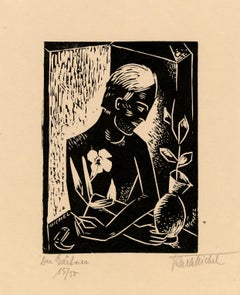
Der Gartner (The Gardener) — German Expressionism
By Karl Michel
Located in Myrtle Beach, SC
Karl Michel, 'Der Gartner' (The Gardener), woodcut, c. 1925. Signed, titled, and numbered '15/50' in pencil. Signed in the block, lower left and right. A fine, richly-inked impression on buff wove paper, with full margins (1 1/2 to 2 3/4 inches), in excellent condition. Matted to museum standards, unframed. Scarce. Image size 5 1/4 x 3 7/8 inches (133 x 98 mm); sheet size 10 x 7 3/4 inches (254 x 198 mm). ABOUT THE ARTIST Karl Michel (1889-1984) was a noted graphic designer and expressionist printmaker during Germany's pre-Nazi Weimar Republic (1919 - 1933). In 1920, his work was featured in the influential German graphic design magazine Das Plakat...
Category

1920s Expressionist South Carolina - Prints and Multiples

Materials

Woodcut

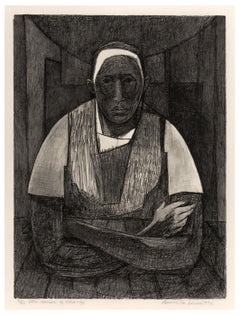
Portrait of an African Woman — 1920s Modernism
By Boris Lovet-Lorski
Located in Myrtle Beach, SC
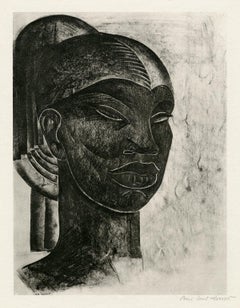
Boris Lovet-Lorski, Untitled (Portrait of an African Woman), lithograph, edition 250, 1929. Signed and numbered 13 in pencil. Number 13 of Volume 2, a series of 10 lithographs publis...
Category

1920s Art Deco South Carolina - Prints and Multiples

Materials

Lithograph

Dancers — 1930s American Modernism
By Charles Turzak
Located in Myrtle Beach, SC
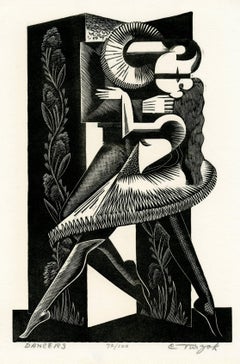
Charles Turzak, 'Dancers', 1939, wood engraving, edition 100. Signed, titled, and numbered 72/100 in pencil. A fine, richly-inked impression, on off-white Japan paper, with full marg...
Category

Mid-20th Century Art Deco South Carolina - Prints and Multiples

Materials

Woodcut

Mehr Sonne fur 1924 (More Sun for 1924)— German Expressionism
By Karl Michel
Located in Myrtle Beach, SC
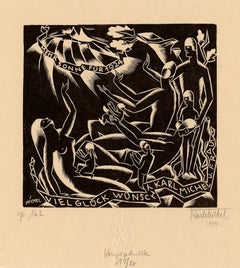
Karl Michel, 'Mehr Sonne fur 1924. Viel Gluck Wunscht Karl Michel U. Frau', woodcut, 1924, edition 20. Signed, dated, and numbered 'op. 162' and '15/20' in pencil. Signed in the image, lower left. A fine, richly-inked impression on buff wove paper, with full margins (1 1/2 to 2 3/4 inches), in very good condition. Printed by the artist. Scarce. Matted to museum standards, unframed. New Year's Greeting – English translation: "More Sun for 1924. Good Luck Wishes from Karl Michel and his Wife." Image size 4 5/8 x 4 3/4 inches (118 x 121 mm); sheet size 7 3/4 x 10 inches (198 x 254 mm). ABOUT THE ARTIST Karl Michel (1889-1984) was a noted graphic designer and expressionist printmaker during Germany's pre-Nazi Weimar Republic (1919-1933). Michel’s work was the subject of a feature article in the influential German graphic design magazine Das Plakat...
Category

1920s Expressionist South Carolina - Prints and Multiples

Materials

Woodcut

River View — Mid-Century American Modernism
By Edward August Landon
Located in Myrtle Beach, SC
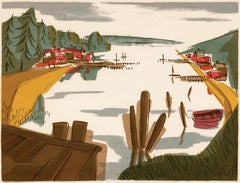
Edward Landon 'River View, color serigraph, 1942, edition 50, Ryan 159. Signed in pencil in the image, lower right. Titled, dated, and annotated '9 COLORS – 50 PRINTS' in the screen,...
Category

1940s American Modern South Carolina - Prints and Multiples

Materials

Screen

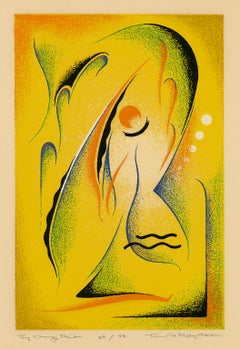
The Orange Point — Mid-Century Modernism
By Thomas A. Robertson
Located in Myrtle Beach, SC
Thomas A. Robertson, 'The Orange Point', color serigraph, edition 54, 1941. Signed, titled, and annotated 'Ed/54' in pencil. A fine impression, with fresh colors, on buff wove paper;...
Category

1940s American Modern South Carolina - Prints and Multiples

Materials

Screen

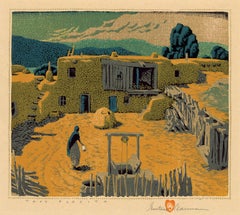
Taos Placita — American Southwest Regionalist Masterwork
By Gustave Baumann
Located in Myrtle Beach, SC
Gustave Baumann, 'Taos Placita', color woodcut, 1947, edition 125. Baumann 132. Signed, titled, and numbered '20-125' in pencil; with the artist’s Hand-in-Heart chop. A superb, richly-inked impression, with fresh colors, on fibrous oatmeal wove paper; the full sheet with margins (2 to 3 1/8 inches); slight rippling at the left sheet edge, in excellent condition. Matted to museum standards, unframed. Image size 9 5/8 x 11 1/4 inches (244 x 286 mm); sheet size 13 1/4 x 17 inches (337 x 432 mm). Collections: Harwood Museum of Art, New Mexico Museum of Art, Phoenix Art Museum, Scottsdale Art Museum, Wichita Art Museum. ABOUT THE ARTIST Gustave Baumann (1881-1971) was a renowned printmaker and a leading figure of the American color woodcut revival whose exquisite craftsmanship and vibrant imagery captured the essence of the Southwest. "A brilliant printmaker, Baumann brought to the medium a full mastery of the craft of woodworking that he acquired from his father, a German cabinetmaker. This craftsmanship was coupled with a strong artistic training that resulted in the handsome objects we see in the exhibition today. After discovering New Mexico in 1918, Baumann began to explore in his woodblock prints of this period the light. color, and architectural forms of that landscape. His prints of this period are among the most beautiful and poetic images of the American West." —Lewis I. Sharp, Director, Denver Art Museum Baumann, the son of a craftsman, immigrated to the United States from Germany with his family when he was ten, settling in Chicago. From 1897 to 1904, he studied in the evenings at the Art Institute of Chicago, working in a commercial printmaking shop during the day. In 1905, he returned to Germany to attend the Kunstwerbe Schule in Munich, where he decided on a career in printmaking. He returned to Chicago in 1906 and worked for a few years as a graphic designer of labels. Baumann made his first prints in 1909 and exhibited them at the Art Institute of Chicago the following year. In 1910, he moved to the artists’ colony in Nashville, Indiana, where he explored the creative and commercial possibilities of a career as a printmaker. In 1915, he exhibited his color woodcuts at the Panama-Pacific International Exposition in San Francisco, winning the gold medal. Among Baumann’s ongoing commercial activities was his work for the Packard Motor Car Company from 1914 to 1920 where he produced designs, illustrations, and color woodcuts until 1923. In 1919, Baumann’s printmaking work dominated the important exhibition of American color woodcuts at the Detroit Institute of Arts. Twenty-six of his prints were included, far more than the works of any other artist. A set of his blocks, a preparatory drawing, and seven progressive proofs complemented the exhibition. That same year, Baumann worked in New York and, over the summer, in Provincetown, Massachusetts. His airy images of Cape Cod employed soft, pastel colors and occasionally showed the influence of the white-line woodcut technique. Many of his Chicago artist friends had traveled to the southwest, and Baumann became intrigued by their paintings, souvenirs, and stories of an exotic place named Taos, New Mexico. In the summer of 1918, he spent the summer in Taos sketching and painting before visiting Santa Fe. Paul Walter, the director of the Museum of New Mexico, offered him a studio in the museum's basement. Inspired by the rugged beauty of the Southwest—the vibrant colors and dramatic landscapes of the region became a central theme in his work, influencing his artistic style and subject matter for the remainder of his career. Later in the decade, he traveled to the West Coast and made prints of California landscape. Baumann's prints became synonymous with the Southwest, capturing the spirit of its place in America's identity with a unique sense of authenticity and reverence. His iconic images of desert vistas, pueblo villages, and indigenous cultures served as visual tributes to the region's rich cultural heritage, earning him a dedicated following among collectors and curators alike. A true craftsman and artist, Baumann completed every step of the printmaking process himself, cutting each block, mixing the inks, and printing every impression on the handmade paper he selected. His dedication to true craftsmanship and his commitment to preserving the integrity of his artistic vision earned him widespread acclaim and recognition within the art world. About the vibrant colors he produced, Baumann stated, “A knowledge of color needs to be acquired since they don’t all behave the same way when ground or mixed...careful chemistry goes into the making of colors, with meticulous testing for permanence. While complicated formulae evolve new colors, those derived from Earth and metal bases are still the most reliable.” In the 1930s, Baumann became interested in puppet theater. He designed and carved his own marionettes and established a little traveling company. From 1943 to 1945, the artist carved an altarpiece for the Episcopal Church of the Holy Faith in Santa Fe. In 1952, a retrospective exhibition of his prints was mounted at the New Mexico Museum of Fine Arts. Throughout his prolific career, Baumann executed nearly four hundred color woodcuts. Baumann’s woodcuts...
Category

1940s American Modern South Carolina - Prints and Multiples

Materials

Woodcut

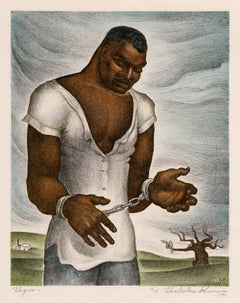
Negro — California WPA Social Realism – Slavery
Located in Myrtle Beach, SC
Nicholas Panesis, 'Negro', 1934, color lithograph, edition 18. Signed, dated, titled, and numbered 8/28 in pencil. Initialed in the stone, lower right. A fine impression, with fresh colors, on buff wove paper, with margins (1 1/8 to 2 3/8 inches). Minor glue staining at the extreme sheet edges verso, where previously taped (not visible recto), otherwise in excellent condition. Very scarce. Matted to museum standards, unframed. Image size 10 5/8 x 8 1/2 inches; (270 x 216 mm); sheet size 14 13/16 x 10 15/16 inches (376 x 278 mm). Created for the California Works Progress Administration, Federal Art Project (WPA). Impressions of this work are held in the public collections of La Salle University Art Museum (Philadelphia), U.S. General Services Administration, and Weisman Art Museum (University of Minnesota). ABOUT THE ARTIST Born in Massachusetts, Nicholas Panesis (1913-1967) studied art at Syracuse University, NY, and went on to teach ceramics at Alfred University, NY. Panesis moved to San Francisco in the early 1930s shortly before settling in Los Angeles, where he worked for different animation studios...
Category

1930s American Realist South Carolina - Prints and Multiples

Materials

Lithograph

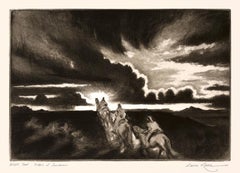
Riders at Sundown — Mid-Century Southwest Regionalism
By Gene Kloss
Located in Myrtle Beach, SC
'Riders at Sundown', aquatint and drypoint, edition 75, 1953, Kloss 451. Signed, titled, and annotated 'Artist's Proof' in pencil. A superb, richly-inked, atmospheric impression, in ...
Category

1950s American Modern South Carolina - Prints and Multiples

Materials

Drypoint, Aquatint

The Plaza, Sunset Glow
By Walter Tittle
Located in Myrtle Beach, SC
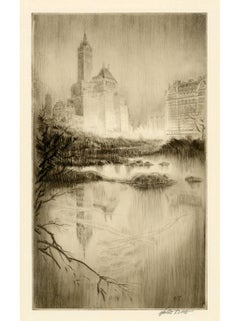
'The Plaza, Sunset Glow', drypoint, c. 1920s, edition not stated. Signed in pencil and initialed in the plate, lower right. Titled 'The Plaza, Sunset' and annotated 'no. 165' in ink, in the bottom left sheet corner. A superb, luminous impression in dark brown ink, with selectively wiped plate tone; on cream wove paper; the full sheet with margins (1 to 2 1/4 inches). Pale tape stains on the top sheet edge, recto, well away from the image, otherwise in excellent condition. Matted to museum standards, unframed. A view across 'The Pond' in New York City's Central Park, toward Grand Army Plaza...
Category

1920s American Impressionist South Carolina - Prints and Multiples

Materials

Drypoint

The Death of Hercules from The Temple of the Muses — 18th Century Engraving
By Bernard Picart
Located in Myrtle Beach, SC
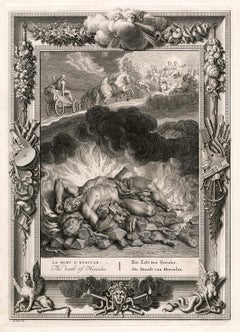
Bernard Picart, 'The Death of Hercules' from 'The Temple of the Muses', engraving, 1730. Signed in the plate, lower left. Titled in French, English, German, and Dutch. A superb, rich...
Category

1730s Baroque South Carolina - Prints and Multiples

Materials

Engraving

Lot Cleaning, Los Angeles — 1930s Modernism
By Paul Landacre
Located in Myrtle Beach, SC
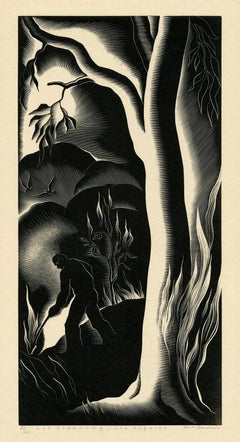
'Lot Cleaning, Los Angeles', wood engraving, edition 60, Zeitlin & Ver Brugge 69. Signed, titled and numbered '51/60' in pencil. A brilliant, black impression, on Kitakata Japan pape...
Category

1930s American Modern South Carolina - Prints and Multiples

Materials

Woodcut

Old Cedars – Early New Mexico Landscape, Southwest Regionalism
By George Elbert Burr
Located in Myrtle Beach, SC
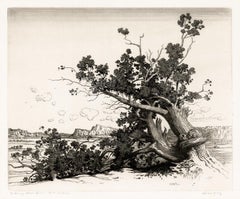
George Elbert Burr, 'Old Cedars – New Mexico', etching, 1920, edition 40, Seeber 218. Signed and annotated '(c) George Elbert Burr Del. et Imp.' in pencil. ...
Category

1920s Realist South Carolina - Prints and Multiples

Materials

Etching

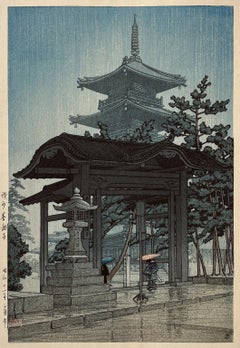
Zentsuji Temple in the Rain — from the series Collected Views of Japan II
By Kawase Hasui
Located in Myrtle Beach, SC
Kawase Hasui, 'Zentsuji Temple in the Rain' from the seres 'Collected Views of Japan II', color woodblock print, 1937. Signed Hasui in black ink, with the artist’s red seal Kawase, ...
Category

1930s Showa South Carolina - Prints and Multiples

Materials

Woodcut

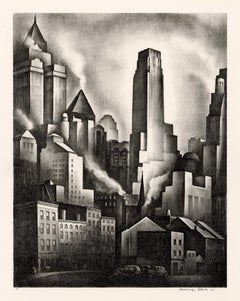
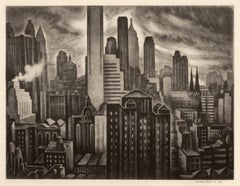
Financial District , New York City — American Modernism
By Howard Norton Cook
Located in Myrtle Beach, SC
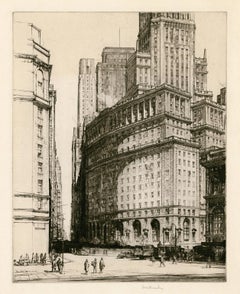
Howard Cook, 'Financial District', lithograph, 1931, edition 75, Duffy 155. A fine, richly-inked impression, on cream wove paper, the full sheet with wide margins (2 3/4 to 5 5/8 inches), in excellent condition. Image size 13 5/16 x 10 3/8 inches (338 x 264 mm); sheet size 23 x 16 inches (584 x 406 mm). Matted to museum standards, unframed. Literature: 'American Master Prints from the Betty and Douglas Duffy Collection', the Trust for Museum Exhibitions, Washington, D.C., 1987. Collections: Crystal Bridges Museum of American Art, Library of Congress, Metropolitan Museum of Art, Philadelphia Museum of Art, Smithsonian American Art Museum. ABOUT THE ARTIST Howard Norton Cook (1901-1980) was one of the best-known of the second generation of artists who moved to Taos. A native of Massachusetts, he studied at the Art Students League in New York City and at the Woodstock Art Colony. Beginning his association with Taos in 1926, he became a resident of the community in the 1930s. During his career, he received two Guggenheim Fellowships and was elected an Academician in the National Academy of Design. He earned a national reputation as a painter, muralist, and printmaker. Cook’s work in the print mediums received acclaim early in his career with one-person exhibitions at the Denver Art Museum (1927) and the Museum of New Mexico (1928). He received numerous honors and awards over the years, including selection in best-of-the-year exhibitions sponsored by the American Institute of Graphics Arts, the Brooklyn Museum, the Society of American Etchers, and the Philadelphia Print Club. His first Guggenheim Fellowship took him to Taxco, Mexico in 1932 and 1933; his second in the following year enabled him to travel through the American South and Southwest. Cook painted murals for the Public Works of Art Project in 1933 and the Treasury Departments Art Program in 1935. The latter project, completed in Pittsburgh, received a Gold Medal from the Architectural League of New York. One of his most acclaimed commissions was a mural in the San Antonio Post Office in 1937. He and Barbara Latham settled in Talpa, south of Taos, in 1938 and remained there for over three decades. Cook volunteered in World War II as an Artist War Correspondent for the US Navy, where he was deployed in the Pacific. In 1943 he was appointed Leader of a War Art Unit...
Category

1930s American Modern South Carolina - Prints and Multiples

Materials

Lithograph

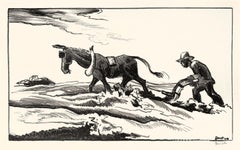
Plowing It Under — WPA Era American Regionalism
By Thomas Hart Benton
Located in Myrtle Beach, SC
Thomas Hart Benton, 'Goin' Home', lithograph, 1937, edition 250, Fath 14. Signed in pencil. Signed in the stone, lower right. A fine, richly-inked impression, on off-white, wove pape...
Category

1930s American Realist South Carolina - Prints and Multiples

Materials

Lithograph

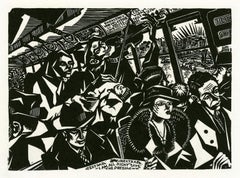
Modern Music — WPA Modernism, New York City El
Located in Myrtle Beach, SC
Albert Potter, 'Modern Music' also Twilight Melodies', linocut, c. 1935, from the posthumous edition of 20, printed in 1977, authorized by the artist’s widow. Estate authenticated in...
Category

1930s American Modern South Carolina - Prints and Multiples

Materials

Linocut

Woolworth Building Under Construction — Early 20th Century Modernism
By Earl Horter
Located in Myrtle Beach, SC
Earl Horter, 'The Woolworth Building Under Construction', etching, c. 1912, edition not stated. Signed in pencil. A fine, richly-inked impression, in warm black ink, with selectively...
Category

1910s American Modern South Carolina - Prints and Multiples

Materials

Etching

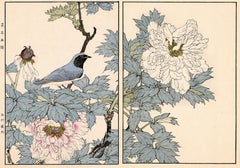
Tree Peony and Blue and White Flycatcher — 19th century woodblock print
Located in Myrtle Beach, SC
Imao Keinen, 'Tree Peony and Blue and White Flycatcher' from the series 'Birds and Flowers of the Four Seasons', color woodblock Oban dipty...
Category

1880s Naturalistic South Carolina - Prints and Multiples

Materials

Woodcut

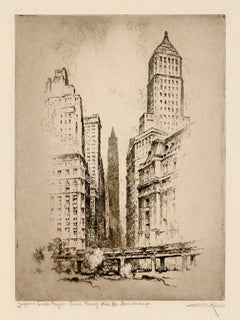
The Gateway to the New World — Vintage New York City
By Otto Kuhler
Located in Myrtle Beach, SC
Otto Kuhler, 'The Gateway to the New World', etching (artist's proof), edition 16, 1926, Kennedy 25. Signed in pencil and annotated 'Japan Silk Paper - Trial Proof - Ltd. Ed. Del. et...
Category

1920s American Modern South Carolina - Prints and Multiples

Materials

Etching

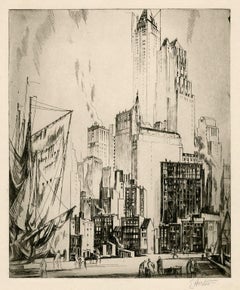
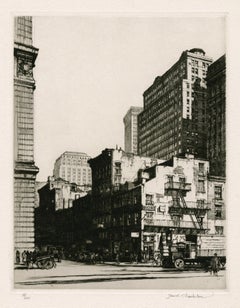
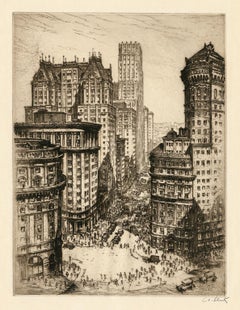
Manhattan Old and New — Vintage New York Cityscape
By Samuel Chamberlain
Located in Myrtle Beach, SC
Samuel Chamberlain, 'Manhattan Old and New', drypoint, 1929, edition 100, Chamberlain and Kingsland 81. Signed, titled, and numbered '81/100' in pencil. Titled and annotated '30.00' in pencil, in the artist's hand, bottom margin. Matted to museum standards, unframed. A superb, finely-detailed impression, with selectively wiped plate tone, on heavy Rives cream wove paper; full margins (1 1/2 to 2 1/4 inches), in excellent condition. The subject of the print is the lower Manhattan cityscape just before the Depression. Image size 8 3/4 x 6 13/16 inches (222 x 173 mm); sheet size 12 3/4 x 10 inches (324 x 254 mm). Impressions of this work are held in the collections of the National Gallery of Art and the Zimmerli Art Museum. ABOUT THE ARTIST 'There is something about the atmospheric vibrancy of an etching which imparts a peculiar and irresistible life to architectural drawing...A copper plate offers receptive ground to the meticulously detailed drawing which so often appeals to the architect'. —Samuel Chamberlain, from the Catalogue Raisonné of his prints. Samuel V. Chamberlain (1896 - 1975), printmaker, photographer, author, and teacher, was born in Iowa. His family moved to Aberdeen, Washington in 1901, and in 1913, Chamberlain enrolled in the University of Washington in Seattle, where he studied architecture under Carl Gould. By 1915, he was enrolled in the School of Architecture of the Massachusetts Institute of Technology in Boston. With the United States' involvement in the First World War, Chamberlain sailed to France, where he volunteered in the American Field Service. In 1918, he was transferred to the United States Army to complete his tour of duty. After the war, he returned to Boston and resumed his architectural studies, which he eventually discontinued, working for a few years as a commercial artist. Chamberlain received the American Field Service Scholarship in 1923, which he used to travel to Spain, North Africa, and Italy. In 1924 he was living in Paris, where he studied lithography with Gaston Dorfinant and etching and drypoint with Edouard Léon, publishing his first etching the following year. In 1927, he studied drypoint with Malcolm Osborne...
Category

1920s American Modern South Carolina - Prints and Multiples

Materials

Drypoint

Chion-in Temple Gate from Eight Scenes of Cherry Blossoms — Jizuri Seal
By Hiroshi Yoshida
Located in Myrtle Beach, SC
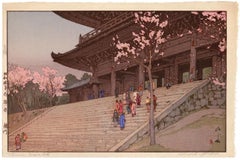
Hiroshi Yoshida, 'Chion-in Temple Gate (Sunset)' from the series 'Eight Scenes of Cherry Blossoms (Sakura hachi dai: Sakura mon)', color woodblock print, 1935. Signed in brush 'Yoshida' and in pencil 'Hiroshi Yoshida'. A superb, early impression, with fresh colors; the full sheet with margins, on cream Japan paper; an area of slight toning in the top right sheet corner, not affecting the image, otherwise in excellent condition. Marked with a jizuri (self-printed) seal, upper left margin. Self-published by the artist. Image size 9 5/8 x 14 3/4 inches (444 x 375 mm); sheet size 10 7/8 x 16 inches (276 x 406 mm). Archivally sleeved, unmatted. Provenance: M. Nakazawa, Tokyo. Literature: Japanese Landscapes of the 20th Century (Hotei Publishing calendar), 2001, May. Collections: Honolulu Museum of Art, Museum of Fine Arts, Boston. ABOUT THE IMAGE Located in Kyoto, Chionin is the main temple of the Jodo sect of Japanese Buddhism, one of the most popular Buddhist sects in Japan, having millions of followers. The Sanmon Gate, Chionin's entrance gate, standing 24 meters tall and 50 meters wide, it is the largest wooden temple gate in Japan and dates back to the early 1600s. Behind the gate, a broad set of stairs leads to the main temple grounds. ABOUT THE ARTIST Painter and printmaker Yoshida Hiroshi (1876-1950) is regarded as one of the greatest artists of the Japanese 'shin hanga' (New Print) movement. Yoshida was born as the second son of Ueda Tsukane in Kurume, Fukuoka Prefecture, a schoolteacher from an old samurai family. In 1891 he was adopted by his art teacher Yoshida Kasaburo in Fukuoka and took his surname. In 1893 he went to Kyoto to study painting, and the following year to Tokyo to join Koyama Shotaro's Fudosha private school; he also became a member of the Meiji Fine Arts Society. These institutions taught and advocated Western-style painting, greatly influencing Yoshida’s artistic development. In 1899 Yoshida had his first American exhibition at Detroit Museum of Art (now Detroit Institute of Art), making the first of many visits to the US and Europe. In 1902 he helped reorganize the Meiji Fine Arts Society, renaming it the Taiheiyo-Gakai (Pacific Painting...
Category

1930s Showa South Carolina - Prints and Multiples

Materials

Woodcut

The Beach at Kaiganji in Sanuki Province — Lifetime Impression
By Kawase Hasui
Located in Myrtle Beach, SC
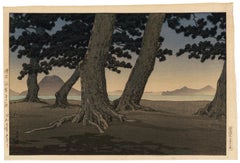
Kawase Hasui, 'The Beach at Kaiganji in Sanuki Province (Sanuki Kaiganji no hama),' from the series Collected Views of Japan II, Kansai Edition (Nihon fûkei shû II Kansai hen), woodblock print, 1934. A very fine, atmospheric impression, with fresh colors; the full sheet, in excellent condition. Signed 'Hasui' with the artist’s seal 'Kawase', lower left. Published by Watanabe Shozaburo with the Watanabe ‘D’ seal indicating an early impression printed between 1931 - 1941. Stamped faintly 'Made in Japan' in the bottom center margin, verso. Horizontal ôban; image size 9 3/8 x 14 1/4 inches (238 x 362 mm); sheet size approximately 10 5/16 x 15 1/2 inches ( 262 x 394 mm). Collections: Art Institute of Chicago; Austrian Museum of Applied Arts (Vienna); Honolulu Museum of Art; Museum of Fine Arts, Boston; National Museum in Warsaw; University of Wisconsin-Madison. ABOUT THE ARTIST “I do not paint subjective impressions. My work is based on reality...I can not falsify...(but) I can simplify…I make mental impressions of the light and color at the time of sketching. While coloring the sketch, I am already imagining the effects in a woodblock print.” — Kawase Hasui Hasui Kawase...
Category

1930s Showa South Carolina - Prints and Multiples

Materials

Woodcut

Green Shade — Mid-century Modernism, Abstract Expressionism, Atelier 17
By Stanley William Hayter
Located in Myrtle Beach, SC
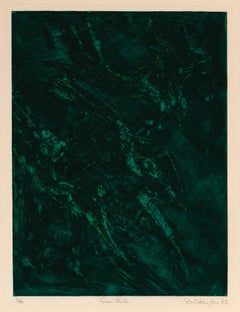
Stanley William Hayter, 'Green Shade', color etching and scraper, 1963, edition 50, (only 39 printed), B&M 278. Signed, titled, dated, and numbered '1/50' in pencil. A superb, richly-inked, luminous impression, with fresh, vivid colors, on Barcham Green textured cream wove paper; the full sheet with margins (2 3/16 to 3 1/4 inches), in excellent condition. Printed: intaglio black-green, contact lumogen yellow, soft roller phthalo green. Scarce. Image size 15 7/16 x 11 5/8 inches (392 x 295 mm); sheet size 21 1/8 x 16 inches (537 x 406 mm). Matted to museum standards (unframed). Collection: The British Museum ABOUT THE ARTIST Stanley William Hayter (1901-1988) was a British painter and printmaker associated in the 1930s with Surrealism and from 1940 onward with Abstract Expressionism. Regarded as one of the most significant printmakers of the 20th century, Hayter founded the legendary Atelier 17...
Category

1960s Abstract Expressionist South Carolina - Prints and Multiples

Materials

Etching

Bowling Green, New York
By Louis Conrad Rosenberg
Located in Myrtle Beach, SC
Louis Conrad Rosenberg, 'Bowling Green, New York', etching, 1940. Signed in pencil. A superb, richly-inked impression, with all the fine lines printing c...
Category

1940s American Realist South Carolina - Prints and Multiples

Materials

Drypoint

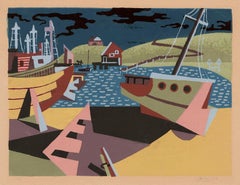
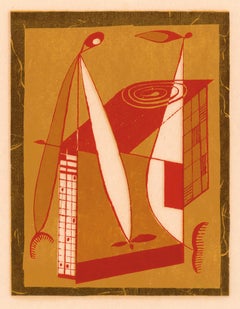
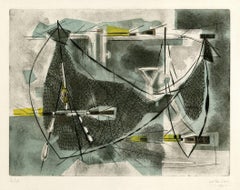
Abstract Boats — American Modernism, WPA
By Leon Bibel
Located in Myrtle Beach, SC
Leon Bibel, 'Abstract Boats', color serigraph, 1938, edition 12. Signed, dated, and numbered ' /12' in pencil. A fine, painterly impression, with fresh colors, on buff wove paper; t...
Category

1930s American Modern South Carolina - Prints and Multiples

Materials

Screen

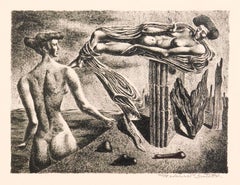
Body and Soul — Mid-20th Century Surrealism
By Federico Castellon
Located in Myrtle Beach, SC
Federico Castellon, 'Body and Soul', 1938, lithograph, edition 30, Freundlich 3. Signed in pencil. Signed in the stone, lower left. A fine, richly-inked, atmospheric impression on cr...
Category

1940s Surrealist South Carolina - Prints and Multiples

Materials

Lithograph

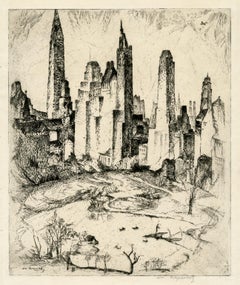
New York, Central Park — 1930s American Modernism
By William Meyerowitz
Located in Myrtle Beach, SC
'New York, Central Park', etching, edition 40, c. 1930. Signed in pencil. Titled and numbered '14/40' on the bottom sheet edge, in pencil. Signed in the plate, lower left. A superb, ...
Category

1930s American Modern South Carolina - Prints and Multiples

Materials

Etching

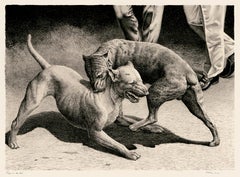
Pups in the Pit — American Realism
Located in Myrtle Beach, SC
William Wind McKim, 'Pups in the Pit', lithograph, 1967, edition c. 50. Signed and titled in pencil. A fine, richly-inked impression, on cream wove paper, with full margins (1 1/8 to...
Category

1940s American Realist South Carolina - Prints and Multiples

Materials

Lithograph

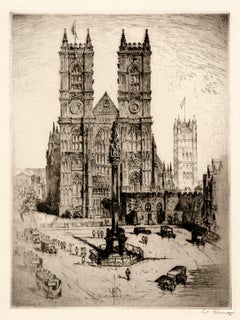
Westminster Abbey — Royal Church, London
By Anton Schutz
Located in Myrtle Beach, SC
Anton Schutz, 'Westminster Abbey', etching, edition not stated, 1927. Signed in pencil. Signed and dated in the plate, lower left. A superb, richly-i...
Category

1920s American Realist South Carolina - Prints and Multiples

Materials

Etching

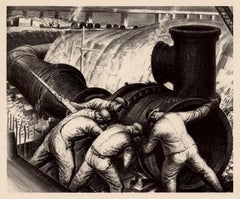
Pipe and Brawn — WPA Era American Realism
By James Allen
Located in Myrtle Beach, SC
James Allen, 'Pipe and Brawn,' 1937, lithograph, edition 40. Signed and annotated 'Ed/40' in pencil. A superb, richly inked impression on cream wove paper, the full sheet with margin...
Category

1930s American Realist South Carolina - Prints and Multiples

Materials

Lithograph

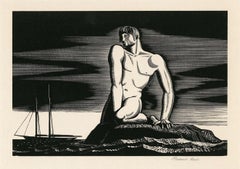
The Bather — Iconic American Modernism
By Rockwell Kent
Located in Myrtle Beach, SC
Rockwell Kent, 'The Bather', wood engraving, 1931, edition 120, Burne Jones 63. Signed in pencil. A brilliant, black impression, on cream, wove Japan paper; the full sheet with margins (2 1/2 to 3 1/4 inches); slight skinning at the top sheet edge, verso, otherwise in excellent condition. Archivally matted to museum standards, unframed. Image size 5 3/8 x 7 7/8 inches (137 x 200 mm); sheet size 11 1/8 x 14 1/2 inches (283 x 368 mm). Impressions of this work are held in the following public collections: Burne Jones Collection (Illinois), Chazen Museum of Art, Chegodaev Collection (Moscow), Kent Collection (New York), National Gallery of Art, Philadelphia Museum of Art; SUNY Plattsburg Art Museum, Princeton University Library, Pushkin Museum (Moscow), Smithsonian American Art Museum, Spector Collection (New York), University of Illinois. ABOUT THE ARTIST Rockwell Kent (1882-1971), though best known as a painter, graphic artist, and illustrator, pursued many careers throughout his life, including architect, carpenter, explorer, writer, dairy farmer, and political activist. Born in Tarrytown, New York, Kent was interested in art from a young age. These ambitions were encouraged by his aunt Jo Holgate, an accomplished ceramicist. Jo came to live with the family after Kent’s father passed away in 1887 and took him to Europe as a teenager, undoubtedly kindling his interest in exploring the world. Kent attended the Horace Mann School in New York City, where he excelled at mechanical drawing. His family’s financial circumstances prevented him from pursuing a career in the fine arts; however, after graduating from Horace Mann in 1900, Kent decided to study architecture at Columbia University. Before matriculating at Columbia, Kent spent the first of three consecutive summers studying painting at William Merritt Chase’s art school in Shinnecock Hills, Long Island. There he found a community of mentors and fellow students who encouraged him to pursue his interest in art. At the end of Kent’s third summer at Shinnecock, Chase offered him a full scholarship to the New York School of Art, where he was a teacher. Kent began taking night classes at the art school in addition to his architecture studies but soon left Columbia to study painting full-time. In addition to Chase, Kent took classes with Robert Henri and Kenneth Hayes Miller, where his classmates included the artists George Bellows and Edward Hopper. Kent spent the summer of 1903 assisting the eccentric painter Abbott Handerson Thayer at his studio in Dublin, New Hampshire—a position he secured through the recommendation of his Aunt Jo. Thayer’s naturalist lifestyle and almost mystical appreciation for natural phenomena greatly influenced Kent; he returned to Dublin for many years to visit Thayer and his family. Thayer gave the young artist time to pursue his work, and that summer Kent painted several views of the New Hampshire landscape, including Mount Monadnock...
Category

1930s American Modern South Carolina - Prints and Multiples

Materials

Woodcut

Encircled — Mid-Century Surrealism, Atelier 17
Located in Myrtle Beach, SC
Ian Hugo, 'Encircled', engraving, 1946, edition 50. Signed, dated, titled, and numbered '5/50' in pencil. With the blind stamp 'madeleine-claude jobrack EDIT...
Category

1940s Surrealist South Carolina - Prints and Multiples

Materials

Engraving

Heart of San Francisco — Vintage 1920s Realism
By Anton Schutz
Located in Myrtle Beach, SC
Anton Schutz, 'Heart of San Francisco', etching, c. 1927, edition not stated. Signed in pencil. A superb, richly-inked impression, on cream wove paper; the full sheet with margins (2...
Category

1920s American Realist South Carolina - Prints and Multiples

Materials

Etching

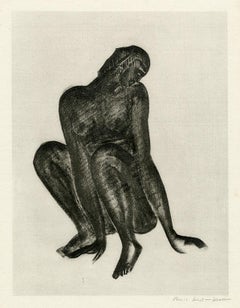
Untitled (Black Woman Crouching) — 1920s Modernism
By Boris Lovet-Lorski
Located in Myrtle Beach, SC
Boris Lovet-Lorski, 'Untitled (Black Woman Crouching)', lithograph, edition 250, 1929. Signed and numbered 16 in pencil. Number 16 of Volume 2, a series of...
Category

1920s Art Deco South Carolina - Prints and Multiples

Materials

Lithograph

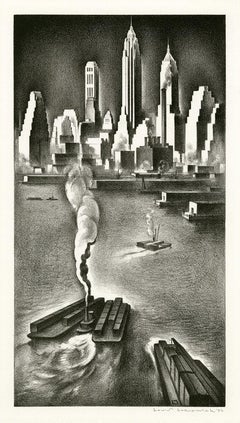
Mural Study: Lower Manhattan — WPA Era Precisionism
By Louis Lozowick
Located in Myrtle Beach, SC
Louis Lozowick, 'Mural Study: Lower Manhattan', lithograph, edition 10 or fewer, 1936. Flint 135. Signed and dated in pencil. Signed in the stone, lower right. A fine, richly-inked...
Category

1930s American Modern South Carolina - Prints and Multiples

Materials

Lithograph

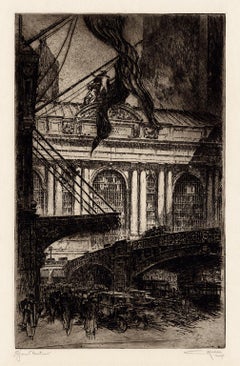
Grand Central Station — New York City Landmark
By Otto Kuhler
Located in Myrtle Beach, SC
Otto Kuhler, 'Grand Central Station', etching and drypoint, 1927, edition c. 50, Kennedy 27. Signed and titled in pencil. A superb, richly-inked impression, in brown/black ink, with ...
Category

1920s American Impressionist South Carolina - Prints and Multiples

Materials

Drypoint, Etching

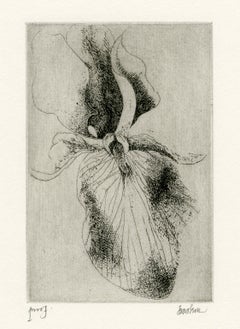
Iris (5)
By Leonard Baskin
Located in Myrtle Beach, SC
Leonard Baskin, 'Iris ( 5 )', etching, 1988, artist proof before the edition of 10, outside the book edition. Signed and annotated 'proof' in pencil. A fine impression, with expertly...
Category

1980s Impressionist South Carolina - Prints and Multiples

Materials

Etching

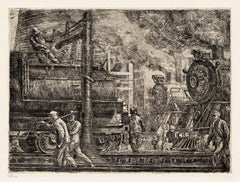
Locomotives Watering — Ashcan School Social Realism
By Reginald Marsh
Located in Myrtle Beach, SC
Reginald Marsh, 'Erie R.R. Locos Watering (Locomotives Watering)', etching, 1934, edition 100 (Whitney, 1969), Sasowsky 155. Unsigned as published; numbered '68/100' in pencil. A su...
Category

1930s Ashcan School South Carolina - Prints and Multiples

Materials

Etching

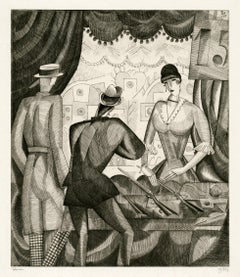
Le Tir Forain (Fairground Shooting) — 1920s French Cubism
By Jean-Emile Laboureur
Located in Myrtle Beach, SC
Le Tir Forain, engraving, edition 108, 1920-21, Sylvain Laboureur 191. Signed and numbered '19/85 ép' in pencil. Initialed 'L' and dated 1920 in the matrix,...
Category

1920s Cubist South Carolina - Prints and Multiples

Materials

Engraving

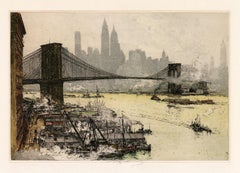
Brooklyn Bridge — Iconic New York City Landmark
By Luigi Kasimir
Located in Myrtle Beach, SC
Luigi Kasimir, 'Brooklyn Bridge', color etching with aquatint, 1927, edition 100. Signed in pencil. A superb impression, with fresh colors, on heavy, cream wove paper; with margins...
Category

1920s American Modern South Carolina - Prints and Multiples

Materials

Etching, Aquatint

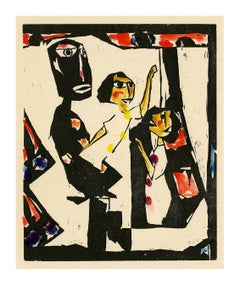
Theater — 1920s German Expressionism
Located in Myrtle Beach, SC
A German Expressionist woodcut, with original hand-coloring in watercolor, depicting a parent and child watching a theatrical production; ...
Category

1920s Expressionist South Carolina - Prints and Multiples

Materials

Woodcut

Poppy — Art Deco Pochoir from the acclaimed portfolio RELAIS
By Edouard Benedictus
Located in Myrtle Beach, SC
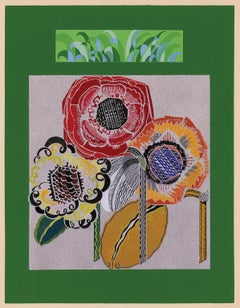
Edouard Benedictus, 'Poppy' from the portfolio 'Relais', plate 14, color pochoir, 1930. Signed in the matrix, in the center bottom margin. A superb, richly-inked impression, with fresh, vibrant colors, including metallic gold and silver inks, on heavy, cream wove paper; the full sheet with margins (1 3/8 inches), in excellent condition. Published by Éditions Vincent, Fréal et Cie, Paris. The pochoir production is by Jean Saudé, the French printmaker known for his mastery of the technique and the author of the first how-to book on the pochoir process. Matted to museum standards, unframed. Image size 14 3/8 x 11 inches (365 x 279 mm); sheet size 17 1/4 x 13 7/8 inches (438 x 352 mm). Impressions of this work are held in the following museum collections: Cooper-Hewitt National Design Museum Library (Smithsonian), Metropolitan Museum of Art, Minneapolis Institute of Art, New York Public Library, Toledo Museum of Art, Victoria and Albert Museum (London), Virginia Museum of Fine Arts. ABOUT THIS WORK The Pochoir process is a refined stencil-based technique employed to create multiples or to add color to prints produced in other mediums. Characterized by its crisp lines and rich color, the print-making process was most popular from the late 19th century through the 1930s, with its center of activity in Paris. The pochoir process began with the analysis of an image’s composition, including color tones and densities. The numerous stencils (made of aluminum, copper, or zinc) necessary to create a complete image were then designed and hand-cut by the 'découpeur.' The 'coloristes' applied watercolor or gouache pigments through the stencils, skillfully employing a variety of different brushes and methods of paint application to achieve the desired depth of color and textural and tonal nuance. The pochoir process, by virtue of its handcrafted methodology, resulted in the finished work producing the effect of an original painting, and in fact, each print was unique. ABOUT THE ARTIST Edouard Benedictus (1878 -1930), artist, designer, composer, and chemist, was born and died in Paris. A highly-regarded designer and art critic of the Art Nouveau era, Benedictus gained renown as a colorist and creator of Art Deco-inspired geometric and floral motifs. His work had a significant influence on international fashions in clothing, home furnishings, graphic design, and decorative objects of the period, earning him commissions from leading European design firms. In 1925 he was invited to represent Art Deco textile design...
Category

1930s Art Nouveau South Carolina - Prints and Multiples

Materials

Stencil

Downtown, New York — 1920s Modernism
By John Taylor Arms
Located in Myrtle Beach, SC
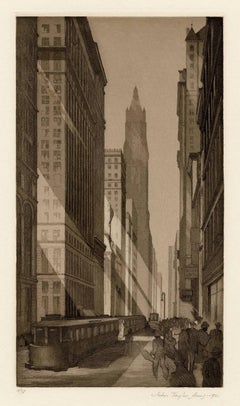
John Taylor Arms, 'Downtown, New York', etching with aquatint, 1921, edition 75, Fletcher 108. Signed, dated, and numbered 14/75 in pencil. A superb, finely nuanced impression, in d...
Category

Early 20th Century American Modern South Carolina - Prints and Multiples

Materials

Etching

Diver — 1930s American Modernism
By Rockwell Kent
Located in Myrtle Beach, SC
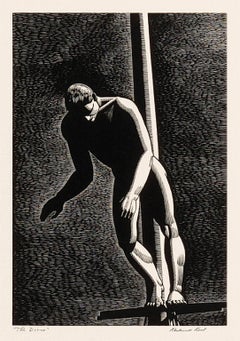
Rockwell Kent, 'Diver', wood engraving, 1931, edition 150, Burne Jones 88. Signed, and titled 'The Diver' in pencil.. A brilliant, black impression, on cream, wove Japan paper; the f...
Category

1930s American Modern South Carolina - Prints and Multiples

Materials

Woodcut

Avalon South —— Mid-Century Modernism
Located in Myrtle Beach, SC
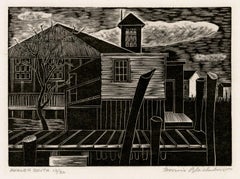
Morris Blackburn, 'Avalon South', wood engraving, 1951, edition 30. Signed, titled, and numbered '12/30' in pencil. A fine black impression on cream wove Japan paper, with wide margins (1 3/8 to 2 1/4 inches), in excellent condition. Archivally sleeved, unmatted. Image size 5 x 7 inches (127 x 178 mm); sheet size 8 5/8 x 10 7/8 inches (219 x 276 mm). ABOUT THE ARTIST Morris Blackburn was a prominent painter, printmaker, and graphic artist, as well as a respected teacher at the Philadelphia Museum School of Industrial Art and the Pennsylvania Academy of Fine Arts. Born in Philadelphia, where he spent most of his career, Blackburn was a descendant of the notable colonial portrait artist Joseph J. Blackburn (c. 1700–1780). He developed an interest in art early on and studied architectural drawing at the Philadelphia Trade School. In 1922, he took classes at the Graphic Sketch Club and later attended the School of Industrial Art. While working for the well-known Philadelphia furniture designer Oscar Mertz, he studied at the Pennsylvania Academy of the Fine Arts from 1925 to 1929. During his studies, he learned painting from Henry Bainbridge McCarter...
Category

1950s Modern South Carolina - Prints and Multiples

Materials

Woodcut

Chinoiserie — Mid-Century Modernism
By Edward August Landon
Located in Myrtle Beach, SC
Edward Landon 'Chinoiserie', color serigraph, 1947, edition 50, Ryan 36. Signed in pencil in the image, lower right. Titled, dated, and annotated '4 COLORS – EDITION 50' in the scree...
Category

Mid-20th Century American Modern South Carolina - Prints and Multiples

Materials

Screen

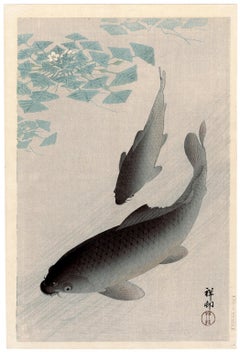
Carp and Water Chestnut — Showa lifetime impression
By Ohara Koson
Located in Myrtle Beach, SC
Ohara Koson (1877-1945), 'Carp and Water Chestnut', color woodblock print, 1926. A fine impression, with fresh colors, on cream Japan paper; the full sheet, in excellent condition. Signed 'Koson' with the artist’s red seal 'Koson'. Published by Watanabe Shozaburo. With the Watanabe 'C' seal in the lower right margin, indicating a lifetime impression printed between 1929-1942. Image size 13 1/2 x 7 1/4 inches (343 x 184 mm); sheet size 14 1/2 x 7 1/2 inches (368 x 191 mm). Archivally sleeved, unmatted. Literature: 'Crows, Cranes, and Camellias: The Natural World of Ohara Koson', Newland, Amy R.: Jan Perree & Robert Schaap, Leiden: Hotei Publishing, 2001. S39.1, pl 169. Collections: National Museum of Asian Art (Smithsonian), Smart Museum of Chicago (University of Chicago). In Japanese art, the carp represents good luck and good fortune. ABOUT THE ARTIST Koson Ohara...
Category

1920s Showa South Carolina - Prints and Multiples

Materials

Woodcut

Soaring New York — 1930s American Modernism, New York City
By Howard Norton Cook
Located in Myrtle Beach, SC
Howard Cook, 'Soaring New York', aquatint, soft-ground etching, roulette, 1931-32, edition 25, Duffy 165. Signed, dated, and annotated 'imp' in pencil. A superb, richly-inked, atmosp...
Category

1930s American Modern South Carolina - Prints and Multiples

Materials

Etching, Aquatint

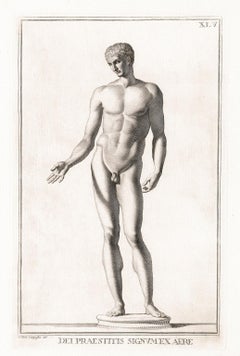
Dei Praestitis Signumexaere — 18th Century Classical Italian Realism
Located in Myrtle Beach, SC
Giovanni Domenico Campiglia, 'Dei Praestitis Signumexaere' (God's Providence Signumexaere), engraving, 1734, edition unknown. Signed 'Dom. Campiglia del.' in the plate, lower left. E...
Category

1730s Realist South Carolina - Prints and Multiples

Materials

Engraving

Nets – Mid-Century Modernism, Atelier 17
By Sigismond Kolos-Vari
Located in Myrtle Beach, SC
Sigismond Kolos-Vari, 'Nets', color etching with soft-ground and aquatint, edition 200 (1 of 60 artist's proofs), 1952. Signed and dated in pencil. Numbered L/LX in pencil. A superb, richly-inked impression, on heavy, off-white, Arches wove paper; the full sheet with margins (1 3/8 to 3 1/2 inches), in excellent condition. Published by the Guide de la Gravure, Switzerland, with their blindstamp in the bottom left sheet corner. Matted to museum standards, unframed. Image size 11 3/4 x 15 5/8 inches (298 x 397 mm); sheet size 15 x 22 1/4 inches (381 x 565 mm). ABOUT THE ARTIST Sigismund Kolos-Vari was born in Hungary and attended the School of Applied Arts in Budapest from 1915 to 1918 and then the School of Decorative Arts until 1925. The artist settled in Paris, and his first one-person show in 1928 at Galerie Miromesnil, which was highly successful, led to numerous subsequent exhibitions, including with the prestigious Galerie Bonaparte in 1929 and Galerie Povolosky in 1930. Kolos-Vari’s early success was abruptly interrupted by the outbreak of WWII when he was arrested by the Gestapo and imprisoned in the Gurs internment camp. During this period, he created a sketchbook for a little girl, which is now preserved at the Centre de Documentation Juive Contemporaine at the Mémorial de la Shoah in Paris. He managed to escape after two years, crossing the border into Switzerland. After the war, he returned to Paris with a renewed dedication to his painting, producing increasingly powerful compositions. His work was highly acclaimed when shown at an important 1946 exhibition at the Musée National d’Art Moderne de Paris, organized by Jean Cassou. The artist was then approached by the eminent art dealer Jean Bucher, who gave Kolos-Vary a major one-person show at his gallery in 1948. During this post-war period, Kolos-Vary participated in the radical Salon de Mai, 1949-1958, the Salon des Réalités Nouvelles, 1956-1961, and the Salon des Comparaisons, 1960-1962. Supported by his association with Stanley William Hayter and the landmark printmaking workshop Atelier 17...
Category

Mid-20th Century Abstract Expressionist South Carolina - Prints and Multiples

Materials

Etching, Aquatint

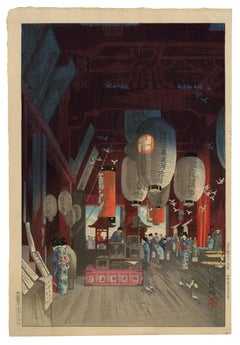
Interior of the Kannon Temple at Asakusa — Tokyo Landmark, Early Edition
Located in Myrtle Beach, SC
NARAZAKI EISHO (1864-1936), 'Asakusa Kannon-do no naido' (Interior of the Kannon Temple at Asakusa), color woodblock print, 1932. Signed Eisho lower right, with the artist’s red seal beneath. A fine impression with fresh colors; the full sheet with slight overall age toning, a drying tack...
Category

1930s South Carolina - Prints and Multiples

Materials

Woodcut

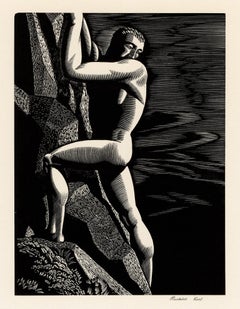
Mountain Climber — American Modernism
By Rockwell Kent
Located in Myrtle Beach, SC
Rockwell Kent, 'Mountain Climber', wood engraving, 1933, edition 250, Burne Jones 93. Signed in pencil. A brilliant, black impression, on cream, wove Japan paper; the full sheet with margins (2 9/16 to 3 5/8 inches); slight skinning at the top sheet edge verso, where previously hinged; otherwise, in excellent condition. Archivally matted to museum standards, unframed. Image size 7 7/8 x 5 7/8 inches (200 x 149 mm); sheet size 14 x 11 1/8 inches (356 x 283 mm). Printed by Pynson Printers, New York. Distributed by The Print Club of Cleveland, Publication No. 11, 1933. Literature: 'Rockwellkentiana,' Harcourt, Brace and Company, New York, 1933. '101 of The World’s Greatest Books', edited by Spencer Armstrong, 1950. Impressions of this work are held in the following museum collections: Akron Art Institute, Burne Jones Collection, IL; Cincinnati Art Museum; Cleveland Museum of Art; Columbus Gallery of Fine Arts; Crystal Bridges Museum of American Art; Davis Museum at Wellesley College; Fine Art Museums of San Francisco; H. M. de Young Museum; Hermitage Museum; Kent Collection, NY; Library of Congress; Memorial Art Gallery, University of Rochester; Metropolitan Museum of Art; New York Public Library; Philadelphia Museum of Art; Princeton University Library; Smithsonian American Art Museum, Spector Collection, NY; SUNY, Plattsburg. ABOUT THE ARTIST Rockwell Kent (1882-1971), though best known as a painter, graphic artist, and illustrator, pursued many careers throughout his life, including architect, carpenter, explorer, writer, dairy farmer, and political activist. Born in Tarrytown, New York, Kent was interested in art from a young age. These ambitions were encouraged by his aunt Jo Holgate, an accomplished ceramicist. Jo came to live with the family after Kent’s father passed away in 1887 and took him to Europe as a teenager, undoubtedly kindling his interest in exploring the world. Kent attended the Horace Mann School in New York City, where he excelled at mechanical drawing. His family’s financial circumstances prevented him from pursuing a career in the fine arts; however, after graduating from Horace Mann in 1900, Kent decided to study architecture at Columbia University. Before matriculating at Columbia, Kent spent the first of three consecutive summers studying painting at William Merritt Chase’s art school in Shinnecock Hills, Long Island. There he found a community of mentors and fellow students who encouraged him to pursue his interest in art. At the end of Kent’s third summer at Shinnecock, Chase offered him a full scholarship to the New York School of Art, where he was a teacher. Kent began taking night classes at the art school in addition to his architecture studies but soon left Columbia to study painting full-time. In addition to Chase, Kent took classes with Robert Henri and Kenneth Hayes Miller, where his classmates included the artists George Bellows and Edward Hopper. Kent spent the summer of 1903 assisting the eccentric painter Abbott Handerson Thayer at his studio in Dublin, New Hampshire—a position he secured through the recommendation of his Aunt Jo. Thayer’s naturalist lifestyle and almost mystical appreciation for natural phenomena greatly influenced Kent; he returned to Dublin for many years to visit Thayer and his family. Thayer gave the young artist time to pursue his work, and that summer Kent painted several views of the New Hampshire landscape, including Mount Monadnock. In 1905 Kent moved from New York to Monhegan Island in Maine, home to a summer art colony, where he continued to find inspiration in nature. Kent soon found success exhibiting and selling his paintings in New York, and in 1907, he was given his first solo show at Claussen Galleries. The following year he married his first wife, Kathleen Whiting (Thayer’s niece), with whom he had five children. The couple divorced in 1924, and Kent married Frances Lee the following year. They divorced after 15 years of marriage, and the artist married Sally Johnstone. For the next several decades, Kent lived a peripatetic lifestyle, settling in several locations in Connecticut, Maine, and New York. During this time he took several extended voyages to remote, often ice-filled, corners of the globe, including Newfoundland, Alaska, Tierra del Fuego, and Greenland, to which he made three separate trips. For Kent, exploration and artistic production were twinned endeavors, and his travels to these rugged, elemental locations inspired his visual art and his writings. He developed a stark, realist landscape style in his paintings and drawings that revealed both nature’s harshness and its sublimity. Kent’s human figures, which appear sparingly in his work, often allude to the mythic themes of isolation, individualism, heroism, and the quest for self-connection. Important exhibitions of works from these travels include the Knoedler Gallery’s shows in 1919 and 1920, featuring Kent’s Alaska drawings...
Category

1930s American Modern South Carolina - Prints and Multiples

Materials

Woodcut

Still Thinking About These?

All Recently Viewed