South Carolina - Prints and Multiples

to
43
323
25
1
3
Overall Width
to
Overall Height
to
151
24
18
16
13
12
7
6
1
16
13
12
12
9
10
15
324
3
4
14
76
86
75
11
11
14
5
2
6
190
154
2
172
88
83
64
47
45
25
23
22
16
16
15
14
11
10
9
9
9
8
8
105
86
74
50
28
1
51,015
36,886
Item Ships From: South Carolina
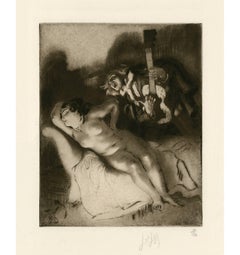
The Serenade — Fin-de-siècle French Romantic Eroticism
By Louis Legrand
Located in Myrtle Beach, SC
Louis Legrand, 'The Serenade', soft-ground etching, drypoint, and aquatint, c. 1895, edition 20. Signed and numbered '9/20' in pencil. Annotated '20 proofs taken' in pencil, bottom l...
Category

1890s Post-Impressionist South Carolina - Prints and Multiples

Materials

Drypoint, Etching, Aquatint

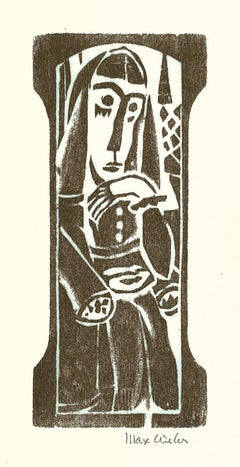
Seated Figure — American Expressionism
By Max Weber
Located in Myrtle Beach, SC
Max Weber, 'Seated Figure", woodcut, edition not stated, 1919-20, Rubenstein 17. Signed in pencil. A fine impression on cream Japan paper; the full sheet with margins (2 to 3 1/8 in...
Category

1920s Expressionist South Carolina - Prints and Multiples

Materials

Woodcut

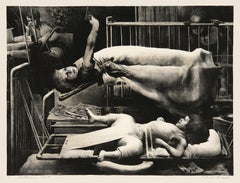
Children s Ward — Socially-Conscious Realism
By Robert Riggs
Located in Myrtle Beach, SC
Robert Riggs, 'Children's Ward', 2-color lithograph, c. 1940, edition c. 50, Beall 11, Bassham 76. Signed, titled, and numbered '14' in pencil. Signed in the stone, lower right. A su...
Category

1940s Realist South Carolina - Prints and Multiples

Materials

Lithograph

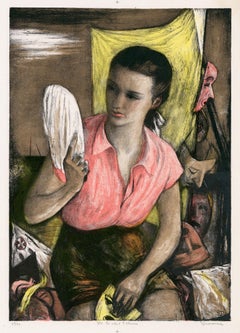
I ll Be What I Choose — Mid-century American Surrealism
By Benton Murdoch Spruance
Located in Myrtle Beach, SC
'I'll Be What I Choose: Vanity of Ambition', color lithograph, 1949, edition 40, Fine and Looney 281. Signed, titled, and numbered '23/40' in pencil. Initialed in the stone, lower ri...
Category

1940s American Modern South Carolina - Prints and Multiples

Materials

Lithograph

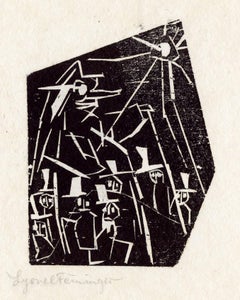
Da - Da I — German Expressionism, Rare
By Lyonel Feininger
Located in Myrtle Beach, SC
Lyonel Feininger, 'Da-Da I' also titled by the artist 'Der Abgott' (The Idol), woodcut, 1918, a proof impression. Prasse W91. Signed in pencil and annotated '1876', the artist’s inv...
Category

1920s Bauhaus South Carolina - Prints and Multiples

Materials

Woodcut

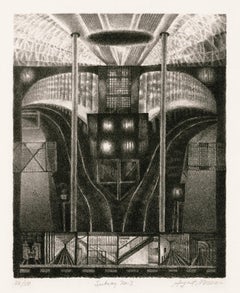
Subway No. 3 — Mid-century Modernism, New York City
By August Mosca
Located in Myrtle Beach, SC
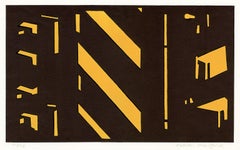
August Mosca, 'Subway No. 3', lithograph, c. 1946-56, edition 50. Signed, titled and numbered '28/50' in pencil. A fine, richly-inked impression on off-white, wove paper; the full sh...
Category

Mid-20th Century American Modern South Carolina - Prints and Multiples

Materials

Lithograph

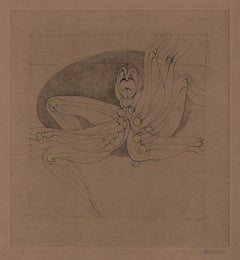
Les Marionettes I — Erotic Surrealism
By Hans Bellmer
Located in Myrtle Beach, SC
Hans Bellmer, Les Marionettes I, etching with hand coloring, 1969, edition 150. Signed and annotated 'HC' in pencil. A fine impression on brown Roma hand-made laid paper; the full sheet with margins (1 to 2 5/8 inches), in excellent condition. Archivally sleeved, unmatted. Image size 11 13/16 x 11 1/8 inches; sheet size 15 5/8 x 13 1/4 inches. A 'Hors Commerce' impression. From a suite of 11 etchings created by Bellmer to illustrate 'On the Marionette Theatre...
Category

1960s Surrealist South Carolina - Prints and Multiples

Materials

Etching

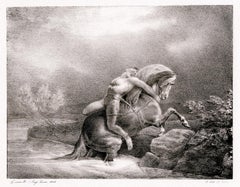
Mazeppa — 19th-Century French Romanticism
By Jean Louis Andre Theodore Gericault
Located in Myrtle Beach, SC
Théodore Géricault and Eugène Lami, 'Mazeppa' from the series 'Oeuvres de Lord Byron', lithograph, 1823, 2nd state of 3, Delteil 94. Rendered by Thé...
Category

1820s Romantic South Carolina - Prints and Multiples

Materials

Lithograph

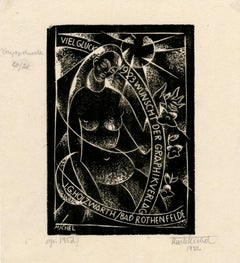
Viel Gluck 1923 (Good Luck Wishes) — German Expressionism
By Karl Michel
Located in Myrtle Beach, SC
Karl Michel, 'Viel Gluck 1923 Wunscht der Graphikverlag, J.G. Holzwarth/Bad Rothenfelde', woodcut, 1922, edition 20. Signed and numbered op. 135d and 20/20 in pencil. Signed in the image, lower left. Annotated 'Vorgesdruck' [artist’s proof] in pencil. A fine, richly-inked impression, on heavy, cream Japan paper, with full margins (5/8 to 1 1/8 inches), in good condition. With the artist’s blind stamp in the top left margin. Printed by the artist. Matted to museum standards, unframed. New Year's Greeting - "1923, Good Luck Wishes from the Graphic Press, J.G. Holzwarth/Bad Rothfelde." Image size 5 x 3 1/2 inches (127 x 89 mm); sheet size 6 5/8 x 5 7/8 inches (168 x 149 mm). ABOUT THE ARTIST Karl Michel (1889-1984) was a noted graphic designer and expressionist printmaker during Germany's pre-Nazi Weimar Republic (1919-1933). Michel’s work was the subject of a feature article in the influential German graphic design magazine Das Plakat (The Poster) in 1920. An anti-war advocate, Michel created a suite of 12 wood engravings depicting his impressions of the humanitarian toll of WWII entitled ‘Humanitas’ (Humanity). The German publishing house Greifenverlag published the series in a reduced folio of unsigned prints. Michel’s graphic work is held in the permanent collections of the Auckland War Memorial Museum (New Zealand), Frederikshavn Kunstmuseum & Exlibrissamling (Denmark), Museum of Applied Arts (Budapest), The Robert Gore Rifkind Center for German Expressionist Studies at the Los Angeles County Museum of Art, and the German Expressionism...
Category

1920s Expressionist South Carolina - Prints and Multiples

Materials

Woodcut

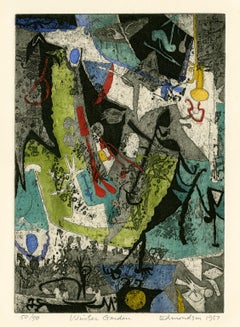
Winter Garden
By Leonard Edmondson
Located in Myrtle Beach, SC
Leonard Edmondson, 'Winter Garden', color etching, edition 50, 1957. Signed, titled, dated, and numbered '50/50' in pencil. A superb, richly-inked impre...
Category

1950s Abstract Expressionist South Carolina - Prints and Multiples

Materials

Etching

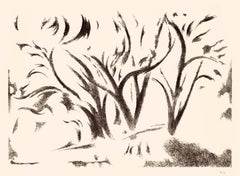
Trees in Ranchitos I — Taos Modernism
By Andrew Dasburg
Located in Myrtle Beach, SC
Andrew Dasburg, 'Trees in Ranchitos I', lithograph, 1975, edition 20. Signed 'A. D.' in pencil. Annotated 'Trial Proof' in pencil, verso. A superb impression in warm black ink, on he...
Category

1970s Modern South Carolina - Prints and Multiples

Materials

Lithograph

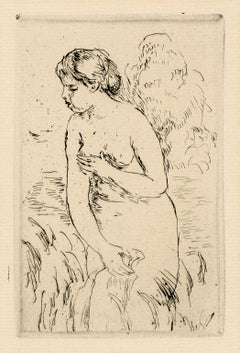
Baigneuse Debout, à Mi-Jambes — French Impressionism
By Pierre-Auguste Renoir
Located in Myrtle Beach, SC
Pierre Auguste Renoir, 'Baigneuse Debout, à Mi-Jambes (Woman Bathing, Standing Up to Her Knees in Water)', 1910, etching, edition not stated, Delteil 23. Unsigned as published. A fin...
Category

1910s Impressionist South Carolina - Prints and Multiples

Materials

Etching

By the Arks — Mid-20th Century Surrealism
By Federico Castellon
Located in Myrtle Beach, SC
Federico Castellon, 'By the Arks', 1941, lithograph, edition 250, Freundlich 10D. Signed in pencil. Signed in the stone, lower left. A fine, atmospheric impression on cream, wove pap...
Category

1940s Surrealist South Carolina - Prints and Multiples

Materials

Lithograph

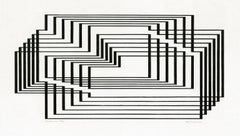
Interim from the series Graphic Tectonics —Mid-Century Geometric Abstraction
By Josef Albers
Located in Myrtle Beach, SC
Josef Albers, 'Interim' from the series 'Graphic Tectonics', zinc plate lithograph, 1942, edition 30, Danilowitz 101. Signed, titled, dated, and numbered '3/30' in pencil. A fine imp...
Category

1940s Abstract Geometric South Carolina - Prints and Multiples

Materials

Lithograph

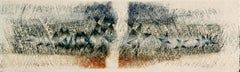
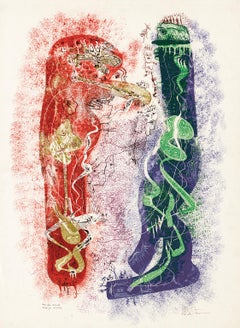
Bertoia — Mid-Century Visionary Abstraction, Unique
By Harry Bertoia
Located in Myrtle Beach, SC
Harry Bertoia, Untitled (Abstraction), monotype, c. 1960, a unique impression. Signed 'HB' in pencil, lower right sheet corner, verso. Inscribed '1852' (the artist’s inventory number) in pencil, lower right sheet corner, recto. A superb, painterly impression, on cream wove Japan paper, the full sheet, in excellent condition. Unmatted, unframed. Sheet size 12 x 39 inches (30 x 99 cm). Provenance: Val Bertoia; Private Collection; Rago Auctions, Lambertville, NJ. Literature: 'Harry Bertoia: Monoprints,' Nancy N. Schiffer, Schiffer Publishing LTD, 2011; pg. 253. This work is included in the Harry Bertoia Foundation digital resource, Harry Bertoia Catalogue Raisonné, number TD.MO.1584. ABOUT THE ARTIST Harry Bertoia (1915-1978) was a visionary Italian-American artist, sculptor, and designer. Born in San Lorenzo, Italy, Bertoia immigrated to the United States with his family at age fifteen, settling in Detroit, Michigan. From an early age, Bertoia demonstrated a keen interest in art and design, studying painting and drawing at the Cass Technical High School in Detroit. Later, he attended the Cranbrook Academy of Art in Bloomfield Hills, Michigan, where he studied under renowned designers Eliel Saarinen and Charles Eames. At Cranbrook, Bertoia first began to explore the possibilities of working with metal, a medium that would come to define his artistic career. In the 1940s, Bertoia moved to California to work for Charles and Ray Eames, contributing to the development of innovative molded plywood furniture. However, his experimentation with metal wire sculpture would ultimately catapult him to international acclaim. Bertoia's iconic "Sonambient" sculptures, consisting of delicate metal rods arranged in various configurations, created ethereal sounds when touched or moved, transforming the act of sculpture into a multisensory experience. Bertoia's talent and innovation caught the attention of Florence Knoll, the founder of Knoll Associates, a leading furniture design company. In 1950, Bertoia began collaborating with Knoll, producing a series of iconic wire chairs that became emblematic of mid-century modern design. His "Diamond Chair," with its geometric form and airy construction, remains a classic of modern furniture design. Bertoia continued to explore sculpture as a means of artistic expression, experimenting with new forms and materials. His work was characterized by organicism and fluidity, with forms that evoked natural phenomena such as waves, leaves, and clouds. A decade before Harry Bertoia began creating three-dimensional sculpture, he dedicated his creative efforts to producing experimental prints at the Cranbrook Academy in Bloomfield Hills, Michigan, pursuing a passion that would continue for the rest of his life. With these spontaneous works, he worked intuitively, testing different tools and techniques to achieve his desired effects. Rather than using a traditional mechanical pressing process, he would apply ink to a glass or smooth Masonite plate with a sheet of paper laid directly on top. Then, tools such as brayers, dog hair brushes, styluses, and different parts of his hands were employed to draw or “press” the images on the back of the sheet. Rice paper was typically used due to its semi-translucent nature, offering Bertoia limited visibility of the effects of his experimentation, but ultimately, the unpredictable nature of the process was an integral aspect of the results, which never ceased to delight him. Each work was a singular composition with abstract imagery ranging from linear, structural compositions to fantastic surrealistic forms to poetic tonal landscapes. He received little input from other artists, developing his unique vision with rare purity and a deep personal resonance. From his first year of printmaking in 1940, Bertoia quickly amassed an extensive collection of unique works. The compositions were strongly tied to the non-objective movement, which, while popular in Europe, was still in its nascent stages in the US. There were few proponents of this new art form to be found in the 1940s, and it was Hilla Rebay, then Director of the Guggenheim Museum of Non-Objective Art, who gave Bertoia the encouragement and promotion he needed. In 1943, Bertoia sent approximately 100 monotypes to Rebay for review. After receiving the prints, she responded with a surprising offer to buy them all. Rebay then began including them in the museum’s exhibitions. The Guggenheim shows succeeded in putting Bertoia’s name out into the world. He began exhibiting his works regularly at the Neierndorf Gallery in New York and was provided a stipend to ensure a steady supply of prints until Karl Neierndorf died in 1947. By the 1950s...
Category

1960s American Modern South Carolina - Prints and Multiples

Materials

Monotype

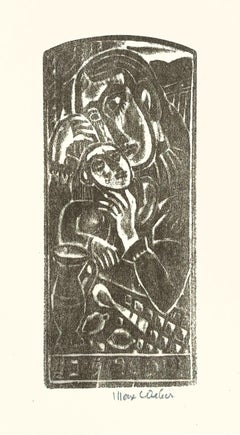
Mother Love (Madonna and Child) — American Expressionism
By Max Weber
Located in Myrtle Beach, SC
Max Weber, 'Mother Love' (Madonna and Child), woodcut, 1920, edition not stated, Rubenstein 35. Signed in pencil. A fine impression, on cream wove Japan paper, with full margins (1 5...
Category

1920s Expressionist South Carolina - Prints and Multiples

Materials

Woodcut

Mokihana (Hawaii) — Classic Polynesian Portrait
Located in Myrtle Beach, SC
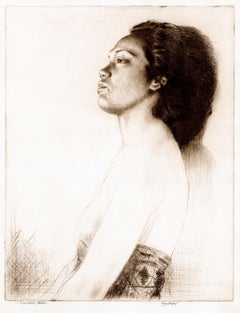
John Melville Kelly, 'Mokihana (Hawaii)', drypoint, 1946. Signed, titled, and annotated 'No 5' in pencil. A superb, finely nuanced impression, in dark brown ink, on cream wove Japan ...
Category

1940s American Modern South Carolina - Prints and Multiples

Materials

Drypoint

Erinnerung (Remembrance) — Turn-of-the Century Romanticism
By Max Klinger
Located in Myrtle Beach, SC
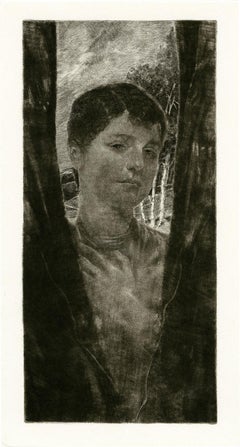
Max Klinger, 'Erinnerung' (Remembrance), original etching with aquatint, 1896. A fine, richly inked impression on off-white, wove paper, with full margins (1 3/4 to 3 1/8 inches), in...
Category

1890s Post-Impressionist South Carolina - Prints and Multiples

Materials

Etching, Aquatint

Harbor with Sailboats — Early 20th-Century Modernism
By George Josimovich
Located in Myrtle Beach, SC
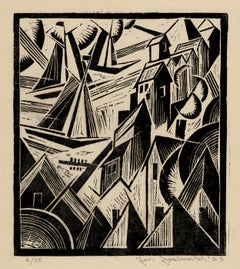
George Josimovich, Untitled (Harbor with Sailboats) ', linocut, 1923, edition 35. Signed, dated, and annotated '4/35' in pencil. Initialed 'G J' in ...
Category

1920s American Modern South Carolina - Prints and Multiples

Materials

Linocut

Child Reaching — 1940s American Modernism
By Will Barnet
Located in Myrtle Beach, SC
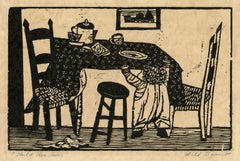
Will barnet, 'Child Reaching', woodcut, 1940, edition 25, Cole 82. Signed and titled in pencil. A fine, black impression, on fibrous Japan paper, with full margins (5/8 to 1 3/4 inch...
Category

1940s American Modern South Carolina - Prints and Multiples

Materials

Woodcut

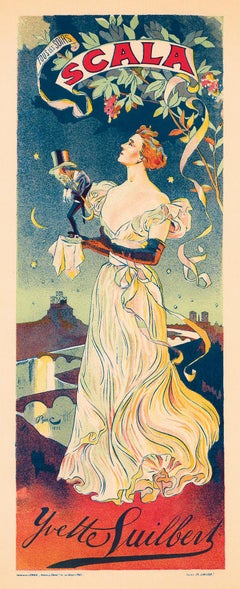
Yvette Guilbert, SCALA — Fin de Siècle, Paris
Located in Myrtle Beach, SC
BAC (Ferdinand Bach), 'Yvette Guilbert, Tous les Soirs SCALA', vintage color lithograph, 1893. Signed, dated, and titled in the stone. A superb, richl...
Category

1890s Art Nouveau South Carolina - Prints and Multiples

Materials

Lithograph

A Wind Is Rising and the Rivers Flow — Mid-Century American Modernism
By Benton Murdoch Spruance
Located in Myrtle Beach, SC
Benton Spruance, 'A Wind is Rising and the Rivers Flow', color lithograph, 1945, edition 40, Fine and Looney 242. Signed, dated, and titled, and annotated 'Ed 40' in pencil. A fine ...
Category

1940s American Modern South Carolina - Prints and Multiples

Materials

Lithograph

The Lamentation — Mid-century Modernism, WWII
By Benton Murdoch Spruance
Located in Myrtle Beach, SC
'The Lamentation', lithograph, 1941, edition 35, Fine and Looney 198. Signed, titled, and annotated 'Ed 35' in pencil. Initialed in the stone, lower ri...
Category

1940s American Modern South Carolina - Prints and Multiples

Materials

Lithograph

Ex Libris Dr. Witropp — German Expressionism
By Karl Michel
Located in Myrtle Beach, SC
Karl Michel, 'Ex Libris Dr. Witropp - Homunculus und Galatee', etching, 1923, edition not stated. Signed, dated, and numbered 'Op. 140' (the artist's inventory number) in pencil. Si...
Category

1920s Expressionist South Carolina - Prints and Multiples

Materials

Etching

#6 — Modernist Abstraction — African American Artist
Located in Myrtle Beach, SC
Hilliard Dean, '#6', color lithograph, 1970, edition 9. Signed, titled, and annotated 'Ed 9' in pencil. A fine impression, with fresh colors, on Arches, ...
Category

1970s Contemporary South Carolina - Prints and Multiples

Materials

Lithograph

Old Injun
By Charles Banks Wilson
Located in Myrtle Beach, SC
Charles Banks Wilson, 'Old Injun', lithograph, 1948, edition 250, Hunt 39. Signed in pencil. A fine, richly-inked impression, on off-white wove paper, with full margins (1 3/4 to 2 inches), in excellent condition. Published by Associated American Artists. Impressions of this work are in the permanent collections of the following institutions: Ackland Art Museum, Georgetown University...
Category

1940s American Realist South Carolina - Prints and Multiples

Materials

Lithograph

Astral Comic — Modernist Abstraction
By Edward August Landon
Located in Myrtle Beach, SC
Edward Landon 'Astral Comic', color serigraph, 1978, edition 25, Ryan 12. Signed, titled, and annotated 'Edition 25' in pencil. A superb, painterly impression, with fresh colors, on ...
Category

1970s Abstract South Carolina - Prints and Multiples

Materials

Screen

Havoc in Heaven — Mid-Century Modernism
By Benton Murdoch Spruance
Located in Myrtle Beach, SC
Benton Spruance, 'Havoc in Heaven', lithograph, 1948, edition 30-35, Fine and Looney 270. Signed, titled, and numbered 'Ed 35' in pencil. Initialed in the stone, lower right. A fine,...
Category

1940s American Modern South Carolina - Prints and Multiples

Materials

Lithograph

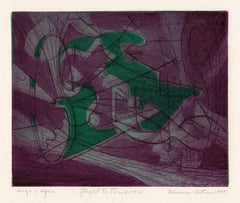
Flight to Tomorrow — Mid-Century American Modernism — Atelier 17
By Minna Citron
Located in Myrtle Beach, SC
Minna Citron, 'Flight to Tomorrow', aquatint and engraving, edition unknown but small, 1948. Signed, titled, dated, and annotated 'engr & aqua' in pencil. A superb, richly-inked impression with selectively wiped plate tone, on heavy cream wove paper, the full sheet with margins (1 3/4 to 3 1/2 inches), in excellent condition. Image size 6 7/8 x 8 7/16 inches (175 x 214 mm); sheet size 11 1/8 x 14 7/8 inches (283 x 378 mm). Matted to museum standards, unframed. Literature: The Women of Atelier 17, Modernist Printmaking in MidCentury New York, Christina Weyl, Yale University Press, 2019, p. 186. Collections: Davis Museum (Wellesley), Five Colleges and Historic Deerfield Museum Consortium, Harvard Art Museums, Museum of Fine Arts, Boston, Palmer Museum of Art (Penn State...
Category

1940s Abstract Expressionist South Carolina - Prints and Multiples

Materials

Engraving, Aquatint

September Still Life — Mid-Century Modernism
By Clinton Adams
Located in Myrtle Beach, SC
Clinton Adams, 'September Still Life', lithograph, 1956, edition 20. A superb impression, on cream wove paper, with full margins (1 1/2 to 3 1/8 inches);...
Category

1950s American Modern South Carolina - Prints and Multiples

Materials

Lithograph

Segments — 1930s Geometric Abstraction
By Josef Albers
Located in Myrtle Beach, SC
Josef Albers, 'Segments', linoleum cut, 1934, edition 20, 25, plus proofs, Danilowitz 79. Signed, titled, dated, and annotated '(proof)' in pencil. A fine, richly-inked impression on...
Category

1930s Abstract Geometric South Carolina - Prints and Multiples

Materials

Linocut

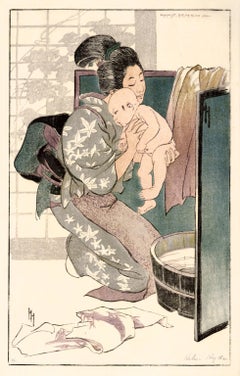
The Bath — Meji Era Cross-Cultural Woman Artist
By Helen Hyde
Located in Myrtle Beach, SC
Helen Hyde, 'The Bath', color woodblock print, edition not stated, 1905, Mason & Mason 59. Signed in pencil in the image, lower right. Numbered '96' in pencil in the image, lower left. The artist's monogram in the block, lower left, and 'Copyright, 1905, by Helen Hyde.' upper right. A superb impression with fresh colors on tissue-thin cream Japanese paper; the full sheet with margins (7/16 to 1 5/8 inches), in excellent condition. Matted to museum standards, unframed. Image size 16 1⁄4 x 10 1⁄8 in. (413 x 260 mm); sheet size: 19 1⁄4 x 11 1⁄8 in. (489 x 283 mm). Literature and Exhibition: Back cover illustration of the catalog of the artist’s prints, 'Helen Hyde', Smithsonian Institution Press, 1990; 'The International Block Print Renaissance, Then And Now, Block Prints In Wichita, Kansas, A Centennial Celebration — 1922-2022', Barbara J. Thompson, Wichita Art Museum, 2022 (back cover). Impressions of this work are held in the following collections: Achenbach Foundation for Graphic Arts, Art Institute of Chicago, Fine Arts Museums of San Francisco (De Young), Harvard Art Museums, Library of Congress, Metropolitan Museum of Art, New York Public Library, Smithsonian American Art Museum, Terra Foundation for American Art, University of Oregon Museum of Art. ABOUT THE ARTIST Helen Hyde (1868-1919) was a pioneer American artist best known for advancing Japanese woodblock printmaking in the United States and for bridging Western and Japanese artistic traditions. Hyde was born in Lima, New York, but after her father died in 1872, her family relocated to Oakland, California, where she spent much of her youth. Hyde pursued formal art education in the United States and Europe. She enrolled in the San Francisco School of Design, where she took classes from the Impressionist painter Emil Carlsen; two years later, she transferred to the Art Students League in New York, studying there with Kenyon Cox. Eager to expand her artistic repertoire, Hyde traveled to Europe, studying under Franz Skarbina in Berlin and Raphael Collin in Paris. While in Paris, she first encountered Japanese ukiyo-e prints, sparking a lifelong fascination with Japanese aesthetics. After ten years of study, Hyde returned to San Francisco, where she continued to paint and began to exhibit her work. Hyde learned to etch from her friend Josephine Hyde in about 1885. Her first plates, which she etched herself but had professionally printed, represented children. On sketching expeditions, she sought out quaint subjects for her etchings and watercolors. In 1897, Hyde made her first color etchings—inked á la poupée (applying different ink colors to a single printing plate)—which became the basis for her early reputation. She also enjoyed success as a book illustrator, and her images sometimes depicted the children of Chinatown. After her mother died in 1899, Hyde sailed to Japan, accompanied by her friend Josephine, where she would reside, with only brief interruptions, until 1914. For over three years, she studied classical Japanese ink painting with the ninth and last master of the great Kano school of painters, Kano Tomonobu. She also studied with Emil Orlik, an Austrian artist working in Tokyo. Orlik sought to renew the old ukiyo-e tradition in what became the shin hanga “new woodcut prints” art movement. She immersed herself in the study of traditional Japanese printmaking techniques, apprenticing with master printer Kanō Tomonobu. Hyde adopted Japanese tools, materials, and techniques, choosing to employ the traditional Japanese system of using craftsmen to cut the multiple blocks and execute the exacting color printing of the images she created. Her lyrical works often depicted scenes of family domesticity, particularly focusing on women and children, rendered in delicate lines and muted colors. Through her distinctive fusion of East and West, Hyde’s contributions to Western printmaking were groundbreaking. At a time when few Western women ventured to Japan, she mastered its artistic traditions and emerged as a significant figure in the international art scene. Suffering from poor health, she returned to the United States in 1914, moving to Chicago. Having found restored health and new inspiration during an extended trip to Mexico in 1911, Hyde continued to seek out warmer climates and new subject matter. During the winter of 1916, Hyde was a houseguest at Chicora Wood, the Georgetown, South Carolina, plantation illustrated by Alice Ravenel Huger Smith in Elizabeth Allston Pringle’s 1914 book A Woman Rice Planter. The Lowcountry was a revelation for Hyde. She temporarily put aside her woodcuts and began creating sketches and intaglio etchings of Southern genre scenes and African Americans at work. During her stay, Hyde encouraged Smith’s burgeoning interest in Japanese printmaking and later helped facilitate an exhibition of Smith’s prints at the Art Institute of Chicago. During World War I, Hyde designed posters for the Red Cross and produced color prints extolling the virtues of home-front diligence. In ill health, Hyde traveled to be near her sister in Pasadena a few weeks before her death on May 13, 1919. She was buried in the family plot near Oakland, California. Throughout her career, Hyde enjoyed substantial support from galleries and collectors in the States and in London. She exhibited works at the St. Louis Exposition in 1897, the Pan-American Exhibition in Buffalo in 1901, the Tokyo Exhibition for Native Art (where she won first prize for an ink drawing) in 1901, the Alaska-Yukon-Pacific Exhibition in Seattle in 1909 (received a gold medal for a print), the Newark Museum in 1913, a solo show at the Chicago Art Institute in 1916, and a memorial exhibition in 1920, Detroit Institute of Arts, Color Woodcut Exhibition in 1919, New York Public Library, American Woodblock Prints...
Category

Early 1900s Showa South Carolina - Prints and Multiples

Materials

Woodcut

Girl with Hands to Face — Mid-century Modernism
By Benton Murdoch Spruance
Located in Myrtle Beach, SC
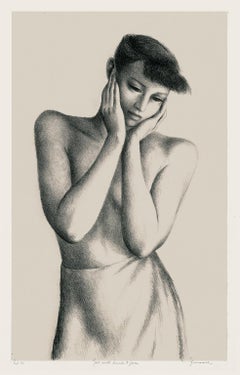
Benton Spruance, 'Girl with Hands to Face', two-color lithograph, 1940, edition 30, Fine and Looney 180. Signed, titled, and annotated 'Ed. 30' in pencil. A superb impression, on cr...
Category

1940s American Modern South Carolina - Prints and Multiples

Materials

Lithograph

New York Skyline, Sketch
By John Taylor Arms
Located in Myrtle Beach, SC
A fine impression, on cream wove paper, with full margins (5/8 to 1 3/8 inches), in excellent condition. Edition 20. Signed and dated in pencil. Annotated 'Bolton Brown...
Category

1920s American Realist South Carolina - Prints and Multiples

Materials

Lithograph

Bacchus — 18th Century Classical Italian Realism
Located in Myrtle Beach, SC
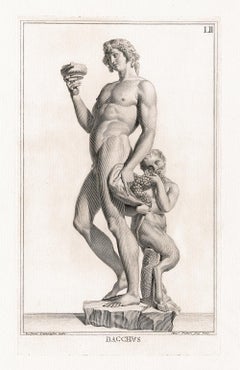
Giovanni Domenico Campiglia, 'Bacchus', engraving, 1734, edition unknown. Signed 'Dom. Campiglia del.' in the plate, lower left. Engraving by Gabbugiani, after the original by Giovan...
Category

1730s Realist South Carolina - Prints and Multiples

Materials

Engraving

#3 — Modernist Abstraction — African American Artist
Located in Myrtle Beach, SC
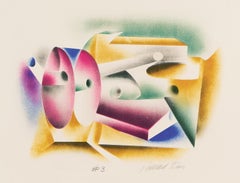
Hilliard Reynolds Dean, '#3', color lithograph, 1970, edition not stated but small. Signed and titled in pencil. A fine impression, with fresh colors, on Arches, heavy, cream wove pa...
Category

1970s American Modern South Carolina - Prints and Multiples

Materials

Lithograph

12th Street Walls — 1940s New York City
By Armin Landeck
Located in Myrtle Beach, SC
Armin Landeck, '12th Street Walls', etching, edition 100, first state, 1944, Kraeft 93. Signed in pencil. Initialed in the plate lower left. A superb, early impression, with all the ...
Category

1940s American Realist South Carolina - Prints and Multiples

Materials

Drypoint

Broad Street (Wall Street)
By Bror Julius Olsson Nordfeldt
Located in Myrtle Beach, SC
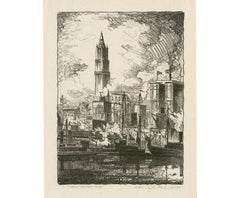
B.J.O. Nordfeldt, 'Broad Street (Wall Street)', etching, edition not stated, c. 1915. Signed in pencil. A superb impression, with rich burr, selectively wiped plate tone, and inky plate edges, on cream wove paper; the full sheet with margins (3/4 to 1 1/4 inches), in excellent condition. Printed by the artist. Matted to museum standards, unframed. Impressions of this work are in the permanent collections of the Fine Arts Museums of San Francisco, Princeton University, Smithsonian American Art Museum. A view looking down Broad Street past the New York Stock Exchange Building on the right with the columned Federal Hall...
Category

1910s American Impressionist South Carolina - Prints and Multiples

Materials

Etching

The Furnace — American Expressionism
By Otto Kuhler
Located in Myrtle Beach, SC
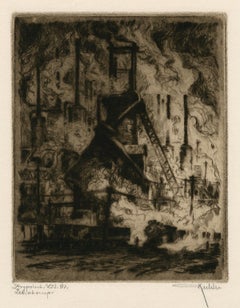
Otto Kuhler, 'The Furnace', drypoint, edition 26, 1924, Kennedy 5. Signed and annotated 'Drypoint. Ltd Ed. Del. et imp.' in pencil. Titled in pencil, in the bottom center sheet edge....
Category

1920s American Modern South Carolina - Prints and Multiples

Materials

Drypoint

Eyes for the Night — Mid-century American Surrealism
By Benton Murdoch Spruance
Located in Myrtle Beach, SC
Benton Spruance, 'Eyes for the Night', lithograph, 1947, edition 35, Fine and Looney 260. Signed, dated, titled, and annotated 'Ed 35' in pencil. A fine impression, on heavy, cream ...
Category

1940s American Modern South Carolina - Prints and Multiples

Materials

Lithograph

Descente de Croix (Descent from the Cross) — 1920s French Cubism
By Albert Gleizes
Located in Myrtle Beach, SC
Albert Gleizes, 'Descente de Croix', color pochoir, 1928, edition c. 50. Signed and dated in pencil. A fine, painterly impression, with fresh colors, on heavy, cream wove paper; the full sheet with margins (3 to 4 inches), in very good condition. The publisher's ink stamp 'EDITIONS MOLY-SABATA' beneath the image, lower left. Matted to museum standards, unframed. Image size 12 x 14 inches (305 x 356 mm); sheet size 18 x 22 inches (457 x 559 mm). ABOUT THE IMAGE After the 1927 painting 'Descente de Croix', one of three religious-themed works that Gleizes developed as preliminaries for murals at the church at Serrières, France, the project was terminated at its final phase, and Gleizes commissioned master printer Robert Pouyaud to create prints of the paintings, closely overseeing the production. ABOUT THE MEDIUM Pochoir is a refined stencil-based technique employed to create multiples or to add color to prints produced in other mediums. Characterized by its crisp lines and rich color, the print-making process was most popular from the late 19th century through the 1930s, with its center of activity in Paris. The pochoir process began with the analysis of an image’s composition, including color tones and densities. The numerous stencils (made of aluminum, copper, or zinc) necessary to create a complete image were then designed and hand-cut by the 'découpeur.' The 'coloristes' applied watercolor or gouache pigments through the stencils, skillfully employing a variety of different brushes and methods of paint application to achieve the desired depth of color and textural and tonal nuance. The pochoir process, by its handcrafted methodology, resulted in the finished work producing the effect of an original painting, and in fact, each print was unique. ABOUT THE ARTIST Albert Gleizes (1881-1953), born in Paris, France, was a pioneering figure in the development of abstract art and one of the leading proponents of Cubism. His contributions to the art world extended beyond his paintings; he was also a prolific writer and theoretician, advocating for a new approach to art that emphasized the geometric abstraction of form and a departure from representational traditions. Gleizes initially studied painting at the Académie Julian and the École des Beaux-Arts in Paris, where he was exposed to the academic conventions of the time. However, his artistic vision was profoundly influenced by encounters with avant-garde movements, including Fauvism and the work of Paul Cézanne. These influences led Gleizes to experiment with form and color, gradually moving away from traditional representation toward a more abstract and geometric style. After completing his secondary schooling, Gleizes spent four years in the French army and then began pursuing a career as a painter, primarily doing landscapes. Initially influenced by the Impressionists, he was only twenty-one years of age when his work titled ‘La Seine à Asnières’ was exhibited at the Société Nationale des Beaux-Arts in 1902. The following year, he was part of the first Salon d'Automne and soon came under the influence of Fernand Léger, Robert Delaunay, Jean Metzinger, and Henri Le Fauconnier. In 1907, Gleizes and some of his friends pursued the idea of creating a self-supporting community of artists that would allow them to develop their art free of any commercial concerns. For nearly a year, Gleizes  , with other painters, poets, musicians, and writers, lived at a large house in Créteil, but a lack of funds forced them to give up their facility in early 1908, and Gleizes moved temporarily into La Ruche, the artist commune in the Montparnasse Quarter of Paris. In the early 1910s, Gleizes became associated with the Cubist movement, which was spearheaded by artists such as Pablo Picasso and Georges Braque...
Category

1920s Cubist South Carolina - Prints and Multiples

Materials

Stencil

Le Paradis Terrestre (Paradise on Earth) — French Symbolism
By Edouard Goerg
Located in Myrtle Beach, SC
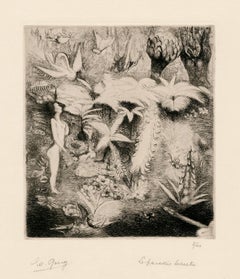
Edouard Goerg, 'Le Paradis Terrestre' (Paradise on Earth), etching, 1931, edition 40. Signed, titled, and numbered '3/40' in pencil. A fine richly-inked impression, on heavy, cream w...
Category

1930s Symbolist South Carolina - Prints and Multiples

Materials

Etching

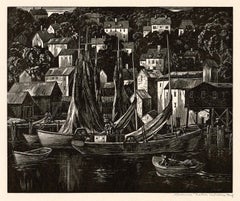
Tranquil Harbor (Gloucester, Massachusetts) — 1950s Cape Ann Regionalism
By Lawrence Wilbur
Located in Myrtle Beach, SC
Lawrence Nelson Wilbur (1897-1988), 'Tranquil Harbor' (Gloucester, Massachusetts), wood engraving, edition 55, 1958. Signed in pencil, and signe...
Category

1950s American Modern South Carolina - Prints and Multiples

Materials

Woodcut

Dialogue Erudite — Mid-century American Surrealism
By Robert Vale Faro
Located in Myrtle Beach, SC
Robert Vale Faro, 'Dialogue Erudite', color lithograph, 1945, edition 16. Signed, dated, titled, and numbered '98' and '4/16' in pen. A fine, richly-inked impression with fresh colors, on heavy, off-white wove paper; full margins (1/2 to 1 1/4 inch), in excellent condition. Image size 20 1/2 x 14 3/8 inches; sheet size 22 1/2 x 17 inches. Scarce. Matted to museum standards, unframed. ABOUT THE ARTIST Robert Vale Faro (1902-1988) was a modernist architect and artist associated with the Chicago Bauhaus. He received his degree in architecture and design from the Armour Institute in Chicago and worked at L'Ecole des Beaux-Arts, Paris, from 1924-27, where he was influenced by Harry Kurt Bieg and Le Corbusier. Upon his return to Chicago, Faro worked with the important modernist Chicago architects George and William Keck under Louis Sullivan. Faro founded the avant-garde printmaking group Vanguard in 1945. The group counted Atelier 17 artists Stanley William Hayter, Sue Fuller...
Category

1940s American Modern South Carolina - Prints and Multiples

Materials

Lithograph

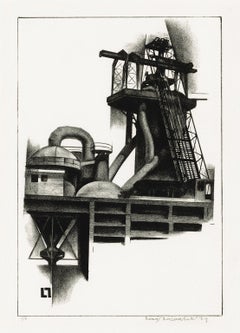
Corner of Steel Plant — American Modernism / Precisionism
By Louis Lozowick
Located in Myrtle Beach, SC
Louis Lozowick, 'Corner of Steel Plant', lithograph, 1929, edition 25, and 10 printed in 1972; Flint 21. Signed, titled, dated, and numbered 'I/X' in penci...
Category

1920s American Modern South Carolina - Prints and Multiples

Materials

Lithograph

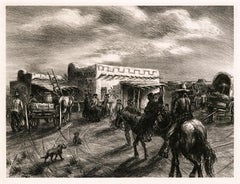
Navajo Trading Post — Southwest Regionalism, American Indian
By Ira Moskowitz
Located in Myrtle Beach, SC
Ira Moskowitz, 'Navajo Trading Post', lithograph, 1946, edition 30, Czestochowski 161. Signed and dated in the stone, lower left. A fine, richly-inked impression, on cream wove paper, with full margins (1 1/2 to 3 1/8 inches). Pale mat line, otherwise in excellent condition. Matted to museum standards, unframed. Image size 11 11/16 x 15 1/2 inches (297 x 395 mm); sheet size 16 5/16 x 191/8 inches (414 x 486 mm). ABOUT THE ARTIST Ira Moskowitz was born in Galicia, Poland, in 1912, emigrating with his family to New York in 1927. He enrolled at the Art Student's League and studied there from 1928-31. In 1935, Moskowitz traveled to Paris and then lived until 1937 in what is now Israel. He returned to the United States in 1938 to marry artist Anna Barry in New York. The couple soon visited Taos and Santa Fe in New Mexico, returning for extended periods until 1944, when they moved there permanently, staying until 1949. During this especially productive New Mexico period, Moskowitz received a Guggenheim fellowship. His work was inspired by the New Mexico landscape and the state’s three cultures (American Southwest, Native American, and Mexican). He focused on Pueblo and Navajo life, producing an extensive oeuvre of authentic American Indian imagery. He and Anna also visited and sketched across the border in Old Mexico. While in the Southwest, Moskowitz flourished as a printmaker while continuing to produce oils and watercolors. Over 100 of Moskowitz’s works depicting Native American ceremonies were used to illustrate the book American Indian Ceremonial Dances by John Collier, Crown Publishers, New York, 1972. After leaving the Southwest, printmaking remained an essential medium for the artist while his focus changed to subject matter celebrating Judaic religious life and customs. These works were well received early on, and Moskowitz was content to stay with them the rest of his life. From 1963 until 1966, Moskowitz lived in Paris, returning to New York City in 1967, where he made his permanent home until he died in 2001. Shortly before his death, Zaplin-Lampert Gallery of Santa Fe staged an exhibition of the artist's works, December 2000 - January 2001. Other one-person shows included the 8th Street Playhouse, New York, 1934; Houston Museum, 1941; and the San Antonio Museum, 1941. The artist’s work was included in exhibitions at the Art Students League, Art Institute of Chicago, Philadelphia Print Club, College Art Association (promotes excellence in scholarship and teaching), and the International Exhibition of Graphic Arts (shown at MOMA, 1955). Moskowitz’s lithographs of American Indian...
Category

1940s American Modern South Carolina - Prints and Multiples

Materials

Lithograph

Karl Michel Exhibition — German Expressionism
By Karl Michel
Located in Myrtle Beach, SC
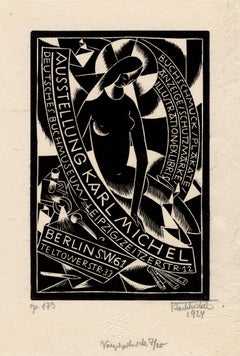
Karl Michel, 'Austellung Karl Michel', woodcut, 1924, edition 20. Signed, dated, numbered 'op. 173' (the artist's inventory number) and '7/20' (the impression number/edition size) and annotated 'Vorgesdruck' (artist's proof) in pencil. A fine, richly-inked impression on hand-made cream, wove paper, with full margins (1 1/16 to 1 1/2 inches); toning to the right sheet edge deckle, otherwise in good condition. With the artist's blind stamp in the bottom center margin. Designed and printed by the artist. Very scarce. Matted to museum standards (unframed). An elegantly designed, dynamic exhibition announcement with the German copy in the block: 'Austellung Karl Michel – Deutsches Buchmuseum Leipzig/Zeitzer str 12, Berlin S.W. 61 Teltower str 33 / Buchschmuck/ Plakate/ Anzeige/ Schultzmarke/ Illustrations/ Ex Libris'. English translation: 'Karl Michel Exhibition – German Book Museum, Leipzig Zeitzer Street 12, Berlin, S.W. 61 Teltower St. 33. / Book Decoration / Posters / Announcements / Illustrations / Ex Libris.' Image size 6 x 4 inches (152 x 102 mm); sheet size 8 1/16 x 5 1/2 inches (205 x 140 mm). ABOUT THE ARTIST Karl Michel (1889-1984) was a noted graphic designer and expressionist printmaker during Germany's pre-Nazi Weimar Republic (1919-1933). Michel’s work was the subject of a feature article in the influential German graphic design magazine 'Das Plakat' (The Poster) in 1920. An anti-war advocate, Michel created a suite of 12 wood engravings depicting his impressions of the humanitarian toll of WWII entitled ‘Humanitas’ (Humanity). The German publishing house Greifenverlag published the series in a folio of unsigned prints. Michel’s graphic work is held in the permanent collections of the Auckland War Memorial Museum (New Zealand), Frederikshavn Kunstmuseum & Exlibrissamling (Denmark), Museum of Applied Arts (Budapest), The Robert Gore Rifkind Center for German Expressionist Studies at the Los Angeles County Museum of Art, and the German Expressionism...
Category

1920s Expressionist South Carolina - Prints and Multiples

Materials

Woodcut

Skyline from Jersey Heights — 1930s Modernism
By Adriaan Lubbers
Located in Myrtle Beach, SC
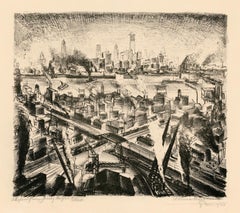
Adriaan Lubbers, 'Skyline from Jersey Heights', lithograph, 1930, edition 25. Signed, titled, and numbered '4/XXV' in pencil. Dated 'Paris 1930' in pencil. A fine impression, on crea...
Category

1930s Modern South Carolina - Prints and Multiples

Materials

Lithograph

Psychopathic Ward — Socially-Conscious Realism
By Robert Riggs
Located in Myrtle Beach, SC
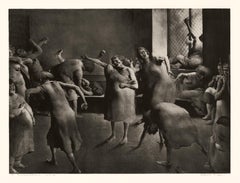
Robert Riggs, 'Psychopathic Ward', 2-color lithograph, c. 1940, edition c. 50, Beall 60, Bassham 78. Signed, titled, and numbered '14' in pencil. Signed in the stone, lower right. A ...
Category

1940s Realist South Carolina - Prints and Multiples

Materials

Lithograph

The Pimp — Graphic Modernism
By Fritz Eichenberg
Located in Myrtle Beach, SC
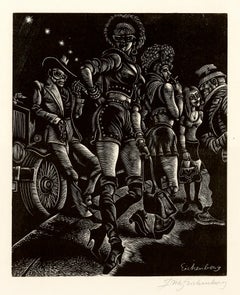
Fritz Eichenberg, 'The Pimp', wood engraving, 1980, artist's proof before the edition. Signed in pencil. Signed in the block, lower right. A fine, richly-inked impression, on cream wove paper, with full margins (2 3/16 to 3 1/2 inches), in excellent condition. Archivally sleeved, unmatted. Image size 12 x 9 3/4 inches (305 x 248 mm); sheet size 18 x 14 inches (457 x 356 mm). ABOUT THE ARTIST Fritz Eichenberg (1901–1990) was a German-American illustrator and arts educator who worked primarily in wood engraving. His best-known works were concerned with religion, social justice, and nonviolence. Eichenberg was born to a Jewish family in Cologne, Germany, where the destruction of World War I helped to shape his anti-war sentiments. He worked as a printer's apprentice and studied at the Municipal School of Applied Arts in Cologne and the Academy of Graphic Arts in Leipzig, where he studied under Hugo Steiner-Prag. In 1923 he moved to Berlin to begin his career as an artist, producing illustrations for books and newspapers. In his newspaper and magazine work, Eichenberg was politically outspoken and sometimes wrote and illustrated his reporting. In 1933, the rise of Adolf Hitler drove Eichenberg, who was a public critic of the Nazis, to emigrate with his wife and children to the United States. He settled in New York City, where he lived most of his life. He worked in the WPA Federal Arts Project and was a member of the Society of American Graphic Artists. In his prolific career as a book illustrator, Eichenberg portrayed many forms of literature but specialized in works with elements of extreme spiritual and emotional conflict, fantasy, or social satire. Over his long career, Eichenberg was commissioned to illustrate more than 100 classics by publishers in the United States and abroad, including works by renowned authors Dostoyevsky, Tolstoy, Charlotte and Emily Brontë, Poe, Swift, and Grimmelshausen. He also wrote and illustrated books of folklore and children's stories. Eichenberg was a long-time contributor to the progressive magazine The Nation, his illustrations appearing between 1930 and 1980. Eichenberg’s work has been featured by such esteemed publishers as The Heritage Club, Random House, Book of the Month Club, The Limited Editions Club, Kingsport Press, Aquarius Press, and Doubleday. Raised in a non-religious family, Eichenberg had been attracted to Taoism as a child. Following his wife's unexpected death in 1937, he turned briefly to Zen Buddhist meditation, then joined the Religious Society of Friends in 1940. Though he remained a Quaker until his death, Eichenberg was also associated with Catholic charity work through his friendship with Dorothy Day...
Category

1980s American Modern South Carolina - Prints and Multiples

Materials

Woodcut

Variation 4, Vol. I
By Katherine Sophie Dreier
Located in Myrtle Beach, SC
Katherine S. Dreier, 'Variation 4, Vol. I' from '1 to 40 Variations', lithograph with pochoir and hand-coloring, 1934, edition 65. Stenciled signature and date, lower right. Annotate...
Category

Mid-20th Century American Modern South Carolina - Prints and Multiples

Materials

Watercolor, Lithograph, Stencil

Clown — WPA American Expressionism
By Leon Bibel
Located in Myrtle Beach, SC
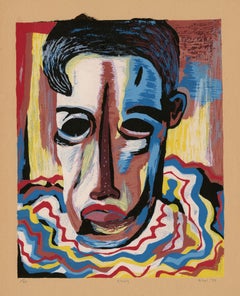
Leon Bibel, 'Clown', color serigraph, 1939, edition 20. Signed, dated, titled, and numbered '/20' in pencil. A fine, richly-inked, painterly impression, with fresh colors, on buff la...
Category

1930s American Modern South Carolina - Prints and Multiples

Materials

Screen

Third Avenue Elevated #1 — Mid-century Precisionist Abstraction
By Ralston Crawford
Located in Myrtle Beach, SC
Ralston Crawford, 'Third Avenue Elevated #1', lithograph, 1951, edition 55. Freeman L51.4. Signed, titled and numbered '48/55' in pencil. A fine, richly-inked impression, with rich ...
Category

1950s Abstract South Carolina - Prints and Multiples

Materials

Lithograph

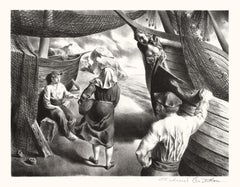
Mending Nets — Cape Ann Regionalism, Rockport
Located in Myrtle Beach, SC
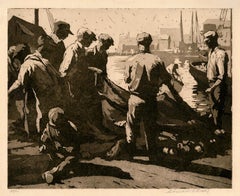
Christian Dull, 'Mending Nets', aquatint, c. 1930, edition 50. Signed and numbered '50/-' in pencil. A fine impression, on cream laid paper, the full sheet with margins (1/2 to 1 1/2...
Category

1920s American Modern South Carolina - Prints and Multiples

Materials

Aquatint

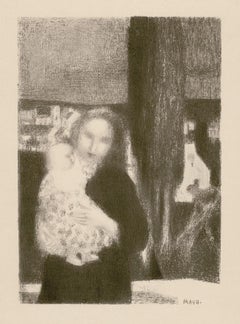
Untitled (Mother and Child)
By Maurice Denis
Located in Myrtle Beach, SC
Maurice Denis, Untitled (Mother and Child), lithograph, 1897, edition not stated. Signed in the stone, lower right. Annotated in linotype 'MAURICE DENIS, ORIGINAL LITHOGRAPHIE PAN III' in the lower left sheet corner. A fine, atmospheric impression, in warm, dark gray ink, on buff wove paper, with full margins (2 1/2 to 1 3/4 inches); a small discoloration in the bottom left sheet corner, otherwise in good condition. Image size 8 5/8 x 6 7/8 inches; sheet size 13 7/8 x 10 5/8 inches. As published in 'Pan', the leading German magazine of the period devoted to art and literature. Matted to museum standards, unframed. Collection: Los Angeles County Museum of Art. Reproduced: German Expressionist Prints...
Category

1890s Symbolist South Carolina - Prints and Multiples

Materials

Lithograph

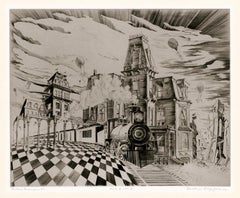
Fantasia Americana, 1880 — Mid-Century American Surrealism
By Lawrence Kupferman
Located in Myrtle Beach, SC
Lawrence Kupferman, 'Fantasia Americana – 1880', drypoint etching with sandground, 1943. Signed, titled, and annotated 'Series A, 1971 2/6' in pencil. A superb, richly-inked impression, on heavy, cream wove paper, with full margins (2 1/2 to 3 1/2 inches); the paper slightly lightened within the original mat opening, otherwise in excellent condition. One of only 6 impressions printed in 1971, with the added sandground grey background tint. Archivally matted to museum standards, unframed. Image size 11 13/16 x 14 3/4 inches; sheet size 18 x 20 1/4 inches. Collections: National Gallery of Art, Zimmerli Art Museum (Rutgers University). ABOUT THE ARTIST Lawrence Kupferman (1909 - 1982) was born in the Dorchester neighborhood of Boston and grew up in a working-class family. He attended the Boston Latin School and participated in the high school art program at the Museum of Fine Arts, Boston. In the late 1920s, he studied drawing under Philip Leslie Hale at the Museum School—an experience he called 'stultifying and repressive'. In 1932 he transferred to the Massachusetts College of Art, where he first met his wife, the artist Ruth Cobb. He returned briefly to the Museum School in 1946 to study with the influential expressionist German-American painter Karl Zerbe. Kupferman held various jobs while pursuing his artistic career, including two years as a security guard at the Museum of Fine Arts, Boston. During the 1930s he worked as a drypoint etcher for the Federal Art Project, creating architectural drawings in a formally realistic style—these works are held in the collections of the Fogg Museum and the Smithsonian American Art Museum. In the 1940s he began incorporating more expressionistic forms into his paintings as he became progressively more concerned with abstraction. In 1946 he began spending summers in Provincetown, Massachusetts, where he met and was influenced by Mark Rothko, Hans Hofmann, Jackson Pollock, and other abstract painters. At about the same time he began exhibiting his work at the Boris Mirski Gallery in Boston. In 1948, Kupferman was at the center of a controversy involving hundreds of Boston-area artists. In February of that year, the Boston Institute of Modern Art issued a manifesto titled 'Modern Art and the American Public' decrying 'the excesses of modern art,' and announced that it was changing its name to the Institute of Contemporary Art (ICA). The poorly conceived statement, intended to distinguish Boston's art scene from that of New York, was widely perceived as an attack on modernism. In protest, Boston artists such as Karl Zerbe, Jack Levine, and David Aronson formed the 'Modern Artists Group' and organized a mass meeting. On March 21, 300 artists, students, and other supporters met at the Old South Meeting House and demanded that the ICA retract its statement. Kupferman chaired the meeting and read this statement to the press: “The recent manifesto of the Institute is a fatuous declaration which misinforms and misleads the public concerning the integrity and intention of the modern artist. By arrogating to itself the privilege of telling the artists what art should be, the Institute runs counter to the original purposes of this organization whose function was to encourage and to assimilate contemporary innovation.” The other speakers were Karl Knaths...
Category

1940s Surrealist South Carolina - Prints and Multiples

Materials

Drypoint, Etching

Les Penitentes #3 — 1970s Modernist Abstraction
By Ralston Crawford
Located in Myrtle Beach, SC
Ralston Crawford, 'Los Penitentes #3', etching, 1976, edition 20. Signed and numbered '6/20' in pencil; titled and annotated 'specially selected for Marcelle and Dan' in the bottom s...
Category

1970s Abstract South Carolina - Prints and Multiples

Materials

Etching

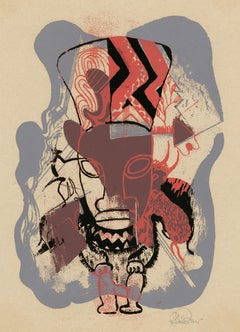
African Idol — American Modernism, Chicago Avant-garde
By Robert Vale Faro
Located in Myrtle Beach, SC
Robert Vale Faro, untitled (African Idol), serigraph, c. 1940, edition 6. Signed in pencil. A fine impression, with fresh colors, on buff wove paper; the full sheet with margins(5/8 to 1 3/8 inches), in excellent condition. Very rare. Matted to museum standards, unframed. Image size 8 3/4 x 6 inches (222 x 152 mm); sheet size 11 x 7 1/2 inches (279 x 192 mm). ABOUT THE ARTIST Robert Vale Faro (1902-1988) was a well-known modernist architect and artist associated with the Chicago Bauhaus. He received his degree in architecture and design from the Armour Institute in Chicago and worked at L'Ecole des Beaux-Arts, Paris, from 1924-27, where he was influenced by Harry Kurt Bieg and Le Corbusier. Upon his return to Chicago, Faro worked with the important modernist Chicago architects George and William Keck under Louis Sullivan. Faro founded the avant-garde printmaking group Vanguard in 1945. The group counted Atelier 17 artists Stanley William Hayter, Sue Fuller, and Anne Ryan as New York members and Francine...
Category

1940s American Modern South Carolina - Prints and Multiples

Materials

Screen

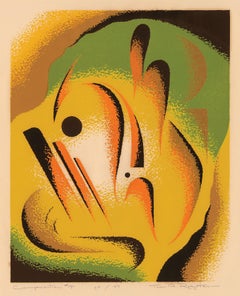
Composition # 4 — Mid-Century Modernism
By Thomas A. Robertson
Located in Myrtle Beach, SC
Thomas Robertson, 'Composition #4,' color serigraph, edition 47, c. 1940. Signed, titled, and annotated 'Ed/47' in pencil. A superb, painterly impression, with fresh colors, on buff wove paper, the full sheet with margins (1 to 2 inches), in excellent condition. Matted to museum standards, unframed. Image size: 10 9/16 x 8 1/2 inches (268 x 216 mm); sheet size 13 x 12 1/2 inches (330 x 318 mm). An impression of this work is represented in the collection of the National Gallery of Art. ABOUT THE ARTIST Born in Little Rock, Arkansas, Thomas Arthur Robertson (1911-1976) was the son of an attorney. Although his father, a co-owner of the Arkansas Law School, insisted that his son study there, after graduating, Robertson enrolled at the Adrian Brewer...
Category

1940s Abstract South Carolina - Prints and Multiples

Materials

Screen

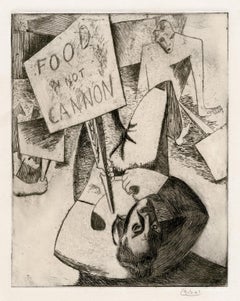
Food Not Cannon — WPA Modernist Work of Social Conscience
By Leon Bibel
Located in Myrtle Beach, SC
Leon Bibel, 'Food Not Cannon', etching, 1937, edition 12 (an early state, probably unique). Signed in pencil. A fine impression, on cream wove paper, with full margins (7/8 to 2 1/8 ...
Category

1930s American Modern South Carolina - Prints and Multiples

Materials

Etching

Still Thinking About These?

All Recently Viewed