Recognized Dealers Historical Memorabilia
to
20
201
123
321
3
1
65
12
7
6
5
5
2
1
1
32
94
195
4
30
105
39
4
5
6
8
6
17
60
13
21
3
158
99
86
57
38
153
80
77
64
46
325
325
325
15
7
4
3
2
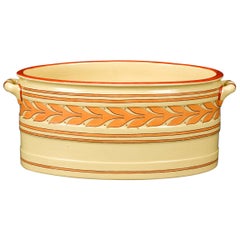
Napoléon
s Footbath by George Bullock
By George Bullock
Located in New Orleans, LA
This amazing footbath was created for Napoleon Bonaparte. It was part of the toilet service to be used during his exile on St. Helena. Just before shipm...
Category
Antique Early 19th Century English Empire Historical Memorabilia
Materials
Porcelain
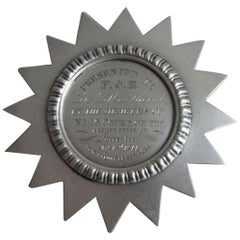
Fourteen Point Star Badge
By George Ward
Located in London, GB
A 14 point star Badge made by George Ward of Manchester and assayed in Chester in 1843
Engraved with "Presented to PCR George Heathcote by members of No...
Category
Antique 19th Century English More Furniture and Collectibles
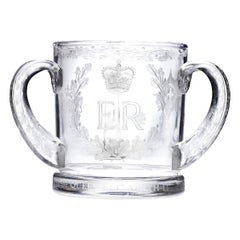
Elizabeth II Commemorative Coronation Tyg
By T. Goode
Co.
Located in New Orleans, LA
Created to commemorate the coronation of Queen Elizabeth II, this engraved glass tyg is a beautiful celebration of this historic event. Held at Westminster Abb...
Category
20th Century English Other Glass
Materials
Glass
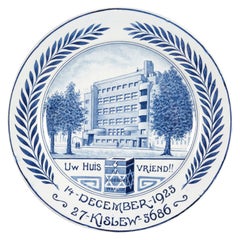
Early 20th Century Dutch Ceramic Commemorative Plate by Petrus Regout Maasticht
Located in New York, NY
Ceramic commemorative plate, The Netherlands, Amsterdam, 1925
Blue and white ceramic plate made in honor of a new building for the Jewish hospital of the Jewish-Dutch charity fund es...
Category
20th Century Dutch Decorative Bowls
Materials
Porcelain
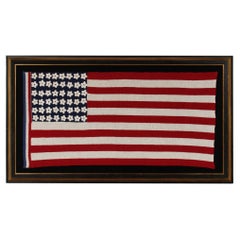
48 Star Crocheted Homemade American Flag, WWII Era, 1941-1945
Located in York County, PA
48 star, crocheted, antique american flag of the wwii era (1941-1945), a beautiful, homemade example, with a red, white, & blue hoist and flower-like stars:
Crocheted American flag of the WWII era (U.S. involvement 1941-1945), with some interesting and beautiful features. Made entirely of cotton, the flag’s most notable attribute is the red, white, and blue color of its hoist. This was carefully stitched to the canton and the striped field with white cotton floss or yarn. The 48 crocheted stars are appliquéd to a length of navy blue plain weave cotton. With pierced centers, note how these more closely resemble flowers than stars, tipped this way and that on their vertical axis. Large, with respect to the canton on which they are placed, note how these crowd their boundaries and overlap into the field.
The elongated format of the flag is also of interest and contributes to the bold presentation, as do the strong colors. Most crocheted flags are smaller than this one, or date to a much later period (namely the 1976...
Category
Mid-20th Century American Political and Patriotic Memorabilia
Materials
Cotton

Price Upon Request
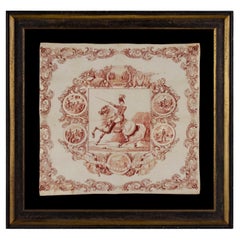
1840 Campaign Kerchief of William Henry Harrison on Horseback
Located in York County, PA
1840 campaign kerchief featuring an image of William Henry Harrison on horseback in military garb, one of the first known campaign textiles in e...
Category
Antique Mid-19th Century American Political and Patriotic Memorabilia
Materials
Cotton
Price Upon Request
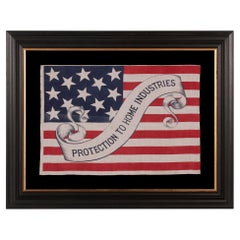
13 Star American Parade Flag with Rare Design, circa 1888 Ex Richard Pierce
Located in York County, PA
13 Star American parade flag in an extremely rare design, with “protection to home industries” slogan on a fanciful, scrolling streamer, made for the 1888 presidential campaign of Benjamin Harrison; formerly in the collection of Richard pierce.
1888 Benjamin Harrison campaign flag, printed on cotton, with 13 large stars in a 3-2-3-2-3 pattern, upon which a whimsical, scrolling streamer is superimposed that features the slogan: “Protection to Home Industries.”
There are numerous styles of both documented and undocumented, red, white, and blue bandanas and handkerchiefs, made for Harrison’s campaign in this year, as well as from the subsequent one, in 1892. Most bear variations of text to support the “Protection for American Industries” platform of the Republican Party. America was in the midst of the industrial age and there was a great deal of public interest, both in protecting growth and discouraging both imported goods and immigration. The constant stream of immigrants posed great challenges for a working families, competing for scarce jobs, in work environments that were already often far from ideal. In post-Civil War America, many of the working men were Civil War veterans.
Bandanas abound from Harrison’s Campaigns, but flags do not. This example, along with three others, were once part of an 1888 patriotic quilt that was disassembled by a dealer and sold piecemeal to collectors. I eventually acquired all four. Fifteen to twenty years ago, these were the only four known copies. A couple of others have since surfaced, but the total count known still stands closer to 5 than 10.
The use of 13 stars is seen in the flags of various candidates in the 19th century. Among these are Abraham Lincoln (1860 campaign), Henry Clay (1844 campaign), John Fremont (1856), and Benjamin Harrison’s grandfather, William Henry Harrison...
Category
Antique 1880s American Political and Patriotic Memorabilia
Materials
Cotton
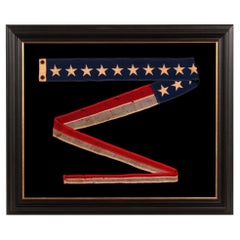
Commission Pennant with 13 Stars, like for Private Vessel, Ca 1892-1910
Located in York County, PA
Commission pennants are the distinguishing mark of a commissioned U.S. Navy ship. Flown at the topmast, the typical American format is a long blue field, usually with a single row of white stars, although sometimes with their total divided into two rows, followed by two long stripes, red-over-white. A ship became commissioned when this pennant was hoisted. Flown during both times of peace and war, the only time the pennant is not flown is if a flag officer or civilian official was aboard and replaced it with their own flag.
Sometimes the owners of private ships mimicked the use of Navy signals. Some seafaring men would have served in the Navy and become privy to various practices in that capacity. Others flew them purely for stylistic reasons, either on a regular basis or while the boat was dressed for special occasion. Hudson River steamers regularly flew pennants of this nature, as evidenced by period photography as well as the paintings of artists such as John and James Bard...
Category
Antique Late 19th Century American Political and Patriotic Memorabilia
Materials
Wool
Price Upon Request
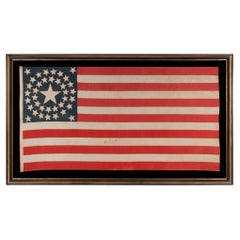
38 Star Antique Flag, Stars in Double Wreath Pattern, Colorado Statehood 1876-89
Located in York County, PA
38 STAR ANTIQUE AMERICAN FLAG WITH A DOUBLE-WREATH CONFIGURATION THAT FEATURES AN ENORMOUS CENTER STAR, REFLECTS THE PERIOD OF COLORADO STATEHOOD, 1876-1889:
38 star American national flag, made entirely of plain weave cotton. The stars are arranged in a medallion configuration. This features an enormous center star, surrounded by two wreaths of much smaller stars, with a flanking star in each corner of the blue canton. The sort of disparity here, present in the scale of the large star, versus those around it, is both exceptionally unusual and graphically dynamic.
Colorado became the 38th state on August 1st, 1876. This was the year of our nation’s centennial. Per the Third Flag Act of 1818, stars were not officially added until the 4th of July following a state's addition. For this reason, 37 remained the official star count for the American flag until part way through the following year. Flag-making was a competitive venture, however, and few flag-makers would have continued to produce 37 star flags when their competitors were making 38’s. Many flag-makers added a 38th star before Colorado entered the Union, in the early part of 1876, or possibly even prior. In fact, many makers of printed flags, called parade flags or hand-wavers, were actually producing flags in the 39 star count, in hopeful anticipation of the addition of two more Western Territories instead of one.
It is for these reasons that 38, 39, and 13 stars, to representing the original 13 colonies, are most often seen on flags displayed at the Centennial International Exhibition. Hosted in Philadelphia, this enormous event was our nation’s first World’s Fair, lasted for a duration of six months, and served as the nucleus of celebrations held to honor America’s 100-year anniversary of independence. The 38 star flag became official on July 4th, 1877 and was generally used until the 39th state was added in November of 1889.
This is probably a homemade flag, though sewn by a very skilled hand, or possibly, by two different individuals. The stripes are pieced and sewn entirely by hand, with remarkable care and precision. The canton is constructed of two lengths of blue fabric, that have been joined with treadle stitching. This was joined to the striped field by hand. The stars are double-appliquéd (applied to both sides) with treadle stitching. There is a treadle-sewn, cotton binding along the hoist, with five, hand-sewn grommets.
It is extremely unusual to encounter this combination of sewing methods. Soon after the sewing machine was mass-marketed, in the mid-1850’s, flag-makers both public and private made good use of treadle machines, to join stripes, when constructing American flags. During the Civil War (1861-65), most stripes were treadle-sewn. Stars were another matter. Until the advent of electric machines...
Category
Antique Late 19th Century American Political and Patriotic Memorabilia
Materials
Cotton
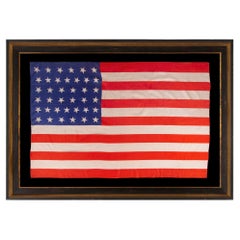
38 Star Antique American Flag, Colorado Statehood, circa 1876-1889
Located in York County, PA
38 star antique American parade flag with scattered star orientation, made of silk, with generous scale and vivid colors, Colorado Statehood, 1876-1889
38 star American national p...
Category
Antique Late 19th Century American Political and Patriotic Memorabilia
Materials
Silk
Price Upon Request
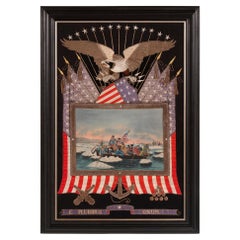
Elaborate Sailor Souvenir of Washington Crossing the Delaware, circa 1885-1912
Located in York County, PA
Elaborate sailor’s souvenir embroidery from the orient with a beautiful hand-painted image of Washington crossing the Delaware, surrounded by a large eagle, federal shield, crossed flags, a cannon, cannonballs, and anchor, circa 1885-1910:
Between roughly 1880 and 1915, American sailors visiting the orient could obtain beautiful needlework embroideries on shore, with patriotic American themes. These extraordinary works of art were acquired as mementos of a long voyage, often with the hope that they might be presented as gifts for loved ones and friends.
Using silk floss, elaborately embellished with both silver and gold metallic bullion thread...
Category
Antique Late 19th Century Asian Political and Patriotic Memorabilia
Materials
Silk
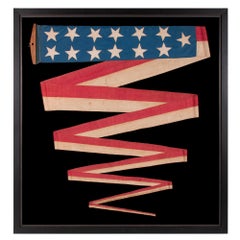
Hand-Sewn 13 Star Cornflower Blue 32 Foot Commission Pennant circa 1845-1865
Located in York County, PA
ENTIRELY HAND-SEWN, 32-FOOT, SHIP’S COMMISSION PENNANT OF THE 1845-1865 ERA, A HOMEMADE, COTTON EXAMPLE, WITH 13 STARS ON A CORNFLOWER BLUE CANTON, IN A BEAUTIFUL STATE OF PRESERVATION
Commission pennants are the distinguishing mark of a commissioned U.S. Navy ship. A ship becomes commissioned when the pennant is hoisted. Flown during both times of peace and war, the only time it is not flown is if a flag officer or civilian official is aboard and replaces it with their own flag. Flown at the topmast, this would be the first thing one would see coming over the horizon and identified the vessel as a warship.
Sometimes the owners of private ships mimicked the use of Navy signals. Some seafaring men would have served in the Navy and become privy to various practices in that capacity. Others flew them purely for stylistic reasons, either on a regular basis or while the boat was dressed for special occasion. Hudson River steamers regularly flew pennants of this nature, as evidenced by period photography as well as the paintings of artists such as John and James Bard...
Category
Antique Mid-19th Century American Political and Patriotic Memorabilia
Materials
Cotton
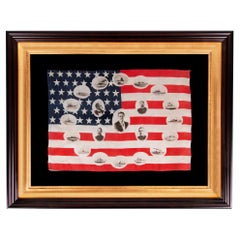
Teddy Roosevelt and His Great White Fleet American Flag, circa 1907-1909
Located in York County, PA
Rare & Beautiful American Parade Flag With Images Of Teddy Roosevelt And His Great White Fleet, 1907-1909, Ex-richard Pierce Collection:
46 star parade ...
Category
Antique Early 1900s American Political and Patriotic Memorabilia
Materials
Silk
Price Upon Request
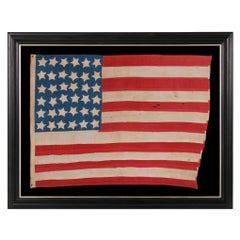
36 Star Antique American Flag, Cornflower blue Canton, circa 1864-1867, Nevada
Located in York County, PA
Antique American Flag With 36 Stars On A Cornflower Blue Canton, Civil War Era, 1864-1867, Reflects The Addition Of Nevada As The 36th State; A Great Folk Exaple With Haphazard Rows Of Starfish-like Stars:
36 star American national flag of the Civil War era with outstanding collector traits. Haphazard rows of fat, starfish-shaped stars fill most of the confines of a brilliant, cornflower blue canton. Note the crude piecing of the thirteen, red and white stripes, joined in an ill-planned manner that results in great variation in width, as well as general irregularity. The 4th red stripe actually falls slightly below the canton, and the height of each does not line up with the corresponding stripe on the reverse. This can clearly be seen at the fly end, which is is turned back and bound to repair obvious extended use in an outdoor environment. Clearly the maker lacked experience in seam work. Lining up the necessary components, so that they could be viewed on both sides, presented a challenge they may have not previously faced. This is also evident in the sewing of the stars, which do not line up on the obverse and reverse sides, as they typically would in a flag sewn by an experienced flag-maker. That said, this is just this kind of homemade charm that fuels interest in early American flags...
Category
Antique 1860s American Political and Patriotic Memorabilia
Materials
Cotton
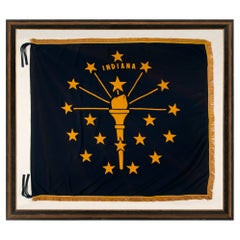
Indiana State Flag, with Gold Fringe circa 1930-1955
Located in York County, PA
Indiana State Flag With Square-like Proportions, An Offset Device, And Gold Fringe, Circa 1930-1955:
Despite the fact that most of the United States joined the Union during the 18...
Category
20th Century American Political and Patriotic Memorabilia
Materials
Cotton
Price Upon Request
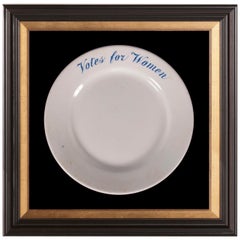
Ironstone Suffragette Plate w/ Votes for Women Text, Made for Alva Belmont, 1914
Located in York County, PA
IRONSTONE PLATE WITH "VOTES FOR WOMEN" TEXT, MADE JOHN MADDOCK & SONS FOR SUFFRAGIST ALVA BELMONT FOR MARBLE HOUSE, HER FAMOUS ESTATE IN NEWPORT, RHODE ISLAND, CIRCA 1914:
Porcelain objects related to the Suffrage movement are extremely scarce. The most celebrated of all American suffrage dinnerware consists of a service of white ironstone, commissioned by Alva Belmont,* prominent Newport, Rhode Island, socialite. Belmont was the founder of a pro-suffrage group called the Political Equality Association. According to Suffrage memorabilia expert Ken Folley, "There are at least eight different examples known in this design, including a cup and saucer, a lunch or dinner plate, a salad or bread plate, a berry bowl, a soup bowl, a celery dish...
Category
Vintage 1910s English Political and Patriotic Memorabilia
Materials
Porcelain
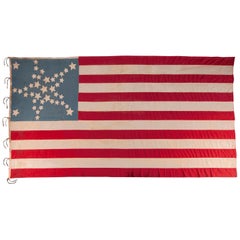
34 Star American flag, Updated to 39 Stars, with Stars in a Great Star Pattern
Located in York County, PA
34 STARS IN A WHIMSICAL RENDITION OF THE GREAT STAR PATTERN, ON A CIVIL WAR PERIOD FLAG WITH A CORNFLOWER BLUE CANTON, UPDATED TO 39 STARS IN 1876
34 star American national flag with additional stars added and one of the most stunning graphic designs I have ever seen in early flag-making. The original pattern was comprised of a circle of 5 large stars, and triangular arms made of smaller stars. These are noticeable pointy and bent like the arms of a starfish. Made of cotton, the stars are hand-sewn and double-appliquéd to a fantastic, cornflower blue canton, a color common to Civil War uniforms...
Category
Antique 1870s American Political and Patriotic Memorabilia
Materials
Cotton
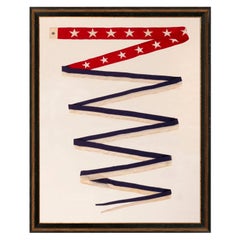
U.S War Department Commissioning Pennant with 13 Stars
Located in York County, PA
EXTREMELY RARE U.S. WAR DEPARTMENT COMMISSIONING PENNANT WITH 13 STARS, A REVERSAL OF THE U.S. NAVY COLOR SCHEME, TWENTY-FOUR FEET ON THE FLY, SP...
Category
20th Century American Political and Patriotic Memorabilia
Materials
Wool
Price Upon Request
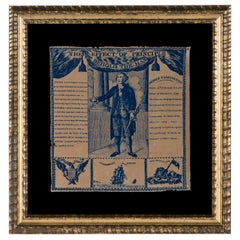
1806 Printed Linen Kerchief Glorifying George Washington, Germantown, Penn
Located in York County, PA
EXTRAORDINARILY EARLY (1806) PRINTED LINEN KERCHIEF GLORIFYING GEORGE WASHINGTON, PRINT WORKS, GERMANTOWN, PENNSYLVANIA
Printed in blue ink on coarse, white linen, this patriotic kerchief shows a standing portrait of George Washington, above which is a swag valance and the words “The Effect of Principle, Behold the Man”. The portrait is based on a mezzotint after Gilbert Stuart’s very famous painting of Washington in his later years, most often referred to as the Landsdowne portrait. Stuart painted three versions of it in oil on canvas, one of which was completed in 1796 for a wealthy merchant by the name of William Constable, who commissioned the work for Alexander Hamilton.
The kerchief is interesting because it is both American-made and documented. This is exceptionally unusual for any printed textile of the 19th century or prior and the earlier the time period the more unlikely an object is to be identified. This kerchief and a companion piece entitled “The Love of Truth Mark the Boy” (also glorifying Washington, through the fabled story of the cherry tree), were made circa 1806 by Germantown Print Works in Germantown, Pennsylvania.
To the left of Washington's image is a portion of his infamous farewell address to his troops at the end of the Revolutionary War. To the right is a short excerpt from his eulogy. Below these are three images. In the center is a square-rigged tall ship with “Commercial Union” above it, flanked by the American eagle on the left and the British lion on the right. It is reasonable to assume that the textile may have been produced in demonstration of the maker's desire, and/or that of others, to advance trade with England. Commercial printers were very influential in early America, as they possessed the means by which to disseminate information.
This kerchief and its companion piece are documented in Threads of History, Americana Recorded on Cloth, 1775 - the Present, by Herbert Ridgeway Collins (1979, Smithsonian Press), p. 63, items 38
39.* The two pieces pictured are in the collection of Cornell University, but the Collins text also cites an uncut pair to be present in the collection of the Western Reserve Historical Society, Cleveland, OH. The name "Germantown Print Works" is printed on the Western Reserve examples. Another example of the textile in question is documented in "Running for President, The Candidates and Their Images, 1789-1896" by Schlesinger, Israel, and Frendt, (1994, Simon
Schuster), p. 15.
I have seen three different color variations of this textile, including sepia, mulberry red, and blue. This particular example has a hand-sewn binding along the top, lower, and left edges.
Mounting: The textile was mounted and framed within our own conservation department, which is led by expert staff. We take great care in the mounting and preservation of flags and have framed thousands of examples.
The gilded molding has a rippled profile and dates to the period between 1825 and 1850.The background is 100% cotton twill, black in color. The glazing is U.V. protective plexiglass. Feel free to contact us for more details.
Condition: There is an all-over golden oxidation of the white fabric and there is very minor staining. There are tiny tack holes in each corner and there are minor nicks around the perimeter.
* Collins relates that Germantown Printworks was operated by the Hewsons. In doing so he cites one of Worthington Chauncey Ford's books on George Washington, but it isn't clear which one (there are many) and no page numbers are given. John Hewson was an Englishman who came to America and opened his printing business on the advice of Benjamin Franklin. He was one of the first “calico printers” and is the earliest documented to have advertised printed kerchiefs. His ads for bandanas appear as early as June 20th, 1774. He is suspected of having produced the very first American kerchief that pictured an American president, which is documented in Collins as item 1 on page 48. Linda Eaton, curator at Winterthur, in 2012, is currently doing in depth research on the three printers of fabrics that were operating in Germantown in early America. She discovered that the owner and/or operator of Germantown Print Works, while not currently known, was not John Hewson. This information is not yet published. She also noted that Winterthur possessed examples of the two George Washington textiles...
Category
Antique Early 1800s American Political and Patriotic Memorabilia
Materials
Cotton
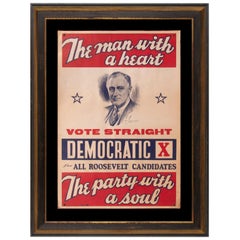
Franklin D. Roosevelt 1936 Campaign Poster: "The Man with a Heart..."
Located in York County, PA
“THE MAN WITH A HEART, THE PARTY WITH A SOUL”: FRANKLIN D. ROOSEVELT POSTER, MADE FOR HIS 1936 PRESIDENTIAL RUN, THE BEST OF ALL KNOWN EXAMPLES ACROS...
Category
Vintage 1930s American Political and Patriotic Memorabilia
Materials
Paper
Price Upon Request
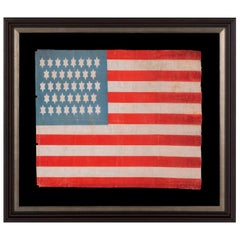
38 Star Parade Flag with Whimsical 6-Pointed Stars, Colorado Statehood
Located in York County, PA
38 WHIMSICAL STARS, WITH 6-POINTED PROFILES, SIMILAR TO THE STAR OF DAVID, ON AN ANTIQUE AMERICAN FLAG OF THE CENTENNIAL ERA; A REMARKABLE SPECIMEN, ONE-OF-A-KIND AMONG KNOWN EXAMPLE...
Category
Antique Late 19th Century American Political and Patriotic Memorabilia
Materials
Cotton
Price Upon Request
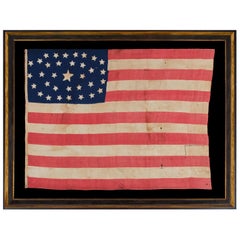
34 Stars in an Outstanding Oval Medallion Configuration, Civil War Period
Located in York County, PA
34 STARS IN AN OUTSTANDING OVAL MEDALLION CONFIGURATION, ON A NARROW CANTON THAT RESTS ON THE 6TH STRIPE, ON A HOMEMADE, ANTIQUE AMERICAN FLAG OF THE CIVIL WAR PERIOD, ENTIRELY HAND-...
Category
Antique 1860s American Political and Patriotic Memorabilia
Materials
Cotton
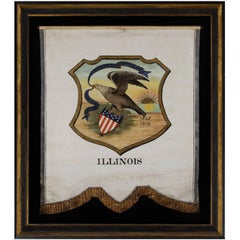
Hand-Painted 19th Century Banner with the 1867 Proposed Seal of Illinois
Located in York County, PA
HAND-PAINTED 19TH CENTURY BANNER WITH AN 1867 VERSION OF THE SEAL OF THE STATE OF ILLINOIS, PROPOSED IN THAT YEAR BY THE SECRETARY OF STATE, BUT IN A VARIATION NEVER FORMALLY ADOPTED
Banner with the Illinois State Seal, in a rare variation of the design, never adopted. In 1867 Illinois Secretary of State Sharon Tyndale proposed that the phrases in the state motto be reversed. In the wake of the Civil War, (which ended in 1865,) Tyndale suggested that the verbiage be changed from "State Sovereignty--National Union" to "National Union--State Sovereignty,” which made sense given the recent secession of the Southern States, which placed their own interests first. Illinois' own Abraham Lincoln had worked hard to preserve national interests, echoed here in the altering of the language. Though Tyndale’s suggestion was rejected, he was nonetheless charged with creating a new design, which he did and was soon adopted. This displayed the dates of "1818," when Illinois became a state, and "1868," when the seal was officially changed. Interestingly enough, Tyndale did manage to send a message in the new version by turning the word “sovereignty” upside-down , with the surmised explanation that this fit accordingly with the orientation / position of the streamer.
The banner is beautifully hand-painted on muslin and retains its original staff. The shape is beautifully scalloped at the bottom edge, which is painted to look as if there is an applied fringe. Most of the elements are congruent with the 1868 version, but there are various differences. Set within a shield-shaped medallion—usually circular—is the expected eagle in a side view, spread wing pose with beak uplifted. The eagle is supposed to be perched upon a rock with one talon, while gripping a Federal shield in the other. Here there is no rock and both talons grip the shield, which displays 13 stars. Note the date of "1867" and Tyndale's preferred order of the wording on the billowing ribbon in the eagle's beak. The foreground of the official design is all grass. Here there are olive branches—a peacetime reference appropriate for a country recovering from war—on a grassy area, set upon a sandy shore before Lake Michigan, with a rising sun on the horizon.
Mounting: The banner was mounted and framed within our own conservation department, which is led by masters degree trained staff. We take great care in the mounting and presentation of flags and have preserved thousands of examples; more than anyone worldwide.
The background is 100% cotton twill, black in color. The mount was placed in a black-painted, hand-gilded and distressed Italian molding. A shadowbox was created to accommodate the staff. The glazing is U.V. protective plexiglass. Feel free to contact us for more details.
Banner - 49" x 56.5"
Frame - 67.75" x 59.25"
About Jeff R. Bridgman Antiques, Inc.:
As an advisor to top museums and collectors alike, Jeff Bridgman is the world's leading expert and source for antique American flags and political textiles...
Category
Antique 1860s American Political and Patriotic Memorabilia
Materials
Cotton
Price Upon Request
Hand-Painted Patriotic Banner With The Seal of the State of Illinois
Located in York County, PA
HAND-PAINTED PATRIOTIC BANNER WITH THE SEAL OF THE STATE OF ILLINOIS AND GREAT FOLK QUALITIES PROBABLY MADE FOR THE 1868 DEMOCRAT NATIONAL CONVENTION...
Category
Antique 1860s North American Political and Patriotic Memorabilia
Materials
Canvas
Price Upon Request
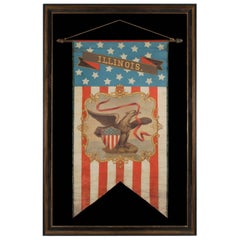
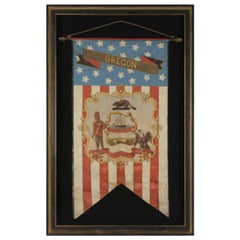
Hand-Painted Patriotic Banner with the Seal of the State of Oregon
Located in York County, PA
HAND-PAINTED PATRIOTIC BANNER WITH THE SEAL OF THE STATE OF OREGON AND GREAT FOLK QUALITIES, 1861-1876:
Swallowtail format, patriotic vertical banne...
Category
Antique Late 19th Century American Political and Patriotic Memorabilia
Materials
Canvas
Price Upon Request