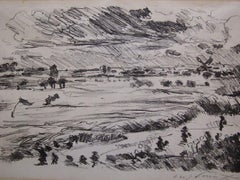
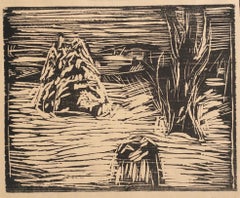
Expressionist Landscape Prints

EXPRESSIONIST STYLE

While “expressionist” is used to describe any art that avoids naturalism and instead employs a bold use of flattened forms and intense brushwork, Expressionist art formally describes early-20th-century work from Europe that drew on Symbolism and confronted issues such as urbanization and capitalism. Expressionist artists experimented in paintings and prints with skewed perspectives, abstraction and unconventional, bright colors to portray how isolating and anxious the world felt rather than how it appeared. 

Between 1905 and 1920, Austrian and German artists, in particular, were inspired by Postimpressionists such as Paul Gauguin and Vincent van Gogh in their efforts to strive for a new authenticity in their work. In its geometric patterns and decorative details, Expressionist art was also marked by eclectic sources like German and Russian folk art as well as tribal art from Africa and Oceania, which the movement’s practitioners witnessed at museums and world’s fairs.

Groups of artists came together to share and promote the themes now associated with Expressionism, such as Die Brücke (The Bridge) in Dresden, which included Erich Heckel, Ernst Ludwig Kirchner and Karl Schmidt-Rottluff and investigated alienation and the dissolution of society in vivid color. In Munich, Der Blaue Reiter (The Blue Rider), a group led by Wassily Kandinsky and Franz Marc, instilled Expressionism with a search for spiritual truths. In his iconic painting The Scream, prolific Norwegian painter Edvard Munch conveyed emotional turmoil through his depiction of environmental elements, such as the threatening sky.

Expressionism shifted around the outbreak of World War I, with artists using more elements of the grotesque in reaction to the escalation of unrest and violence. Printmaking was especially popular, as it allowed artists to widely disseminate works that grappled with social and political issues amid this time of upheaval. Although the art movement ended with the rise of Nazi Germany, where Expressionist creators were labeled “degenerate,” the radical ideas of these artists would influence Neo-Expressionism that emerged in the late 1970s with painters like Jean-Michel Basquiat and Francesco Clemente.

​​Find a collection of authentic Expressionist paintings, sculptures, prints and more art on 1stDibs.

to
290
243
95
17
12
1
Overall Width
to
Overall Height
to
4,673
3,198
812
808
745
655
649
442
89
83
78
28
15
110
18
8
8
8
1
327
42
19
6
5
6
2
75
93
28
56
19
250
112
6
212
137
110
88
67
59
57
36
16
16
14
13
11
11
9
8
8
8
7
6
255
45
35
27
6
15
3
346
24
Style: Expressionist
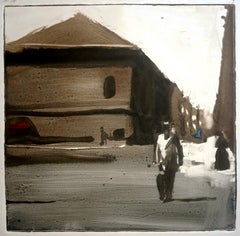
Ghosts of New York 5, mysterious, monochromatic cityscape
Located in Brooklyn, NY
One of a series of oil based monotypes on fine printmaking paper, subtle color design, symbolic and atmospheric figure/figures in cityscape
Category

2010s Expressionist Landscape Prints

Materials

Monotype, Archival Paper

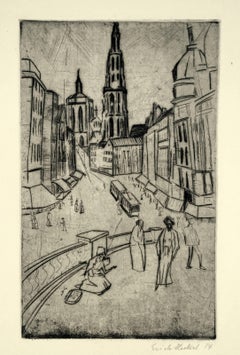
Antwerp
Located in New York, NY
Erich Heckel (1883-1970), Antwerp, drypoint, 1914, signed and dated in pencil lower right margin. Reference: Dube 123. In excellent condition, the full sheet on a cream/ivory wove pa...
Category

1910s Expressionist Landscape Prints

Materials

Drypoint

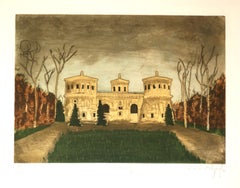
Luxemberg original aquatint etching by J.J. Regal
Located in Paonia, CO
  Luxemberg is an original signed limited edition aquatint etching by J.J. Regal printed on B F K Rives paper. This is a very bold design with an original depiction of a major Europe...
Category

20th Century Expressionist Landscape Prints

Materials

Etching

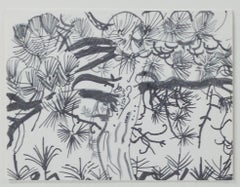
"Pine Tree, " Offset Black White Lithograph by Ruth Grotenrath
Located in Milwaukee, WI
"Pine Tree" is an offset lithograph by Ruth Grotenrath, created for the Riveredge Nature Center, Inc. for their Artists for Conservation series. It depicts an elaborate drawing of a pine tree with branches growing in multiple directions and overlapping one another. 5" x 6 5/8" art 13 5/8" x 15 1/4" frame "The paintings of Ruth...
Category

1960s Expressionist Landscape Prints

Materials

Lithograph

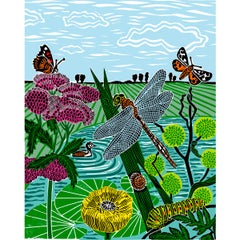
The Norfolk Broads by Kate Heiss, Limited edition print, Landscape, Wildlife
Located in Deddington, GB
The Norfolk Broads [2022] limited_edition and hand signed by the artist Oil based inks on 300GSM Somerset Velvet Paper Edition number 15 Image size:...
Category

21st Century and Contemporary Expressionist Landscape Prints

Materials

Paper, Ink, Mixed Media

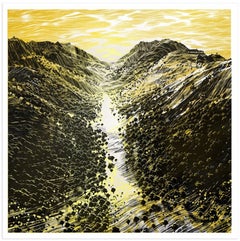
Valley Of Gold, Chris Keegan, Limited Edition Print, Landscape Art, Affordable
Located in Deddington, GB
Valley of Gold By Chris Keegan [2021] limited edition Screen print Edition of 40 Image size: H:56 cm x W:56 cm Complete Size of Unframed Work: H:54 cm x W:54 cm x D:0.1cm Sold U...
Category

21st Century and Contemporary Expressionist Landscape Prints

Materials

Screen

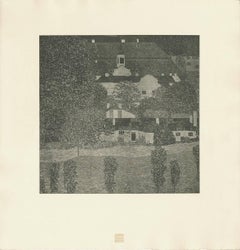
H.O. Miethke Das Werk folio "Schloss Kammer on Lake Attarsee II" collotype print
Located in Palm Beach, FL
DAS WERK GUSTAV KLIMTS, a portfolio of 50 prints, ten of which are multicolor collotypes on chine colle paper laid down on hand-made heavy cream wove paper with deckled edges; under each of the 50 prints is a gold signet intaglio printed on the cream paper each of which Klimt designed for the publication as unique and relating to its corresponding image; H.O. Miethke, Editor-Publisher; k.k. Hof-und Staatsdruckerei, Printer; printed in a limited edition of 300 numbered plus several presentation copies; Vienna, 1908-1914. The idea of collaboration in the arts is anything but new; however it has so often been viewed and assessed as somehow devaluing the intrinsic worth of art. It’s as if it was a dirty secret to be hidden away. More so even than the eroticism explored by Klimt, which divided public opinion, the artistic avant-garde began to boldly flaunt artistic collaboration beginning in the 19th century- which gained steam in the first part of the 20th century- to become a driving vehicle of contemporary artistic creation. Viewed in this context, the folios of collotype prints published by H.O. Miethke in Vienna between 1908-1914 known as Das Werk Gustav Klimts, are important art documents worthy of as much consideration for their bold stand they take on established ways of thinking about artistic collaboration as they are for their breathtakingly striking images. 1908 is indeed a watershed moment in the history of art. To coincide with the 60th anniversary of the reign of Emperor Franz Joseph I, Kunstschau opened in Vienna in May of that year. It was there that Klimt delivered the inaugural speech. Speaking about the avant-garde group’s unifying philosophy of Gesamtkunstwerk, or the synthesis of the arts, Klimt shared his belief that the ideal means to bring artists and an audience together was via “work on major art projects.” It was at Kunstschau 1908 that Klimt first exhibited his most iconic painting, The Kiss, as well as The Sunflower, Water Snakes I and II and Danae. It was at Kunstschau 1908 that Das Werk Gustav Klimts was first available for purchase. Thanks to Galerie Miethke’s organization, Kunstschau 1908 was possible. Miethke’s pioneering art house had become Klimt’s exclusive art dealer and main promoter of his modernist vision. Paul Bacher and Carl Moll, a founding member with Klimt of the Vienna Secession, who all broke away during the rift in 1905, took stewardship of the gallery following the fallout with the Secession. Das Werk Gustav Klimts is a prime example of Miethke’s masterful and revolutionary approach to marketing art. Miethke’s innovative marketing strategy played to a penchant for exclusivity. The art gallery and publishing house utilized the press and art critics- such as Austria’s preeminent Art Historian, Hugo Haberfield, who became Director of the gallery in 1912- as a means of gaining publicity as well as maintaining effective public relations. Miethke used the grand exposition format to extend the art gallery’s market reach, cultivating their product’s prestige by stroking the egos of current art patrons while simultaneously creating accessibility for newcomers and others avid collectors to share a relative proximity to other wealthy and respected members of the art collecting community. Essentially, their approach paved the way for what is still the predominant means of marketing. Between 1908 and 1914, H.O. Miethke published a total of 5 installments of print folios of Klimt’s painted work, each comprising 10 prints. The series was limited in availability to 300 and purchase was arranged through subscription. Each issue was presented unbound in a gold embossed black paper folder. Included in the folio was a Title Page, a Justification page and a Table of Contents page itemizing each of the 10 printed works with details about their corresponding painted works as well as information about each work’s current owner. These folios were not comprehensive of Klimt’s work; but rather, they feature what he believed were his most important paintings from 1898-1913. Only 2 collotypes in each folio were multicolored. To punctuate the fact that Klimt, himself, was very much an active player in creating these printed works, he created square-shaped signets, unique to each collotype which were intaglio printed in gold ink at the bottom of the cream wove papers to which the chine collie papers were affixed.These signets relate thematically to their corresponding printed images and designate each of those images by their placement in the folio’s Table...
Category

Early 1900s Expressionist Landscape Prints

Materials

Paper

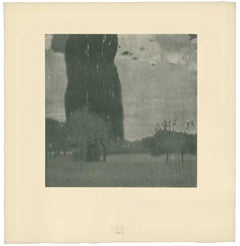
H.O. Miethke Das Werk folio "The Great Poplar I" collotype print
Located in Palm Beach, FL
DAS WERK GUSTAV KLIMTS, a portfolio of 50 prints, ten of which are multicolor collotypes on chine colle paper laid down on hand-made heavy cream wove paper with deckled edges; under ...
Category

Early 1900s Expressionist Landscape Prints

Materials

Paper

Wide Landscape, 1916
Located in London, GB
This original lithograph is hand signed in pencil by the artist "Lovis Corinth" at the lower right corner. It was printed in 1916 in a limited edition of 50 hand signed impressions,...
Category

Early 20th Century Expressionist Landscape Prints

Materials

Lithograph

GARDEN IN SNOW
Located in Santa Monica, CA
EDVARD MUNCH (1863 – 1944) GARDEN IN SNOW, II 1913 (WO 467: Sch. 418) Woodcut, 13 ½” x 16 7/8” signed in pencil. Generally very good condition. Irregular sheet of simili-japan ...
Category

1910s Expressionist Landscape Prints

Materials

Woodcut

Expressionist landscape prints for sale on 1stDibs.

Find a wide variety of authentic Expressionist landscape prints available for sale on 1stDibs. Works in this style were very popular during the 21st Century and Contemporary, but contemporary artists have continued to produce works inspired by this movement. If you’re looking to add landscape prints created in this style to introduce contrast in an otherwise neutral space in your home, the works available on 1stDibs include elements of blue, orange, pink, purple and other colors. Many Pop art paintings were created by popular artists on 1stDibs, including Marc Chagall, Gustav Klimt K.K. Hof-und Staatsdruckerei, Graciela Rodo Boulanger, and (after) Gustav Klimt. Frequently made by artists working with Lithograph, and Paper and other materials, all of these pieces for sale are unique and have attracted attention over the years. Not every interior allows for large Expressionist landscape prints, so small editions measuring 3.25 inches across are also available. Prices for landscape prints made by famous or emerging artists can differ depending on medium, time period and other attributes. On 1stDibs, the price for these items starts at $100 and tops out at $79,600, while the average work sells for $980.

Recently Viewed

View All