Italian Paintings
to
227
893
602
1,434
60
46
Height
to
Width
to
173
118
101
71
26
17
12
11
6
6
5
5
4
2
2
1
415
395
624
106
127
236
173
14
14
31
20
15
47
62
84
22
22
779
759
606
445
168
9,683
6,529
5,829
2,846
1,540
1,540
1,516
1,527
14
11
7
6
6
Place of Origin: Italian
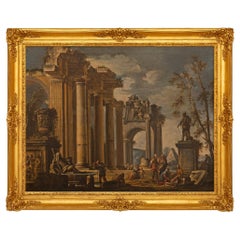
Italian 18th century Louis XV st. Oil on Canvas and Giltwood painting
By Giovanni Paolo (Pannini)
Located in West Palm Beach, FL
A decorative and statement making Italian 18th century Louis XV st. Oil on Canvas and Giltwood painting, in the manner of Giovanni Paolo Panini. This storytelling Capriccio style pai...
Category
18th Century Louis XV Antique Italian Paintings
Materials
Giltwood
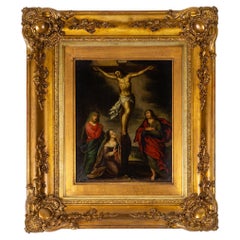
Baroque Oil On Copper Crucifixion, Old Master Religious Painting, 17th Century
Located in Lisbon, PT
This 17th Century Italian Baroque painting, executed in oil on copper, depicts the Crucifixion of Christ with remarkable depth and dramatic composition.
Christ is shown on the cros...
Category
17th Century Baroque Antique Italian Paintings
Materials
Copper

$8,204 Sale Price
22% Off
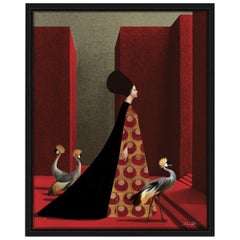
Walking in Are Place Digital Painting
By Daria Petrilli
Located in Milan, IT
Female sacredness is recurrent in this artist's pop-surrealist works. The splendid priestess crosses the metaphysical architecture of her palace, embodying the archaic mystery of femininity. On a panel of fine cotton pictorial canvas, the piece is complete with an American box frame in basswood. Signed and numbered limited edition...
Category
2010s Modern Italian Paintings
Materials
Canvas, Cotton, Wood
$4,410 / item
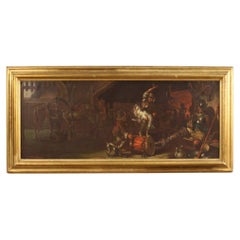
20th Century Oil on Canvas Italian Popular Scene Painting Signed Mattia Traverso
Located in Vicoforte, Piedmont
Italian painting from the first half of the 20th century. Oil painting on canvas, first canvas, depicting tavern in eighteenth-century style with characters and horses. Very pleasant...
Category
1920s Vintage Italian Paintings
Materials
Canvas
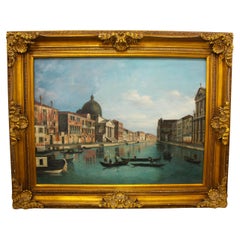
Oil on canvas, View of Venice
Located in Rome, IT
Oil on canvas, splendid View of Venice, unknown artist, with more recent gilded wooden frame,. ADDITIONAL PHOTOS, INFORMATION OF THE LOT AND SHIPPING INFORMATION CAN BE REQUEST BY SENDING AN EMAIL.
Indicative shipping costs in Italy: 170€ and Europe: 340€.
Tags: Olio su tela, Veduta di Venezia. Óleo sobre lienzo, Vista de Venecia. Huile sur toile, Vue de Venise...
Category
Mid-20th Century Italian Paintings
Materials
Canvas
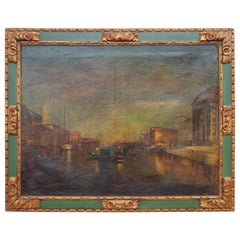
Manner of J.M.W Turner, Venice Scene of the Grand Canal Painting
Located in Nashville, TN
Probably circa 1910, decorative painting with craquelure throughout. Old dark varnish. The sky near frame edge has thicker paint suggesting some later in painting. Stretcher marks sh...
Category
1910s Vintage Italian Paintings
$1,750 Sale Price
25% Off
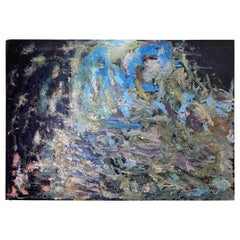
Oil Painting Abstract post impressionist from Venitian Palace, Italy Venise 1970
Located in La xara, VC
Exceptional oil on wood panel period abstract gift 1970, large format approaching an impressionist atmosphere ... water lily. work commissioned for a palace on the Italian coast near...
Category
1970s Modern Vintage Italian Paintings
Materials
Wood, Paint
$11,393 Sale Price
52% Off
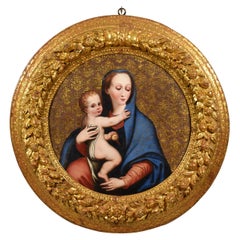
17th Century, Italian Oil on Panel Painting Depicting Madonna della Purità
Located in IT
17th Century, Italian Oil on Panel Painting Depicting Madonna della Purità
The painting, executed in oil on a circular wooden panel and presented in an imposing carved and gilded wo...
Category
17th Century Renaissance Antique Italian Paintings
Materials
Wood, Giltwood
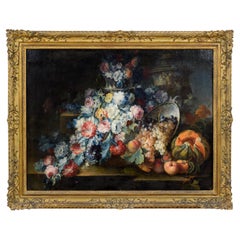
Late 18th, Italian Still Life by Michele Antonio Rapos
By Michele Antonio Rapos
Located in IT
Michele Antonio Rapos (Turin, 1733–1819), Still Life with Flowers and Fruit
Oil on canvas; frame: cm W 127 x H 101 x D 7; tela cm W 106 x H 80
This fine painting, presented in an i...
Category
Late 18th Century Rococo Antique Italian Paintings
Materials
Canvas
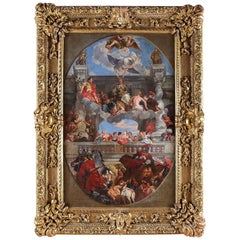
18th-19th Century Oil on Canvas "The Triumph of Venice" After Paolo Veronese
By Paolo Veronese
Located in Los Angeles, CA
A very fine and Large Italian 18th-19th century oval-shaped oil on canvas titled "The Triumph of Venice" After the original work by Paolo Veronese (Venice, 1528-1588). The original of this painting hangs in the Palazzo Ducale, Venice. The 'Ricci' coloration suggests a late 17th-early 18th century date. In 1715 Charles de la Fosse advised Ricci to paint only "Veroneses and no more Riccis", Venice, circa 1800.
Measures:
Height: 45 1/4 inches (115 cm).
Width: 29 inches (73.7 cm).
Frame height: 58 1/4 inches (147.9 cm).
Frame width: 43 1/4 inches (109.9 cm).
Frame depth: 5 1/4 (13.3 cm).
Provenance: Royal Academy of Scotland.
Paolo Veronese (Born 1528, Verona, Republic of Venice - died April 9, 1588, Venice) was an Italian painter of the Renaissance in Venice, famous for paintings such as The Wedding at...
Category
Early 1800s Renaissance Antique Italian Paintings
Materials
Wood, Gesso, Canvas
$59,850 Sale Price
52% Off
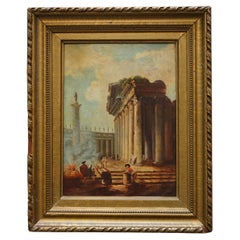
ANTIQUE GRAND TOUR MARCUS AURELIUS STATUE CORINTHIAN PiLLAR ROMAN OIL PAINTING
Located in West Sussex, Pulborough
Royal House Antiques
Royal House Antiques is delighted to offer for sale this stunning original circa 1860-1880 Italian Grand Tour Oil on Board painting of Roman Temple Ruins with a...
Category
1860s Grand Tour Antique Italian Paintings
Materials
Wood
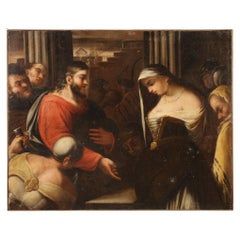
18th Century Oil on Canvas Religious Italian Painting Christ and the Adulteress
Located in Vicoforte, Piedmont
Antique 18th-century Italian painting. Oil on canvas artwork inspired by Luca Giordano's famous masterpiece, Christ and the Adulteress, an original from the second half of the 17th c...
Category
1780s Antique Italian Paintings
Materials
Canvas
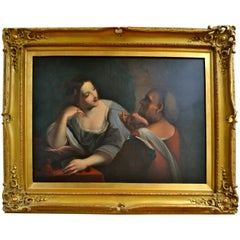
Italian Baroque Style Painting of Beauty and Old Age attributed to R. Manchetti
Located in Vancouver, British Columbia
An old master style 18th century allegorical painting representing youth and old age, and/or beauty and wisdom, depicted by a beautiful young ...
Category
Mid-18th Century Baroque Antique Italian Paintings
Materials
Canvas
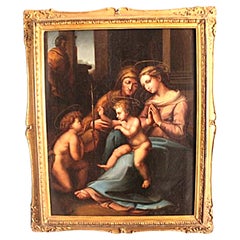
19th Century Oil on Canvas After Raphael: Holy Family Painting
By (after) Raphael (Raffaello Sanzio da Urbino)
Located in Seaford, GB
Early 19th-Century Italian School Oil on Canvas – After Raphael
The Holy Family with Saint Elisabeth and the Infant Saint John the Baptist
Introduction: A Masterpiece Inspired by Rap...
Category
Early 19th Century Renaissance Antique Italian Paintings
Materials
Canvas
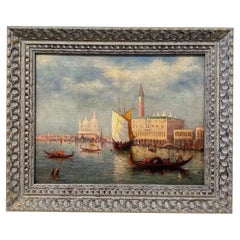
Original Oil on Canvas of Venice, Italy
Located in Nashville, TN
This is a beautiful original work of art depicting Venice, Italy with it's beautiful color and architecture from the early 1900s. There are no repairs on this painting it shows brill...
Category
1930s Vintage Italian Paintings
Materials
Paint
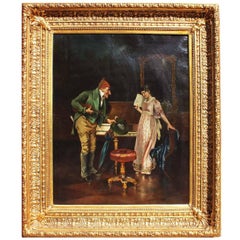
Italian 19th Century Oil on Canvas "The Music Professor" Carlo Sassi
By Carlo Sassi
Located in Los Angeles, CA
Italian 19th century oil on canvas titled "The Music Professor" depicting a mid-19th century music-room scene of an elder man, the music professor, holding his violin, hat and umbrel...
Category
19th Century Other Antique Italian Paintings
Materials
Gesso, Canvas, Wood
$9,960 Sale Price
20% Off
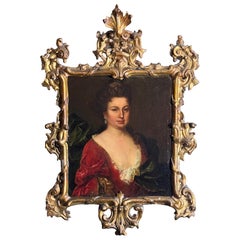
Important Portrait of the Princess of Ruspoli, 18th Century, Italian School
By Midcentury Italian school
Located in Madrid, ES
Important Portrait of the Princess of Ruspoli, began 18th Century, Italian School
Began 18th-century oil on canvas depicting the Princess of Ruspoli, a member of one of the most in...
Category
18th Century Baroque Antique Italian Paintings
Materials
Paint
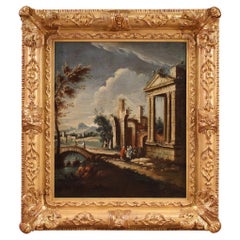
18th Century Oil on Canvas Architectural Capriccio Landscape Venetian Painting
Located in Vicoforte, Piedmont
Refined Italian landscape from the second half of the 18th century. Oil painting on canvas depicting a splendid view with ancient ruins and figures in Venetian dress...
Category
1760s Antique Italian Paintings
Materials
Canvas
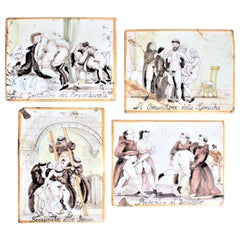
Four Antique Italian Extreme Erotica Hand Painted Pottery Tiles of Monks
Nuns
Located in Hamilton, Ontario
This set of four antique hand painted pottery tiles are all unsigned, so no specific artist can be identified, but are presumed to have be...
Category
Late 18th Century Neoclassical Antique Italian Paintings
Materials
Pottery
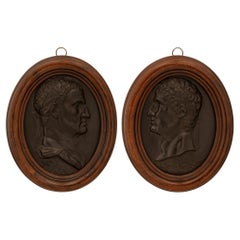
Italian late 19th century Basalt Wedgwood and patinated Wood plaques
Located in West Palm Beach, FL
A handsome and most decorative pair of Italian late 19th century Basalt Wedgwood and patinated Wood plaques. Each finely detailed silhouette is identifying a Roman Emperor on a Basal...
Category
19th Century Antique Italian Paintings
Materials
Wood
Late 19th Century Italian Lakeside Oil on Canvas
Located in Los Angeles, CA
Antique oil on canvas made in Italy in the late 19th Century, depicting a lakeside view with trees all around and a fisherman on the back. It is protected by a carved giltwood frame....
Category
Late 19th Century Antique Italian Paintings
Materials
Canvas, Giltwood
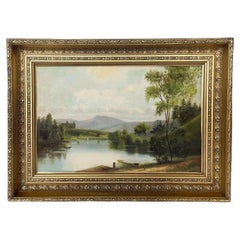
Italian 18th Century Oil on Canvas from the Piedmont Region
Located in West Palm Beach, FL
A sensational and large scale Italian 18th century oil on canvas from the Piedmont region. The beautiful painting is set in its original polychrome frame which displays a lovely carv...
Category
18th Century Antique Italian Paintings
Materials
Canvas, Wood
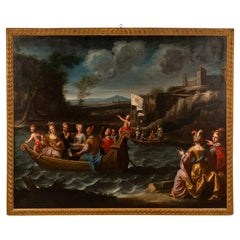
17th Century Oil on Canvas Italian Painting Saint Francis of Assisi, 1660
Located in Vicoforte, Piedmont
Antique 17th-century Italian painting. Oil on canvas artwork depicting Saint Francis of Assisi in meditation, of remarkable pictorial quality. The saint is depicted in a cave, next t...
Category
1660s Antique Italian Paintings
Materials
Canvas
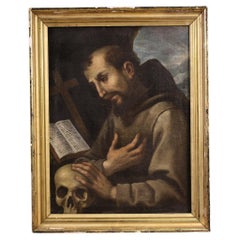
Pair of Italian 19th Century Neapolitan Gouaches
Located in Bradenton, FL
An absolutely exquisite pair of Italian 19th century Neapolitan gouaches in 20th century giltwood frames. One depicts the volcano eruption of 1822 in Naples, the other is an affluent...
Category
19th Century Grand Tour Antique Italian Paintings
Materials
Paint
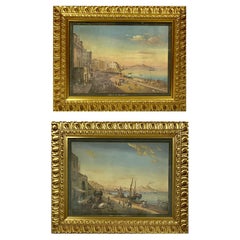
$4,440 Sale Price / set
40% Off
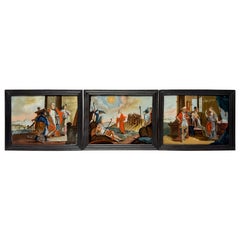
Set of 3, 19th Century Allegorical Reverse Glass Paintings
Located in Atlanta, GA
**Set of 3, 19th Century Allegorical Reverse Glass Paintings**
This captivating set of **three 19th-century allegorical reverse glass paintings** presents richly detailed narratives imbued with symbolism and classical themes. Each painting is executed in the traditional reverse glass technique, providing a smooth and reflective surface that enhances the vibrant palette and fine detailing.
1. **Painting 1 (Left Panel):**
This scene portrays a dramatic encounter, likely a moment of judgment or persuasion, set against a distant landscape. A figure in a flowing blue robe gestures emphatically toward a well-dressed couple, perhaps symbolizing conflict, intervention, or moral decision-making. The background includes a sweeping view of the countryside, with figures in the distance adding depth and context.
2. **Painting 2 (Center Panel):**
The central panel features a pastoral scene steeped in allegorical significance. A central figure dressed in red, resembling a shepherd, commands attention under a radiant sunburst. Surrounding characters appear in moments of tension and repose, including a reclining figure and a soldier-like character. This composition evokes themes of guidance, struggle, and divine providence, with the bright sky and natural elements reinforcing the allegorical tone.
3. **Painting 3 (Right Panel):**
The final panel depicts an intimate interior scene, with two seated women engaged in conversation, one gesturing emphatically as a standing male figure observes. The setting includes detailed furnishings, such as a writing desk, a red draped curtain, and objects hinting at scholarly or domestic pursuits. This tableau may represent themes of wisdom, counsel, or moral reflection, supported by the characters' thoughtful expressions and elaborate dress.
Each painting is framed in its **original dark wooden frame**, complementing the vibrant colors and enhancing their display value. The set embodies the **19th-century European fascination with allegory and storytelling**, making it a significant piece for collectors of reverse glass art...
Category
Mid-19th Century Baroque Antique Italian Paintings
Materials
Glass, Paint
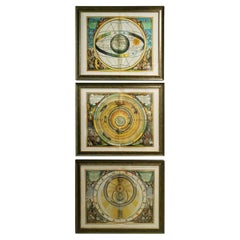
Set of 3 Italian Renaissance Celestial Lithographs of the Universe
Located in Queens, NY
SET of 3 Italian Renaissance framed celestial lithographs featuring early beliefs of the solar system (PRICED AS SET) (Available individually...
Category
20th Century Renaissance Italian Paintings
Materials
Paper
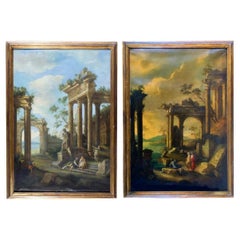
Italian Painter of 1700 "Capriccio with classical ruins and figures"
Located in Cesena, FC
Painter of ruins xviii century:
"capriccio with classical ruins and four figures" , pendant with "capriccio with classical ruins and three figures"
Oil on canvas cm 140 x 95
The ...
Category
1730s Antique Italian Paintings
Materials
Canvas
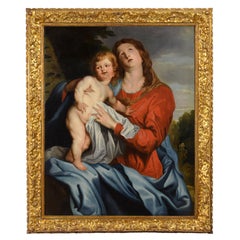
17th Century, Italian Painting with Virgin and Child by Follower of Van Dyck
By Anthony van Dyck
Located in IT
17th century, Italian painting with virgin and childr by Follower of Sir Anthony van Dyck
cm W 90 x H 113; cornice cm W 111 x H 135 x D 7
The canvas depicts the Madonna with the Chi...
Category
Late 17th Century Baroque Antique Italian Paintings
Materials
Canvas
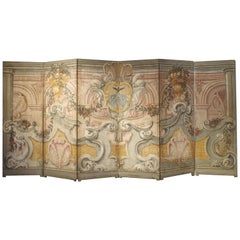
Spectacular Painted Six-Panel Armorial Baroque Screen from Italy, Circa 1700
Located in Dallas, TX
This six panel Italian screen is from the Baroque period, circa 1700. The four central panels have been affixed to a foldable frame, while the two outer panels are detached. When all...
Category
Early 18th Century Baroque Antique Italian Paintings
Materials
Wood, Canvas
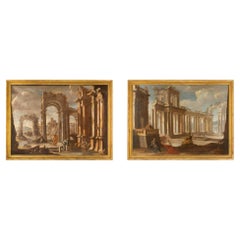
Pair of Italian Mid-18th Century Old Master Oil on Canvas Paintings of Ruins
Located in West Palm Beach, FL
A spectacular and extremely well executed pair of Italian mid 18th century Old Master oil on canvas paintings of ruins. Each painting displays wonderful perspectives, exceptional arc...
Category
18th Century Antique Italian Paintings
Materials
Canvas, Giltwood
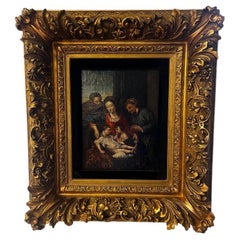
Early 17th Century School of Peter Paul Rubens “The Holy Family” Oil on Canvas
Located in Doha, QA
This is an absolutely incredible early 17th century oil on canvas painting representing Holy Family-Virgin Mary, St.Joseph, St. Elisabeth, John the Baptist and Baby Jesus. Sir Peter ...
Category
Early 17th Century Baroque Antique Italian Paintings
Materials
Canvas
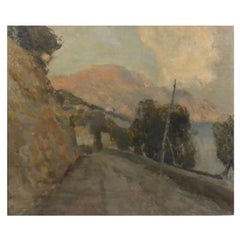
Gennaro Villani (1885-1948) Amalfi Coast
By Gennaro Villani 1
Located in New York, NY
Gennaro Villani (1885-1948) Amalfi Coast, oil on canvas in painted and gilt frame, signed lower left. Italy, circa 1920. Dimensions: 27" W x 23" H x 1.25" D; sight 24.5" W x 21" H.
Category
1920s Vintage Italian Paintings
Materials
Canvas, Paint
Italian 18th century Giltwood, Mecca, and Oil on Canvas painting
Located in West Palm Beach, FL
A most handsome and finely detailed Italian 18th century Giltwood, Mecca, and Oil on Canvas painting, by Antonio Visentini. This beautiful painting depicts Italian ruins with what ap...
Category
18th Century Antique Italian Paintings
Materials
Giltwood
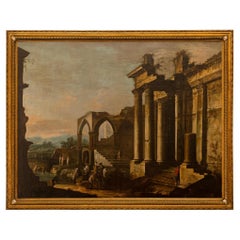
18th Century Oil on Canvas Italian Bucolic Landscape Painting, 1770
Located in Vicoforte, Piedmont
Venetian school of the second half of the 18th century. Oil painting on canvas depicting an Arcadian landscape of pastoral genre. This type of pictorial representation established it...
Category
1770s Antique Italian Paintings
Materials
Canvas
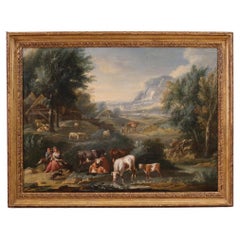
Antique Oil on Canvas Portrait of a Lady
Located in Los Angeles, CA
A beautifully painted oil on canvas of a lady, circa 1825, merged with a period gilt-wood frame.
Category
1820s Antique Italian Paintings
Materials
Canvas, Giltwood, Paint
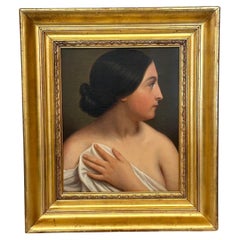
Pietro Gabrini Large Oil on Canvas "Three Singing Italian Beauties on The Road"
By Pietro Gabrini 1
Located in Los Angeles, CA
Pietro Gabrini (Italian, 1856-1926) a very fine and large oil on canvas "Three Singing Italian Beauties on The Road" depicting three cheerful Village young maidens walking through a ...
Category
Late 19th Century Baroque Revival Antique Italian Paintings
Materials
Canvas, Wood
$29,850 Sale Price
60% Off
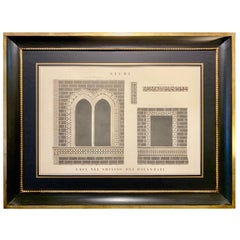
Italian 19th Century Big Size Architectural Watercolor with Black Gold Frame
Located in Scandicci, Florence
Rare extra-large (cm 59 x 85) antique watercolor from a collection of architectural details of Florence monuments painted in Italy in the mid-19th century.
Black mat with gold hand ...
Category
1840s Neoclassical Antique Italian Paintings
Materials
Gold Leaf
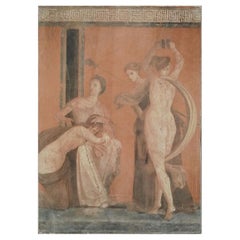
Painted Pompeii Fresco Panel on Canvas
Located in Los Angeles, CA
Painted Pompeii fresco panel depicting scene VIII from the "Sala di Grande Dipinto" in the Villa de Misteri at Pompeii on canvas. This is in the style of painted on canvas. Measures ...
Category
1950s Other Vintage Italian Paintings
Materials
Canvas
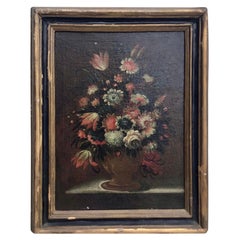
Antique Old Master Floral Still Life Oil Painting Flowers 18th Century Italian
Located in Bradenton, FL
A Beautiful Italian Still Life oil painting on old canvas of a brass urn holding a bouquet of assorted flowers set on a ledge. 18th or ...
Category
18th Century Baroque Antique Italian Paintings
Materials
Paint
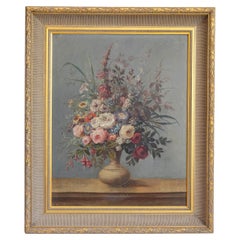
Italian Rococo 1770s Framed Still-Life Painting Depicting a Bouquet of Flowers
Located in Atlanta, GA
An Italian Rococo period framed still-life oil on canvas painting from the late 18th century, depicting a colorful bouquet. Created in Italy during the third quarter of the 18th cent...
Category
Late 18th Century Rococo Antique Italian Paintings
Materials
Canvas, Paint
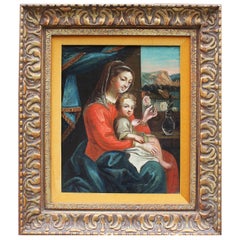
Italian Mid-19th Century Oil on Board Representing a "Mother and Child"
Located in Los Angeles, CA
An Italian mid-19th century oil on board representing a "Mother and Child". The Renaissance revival style painting in the manner of a Raphaelite Madonna and Child, of a seated young ...
Category
Mid-19th Century Renaissance Revival Antique Italian Paintings
Materials
Wood, Giltwood
$3,850 Sale Price
22% Off
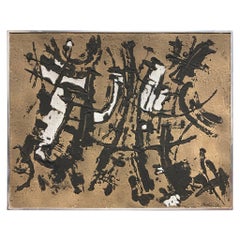
Italian Abstract Expressionist Painting by Ugo Sterpini, Signed and Dated 1958
Located in Stamford, CT
Ugo Sterpini (Italian, 1927-2000)''La Lotta Sulla Duna" (The Battle On The Dune). Mixed media on canvas, signed and dated ''58'' lower right, signed, titl...
Category
Mid-20th Century Mid-Century Modern Italian Paintings
Materials
Canvas
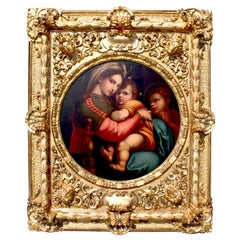
After Raffaello Sanzio 1483-1520 Raphael La Madonna della Seggiola Oil on Canvas
By Raphael (Raffaello Sanzio da Urbino)
Located in Los Angeles, CA
A fine Italian 19th century oil painting on canvas "La Madonna della Seggiola" after Raphael (Raffaello Sanzio da Urbino 1483-1520) The circular canvas depicting a seated Madonna holding an infant Jesus Christ next to a child Saint John the Baptist, all within a massive carved gilt wood and gesso frame (all high quality gilt is original) which is identical to the frame on Raphael's original artwork. This painting is a 19th Century copy of Raphael's Madonna della Seggiola painted in 1514 and currently exhibited and part of the permanent collection at the Palazzo Pitti, Galleria Palatina, Florence, Italy. The bodies of the Virgin, Christ, and the boy Baptist fill the whole picture. The tender, natural looking embrace of the Mother and Child, and the harmonious grouping of the figures in the round, have made this one of Raphael's most popular Madonnas. The isolated chair leg is reminiscent of papal furniture, which has led to the assumption that Leo X himself commissioned the painting, circa 1890-1900.
Subject: Religious painting
Measures: Canvas height: 29 1/4 inches (74.3 cm)
Canvas width: 29 1/4 inches (74.3 cm)
Painting diameter: 28 1/4 inches (71.8 cm)
Frame height: 57 7/8 inches (147 cm)
Frame width: 45 1/2 inches (115.6 cm)
Frame depth: 5 1/8 inches (13 cm).
Raffaello Sanzio da Urbino (Italian, March 28 or April 6, 1483 - April 6, 1520), known as Raphael, was an Italian painter and architect of the High Renaissance. His work is admired for its clarity of form, ease of composition, and visual achievement of the Neoplatonic ideal of human grandeur. Together with Michelangelo and Leonardo da Vinci, he forms the traditional trinity of great masters of that period.
Raphael was enormously productive, running an unusually large workshop and, despite his death at 37, leaving a large body of work. Many of his works are found in the Vatican Palace, where the frescoed Raphael Rooms were the central, and the largest, work of his career. The best known work is The School of Athens in the Vatican Stanza della Segnatura. After his early years in Rome much of his work was executed by his workshop from his drawings, with considerable loss of quality. He was extremely influential in his lifetime, though outside Rome his work was mostly known from his collaborative printmaking.
After his death, the influence of his great rival Michelangelo was more widespread until the 18th and 19th centuries, when Raphael's more serene and harmonious qualities were again regarded as the highest models. His career falls naturally into three phases and three styles, first described by Giorgio Vasari: his early years in Umbria, then a period of about four years (1504–1508) absorbing the artistic traditions of Florence, followed by his last hectic and triumphant twelve years in Rome, working for two Popes and their close associates.
Raphael was born in the small but artistically significant central Italian city of Urbino in the Marche region, where his father Giovanni Santi was court painter to the Duke. The reputation of the court had been established by Federico III da Montefeltro, a highly successful condottiere who had been created Duke of Urbino by the Pope - Urbino formed part of the Papal States - and who died the year before Raphael was born. The emphasis of Federico's court was rather more literary than artistic, but Giovanni Santi was a poet of sorts as well as a painter, and had written a rhymed chronicle of the life of Federico, and both wrote the texts and produced the decor for masque-like court entertainments. His poem to Federico shows him as keen to show awareness of the most advanced North Italian painters, and Early Netherlandish artists as well. In the very small court of Urbino he was probably more integrated into the central circle of the ruling family than most court painters.
Federico was succeeded by his son Guidobaldo da Montefeltro, who married Elisabetta Gonzaga, daughter of the ruler of Mantua, the most brilliant of the smaller Italian courts for both music and the visual arts. Under them, the court continued as a centre for literary culture. Growing up in the circle of this small court gave Raphael the excellent manners and social skills stressed by Vasari. Court life in Urbino at just after this period was to become set as the model of the virtues of the Italian humanist court through Baldassare Castiglione's depiction of it in his classic work The Book of the Courtier, published in 1528. Castiglione moved to Urbino in 1504, when Raphael was no longer based there but frequently visited, and they became good friends. He became close to other regular visitors to the court: Pietro Bibbiena and Pietro Bembo, both later cardinals, were already becoming well known as writers, and would be in Rome during Raphael's period there. Raphael mixed easily in the highest circles throughout his life, one of the factors that tended to give a misleading impression of effortlessness to his career. He did not receive a full humanistic education however; it is unclear how easily he read Latin.
Early Life and Works
His mother Màgia died in 1491 when Raphael was eight, followed on August 1, 1494 by his father, who had already remarried. Raphael was thus orphaned at eleven; his formal guardian became his only paternal uncle Bartolomeo, a priest, who subsequently engaged in litigation with his stepmother. He probably continued to live with his stepmother when not staying as an apprentice with a master. He had already shown talent, according to Vasari, who says that Raphael had been "a great help to his father". A self-portrait drawing from his teenage years shows his precocity. His father's workshop continued and, probably together with his stepmother, Raphael evidently played a part in managing it from a very early age. In Urbino, he came into contact with the works of Paolo Uccello, previously the court painter (d. 1475), and Luca Signorelli, who until 1498 was based in nearby Città di Castello.
According to Vasari, his father placed him in the workshop of the Umbrian master Pietro Perugino as an apprentice "despite the tears of his mother". The evidence of an apprenticeship comes only from Vasari and another source, and has been disputed—eight was very early for an apprenticeship to begin. An alternative theory is that he received at least some training from Timoteo Viti, who acted as court painter in Urbino from 1495.Most modern historians agree that Raphael at least worked as an assistant to Perugino from around 1500; the influence of Perugino on Raphael's early work is very clear: "probably no other pupil of genius has ever absorbed so much of his master's teaching as Raphael did", according to Wölfflin. Vasari wrote that it was impossible to distinguish between their hands at this period, but many modern art historians claim to do better and detect his hand in specific areas of works by Perugino or his workshop. Apart from stylistic closeness, their techniques are very similar as well, for example having paint applied thickly, using an oil varnish medium, in shadows and darker garments, but very thinly on flesh areas. An excess of resin in the varnish often causes cracking of areas of paint in the works of both masters. The Perugino workshop was active in both Perugia and Florence, perhaps maintaining two permanent branches. Raphael is described as a "master", that is to say fully trained, in December 1500.
His first documented work was the Baronci altarpiece for the church of Saint Nicholas of Tolentino in Città di Castello, a town halfway between Perugia and Urbino. Evangelista da Pian di Meleto, who had worked for his father, was also named in the commission. It was commissioned in 1500 and finished in 1501; now only some cut sections and a preparatory drawing remain. In the following years he painted works for other churches there, including the Mond Crucifixion (about 1503) and the Brera Wedding of the Virgin (1504), and for Perugia, such as the Oddi Altarpiece. He very probably also visited Florence in this period. These are large works, some in fresco, where Raphael confidently marshals his compositions in the somewhat static style of Perugino. He also painted many small and exquisite cabinet paintings in these years, probably mostly for the connoisseurs in the Urbino court, like the Three Graces and St. Michael, and he began to paint Madonnas and portraits. In 1502 he went to Siena at the invitation of another pupil of Perugino, Pinturicchio, "being a friend of Raphael and knowing him to be a draughtsman of the highest quality" to help with the cartoons, and very likely the designs, for a fresco series in the Piccolomini Library in Siena Cathedral. He was evidently already much in demand even at this early stage in his career.
Influence of Florence
Raphael led a "nomadic" life, working in various centres in Northern Italy, but spent a good deal of time in Florence, perhaps from about 1504. Although there is traditional reference to a "Florentine period...
Category
19th Century Baroque Antique Italian Paintings
Materials
Gesso, Canvas, Wood
$19,850 Sale Price
42% Off
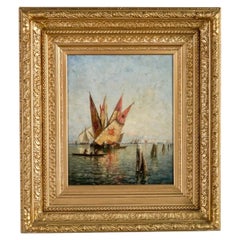
"Boats in the Harbor, Venice" by American Artist Lemuel D. Eldred
By Lemuel D. Eldred
Located in Wiscasset, ME
An oil on canvas, signed in the lower left corner and present in a period, if not the original, frame measuring 26.75" x 24" (frame included) featuring boat in the harbor of Venice, ...
Category
Late 19th Century Victorian Antique Italian Paintings
Materials
Paint
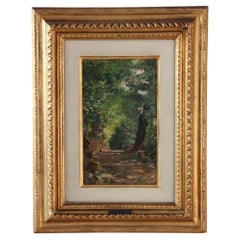
Late 19th Century Italian Oil Painting on Board, Path in the Woods, Signed
Located in Casale Monferrato, IT
We present this fantastic oil painting on board dating back to the end of the 19th century. The painting features the Leto signature at the bottom right (see photo). Attributable to ...
Category
Late 19th Century Antique Italian Paintings
Materials
Poplar
$1,656 Sale Price
44% Off
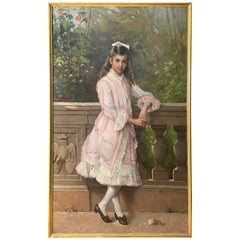
Large Painting Of Anna Maria Borghese by Vittorio Matteo Corcos
Located in Norwood, NJ
Vittorio Matteo Corcos, Italian, (1859–1933)
Original portrait of Anna Maria Borghese by Vittorio Matteo Corcos. Oil on canvas. Unsigned. Ex-Sot...
Category
Late 19th Century Antique Italian Paintings
Materials
Gold Leaf
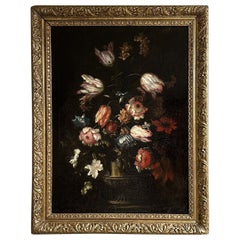
Oil on canvas, Vase of Flowers by Francesco Caldei known as Francesco Mantovani
Located in Milan, IT
Oil on canvas, Vase of Flowers by Francesco Caldei, known as Francesco Mantovani, Mantua 1584-Venice 1674.
This is a painting created around 1600 by Francesco Caldei, known as Franc...
Category
Early 1600s Baroque Antique Italian Paintings
Materials
Canvas
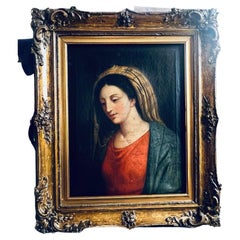
Antique 17th Century Painting Madonna /Virgin Mary Italy Oil on Canvas
Located in Doha, QA
Magnificent Italian 17th century Portrait of Virgin Mary measures 52 x 68 cm without the frame.
The colors are stunning and the paintin...
Category
17th Century Baroque Antique Italian Paintings
Materials
Canvas
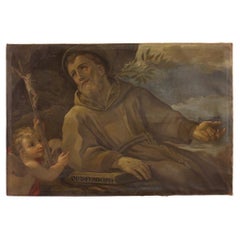
18th Century Oil on Canvas Italian Religious Painting Saint Francis of Assisi
Located in Vicoforte, Piedmont
Great Italian painting from the second half of the 18th century. Oil on canvas painting, on the first canvas, depicting Saint Francis of Assisi in ecstasy. The Saint is accompanied b...
Category
1770s Antique Italian Paintings
Materials
Canvas
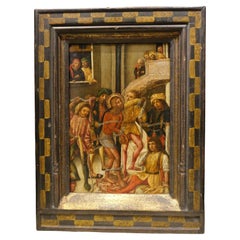
Christ with bonds, Venetian work from the second half of the 15th century
Located in PARIS, FR
Venetian work, second half of the 15th century
Tempera on panel
34 x 23 cm
An episode from the Passion of Christ during the trial of Pontius Pilate, the Roman procurator, concerning ...
Category
15th Century and Earlier Renaissance Antique Italian Paintings
Materials
Wood
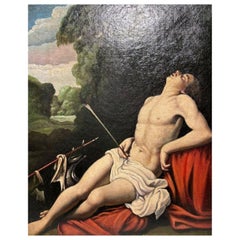
"Saint Sebastian" by Carlo Saraceni 19th Century Italian School with Video
Located in Madrid, ES
"Saint Sebastian" by Carlo Saraceni 19th Century Italian School with Video
Oil painting on canvas, Italian school, 19th century, depicting Saint Sebastian in the style of Carlo Sara...
Category
Late 19th Century Baroque Antique Italian Paintings
Materials
Paint
Italian Lithograph by Remo Brindisi Proof of Author, 1980s
By Remo Brindisi
Located in Milano, MI
Lithograph from the 1990s by Remo Brindisi, Italian painter.
Measures: Ø cm 50 H cm 70.
Realist painter of the twentieth century, he was born in Rome in 1918. His artisti...
Category
1980s Mid-Century Modern Vintage Italian Paintings
Materials
Paper
$511 Sale Price
20% Off
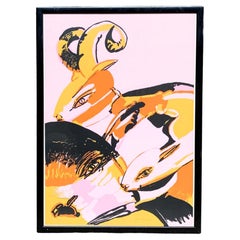
Italian 1970s Mixed-Media Art by Roffi
Roberto Fraschetti
Located in London, GB
Italian 1970s mixed-media art by Roffi (Roberto Fraschetti).
Accompanied by Artist authentication and signature.
In excellent vintage condition.
Category
1960s Mid-Century Modern Vintage Italian Paintings
Materials
Paint
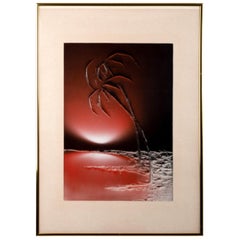
Max Marra Italian Tempera on Paper
By Max Marra
Located in Prato, Tuscany
Contemporary Italian tempera on paper signed Max Marra 2004(multimedia experimenter), tempera on a gold background. Max Marra was born in Paola, Calabria, in 1950. He moved to Lisson...
Category
21st Century and Contemporary Modern Italian Paintings
Materials
Paper, Wood
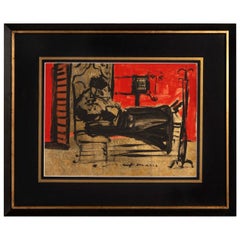
17th Century Venetian Old Master Floral Still Life Oil Painting Flowers
Located in Bradenton, FL
A beautiful Italian Still Life oil painting on old canvas of an urn holding a bouquet of assorted flowers set on a ledge. 17th century....
Category
17th Century Baroque Antique Italian Paintings
Materials
Paint
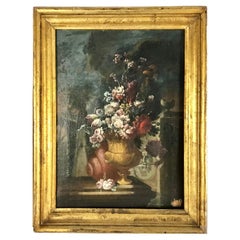
$3,680 Sale Price
20% Off
After Raffaello Sanzio 1483-1520 Raphael La Madonna della Seggiola Oil on Canvas
By (after) Raphael (Raffaello Sanzio da Urbino)
Located in Los Angeles, CA
A Fine Italian 19th Century Oil Painting on Canvas "La Madonna della Seggiola" after Raphael (Raffaello Sanzio da Urbino 1483-1520). The circular painted canvas depicting a seated Madonna holding an infant Jesus Christ next to a child Saint John the Baptist, all within a massive carved gilt wood and gesso frame, which is identical to the frame on Raphael's original artwork. This painting is a 19th Century copy of Raphael's Madonna della Seggiola painted in 1514 and currently exhibited and part of the permanent collection at the Palazzo Pitti, Galleria Palatina, Florence, Italy. The bodies of the Virgin, Christ, and the boy Baptist fill the whole picture. The tender, natural looking embrace of the Mother and Child, and the harmonious grouping of the figures in the round, have made this one of Raphael's most popular Madonnas. The isolated chair leg is reminiscent of papal furniture, which has led to the assumption that Leo X himself commissioned the painting. A retailer's label reads " Fred K/ Keer's Sons - Framers and Fine Art Dealers - 917 Broad St. Newark, N.J." - Another label from the gilder reads "Carlo Bartolini - Doratore e Verniciatori - Via Maggio 1924 - Firenze". Circa: 1890-1900.
Subject: Religious painting
Canvas diameter: 28 inches (71.1 cm)
Frame height: 54 inches (137.2 cm)
Frame width: 42 1/2 inches (108 cm)
Frame depth: 5 1/2 inches (14 cm)
Raffaello Sanzio da Urbino (Italian, March 28 or April 6, 1483 - April 6, 1520), known as Raphael, was an Italian painter and architect of the High Renaissance. His work is admired for its clarity of form, ease of composition, and visual achievement of the Neoplatonic ideal of human grandeur. Together with Michelangelo and Leonardo da Vinci, he forms the traditional trinity of great masters of that period.
Raphael was enormously productive, running an unusually large workshop and, despite his death at 37, leaving a large body of work. Many of his works are found in the Vatican Palace, where the frescoed Raphael Rooms were the central, and the largest, work of his career. The best known work is The School of Athens in the Vatican Stanza della Segnatura. After his early years in Rome much of his work was executed by his workshop from his drawings, with considerable loss of quality. He was extremely influential in his lifetime, though outside Rome his work was mostly known from his collaborative printmaking.
After his death, the influence of his great rival Michelangelo was more widespread until the 18th and 19th centuries, when Raphael's more serene and harmonious qualities were again regarded as the highest models. His career falls naturally into three phases and three styles, first described by Giorgio Vasari: his early years in Umbria, then a period of about four years (1504–1508) absorbing the artistic traditions of Florence, followed by his last hectic and triumphant twelve years in Rome, working for two Popes and their close associates.
Raphael was born in the small but artistically significant central Italian city of Urbino in the Marche region, where his father Giovanni Santi was court painter to the Duke. The reputation of the court had been established by Federico III da Montefeltro, a highly successful condottiere who had been created Duke of Urbino by the Pope - Urbino formed part of the Papal States - and who died the year before Raphael was born. The emphasis of Federico's court was rather more literary than artistic, but Giovanni Santi was a poet of sorts as well as a painter, and had written a rhymed chronicle of the life of Federico, and both wrote the texts and produced the decor for masque-like court entertainments. His poem to Federico shows him as keen to show awareness of the most advanced North Italian painters, and Early Netherlandish artists as well. In the very small court of Urbino he was probably more integrated into the central circle of the ruling family than most court painters.
Federico was succeeded by his son Guidobaldo da Montefeltro, who married Elisabetta Gonzaga, daughter of the ruler of Mantua, the most brilliant of the smaller Italian courts for both music and the visual arts. Under them, the court continued as a centre for literary culture. Growing up in the circle of this small court gave Raphael the excellent manners and social skills stressed by Vasari. Court life in Urbino at just after this period was to become set as the model of the virtues of the Italian humanist court through Baldassare Castiglione's depiction of it in his classic work The Book of the Courtier, published in 1528. Castiglione moved to Urbino in 1504, when Raphael was no longer based there but frequently visited, and they became good friends. He became close to other regular visitors to the court: Pietro Bibbiena and Pietro Bembo, both later cardinals, were already becoming well known as writers, and would be in Rome during Raphael's period there. Raphael mixed easily in the highest circles throughout his life, one of the factors that tended to give a misleading impression of effortlessness to his career. He did not receive a full humanistic education however; it is unclear how easily he read Latin.
Early Life and Works
His mother Màgia died in 1491 when Raphael was eight, followed on August 1, 1494 by his father, who had already remarried. Raphael was thus orphaned at eleven; his formal guardian became his only paternal uncle Bartolomeo, a priest, who subsequently engaged in litigation with his stepmother. He probably continued to live with his stepmother when not staying as an apprentice with a master. He had already shown talent, according to Vasari, who says that Raphael had been "a great help to his father". A self-portrait drawing from his teenage years shows his precocity. His father's workshop continued and, probably together with his stepmother, Raphael evidently played a part in managing it from a very early age. In Urbino, he came into contact with the works of Paolo Uccello, previously the court painter (d. 1475), and Luca Signorelli, who until 1498 was based in nearby Città di Castello.
According to Vasari, his father placed him in the workshop of the Umbrian master Pietro Perugino as an apprentice "despite the tears of his mother". The evidence of an apprenticeship comes only from Vasari and another source, and has been disputed—eight was very early for an apprenticeship to begin. An alternative theory is that he received at least some training from Timoteo Viti, who acted as court painter in Urbino from 1495.Most modern historians agree that Raphael at least worked as an assistant to Perugino from around 1500; the influence of Perugino on Raphael's early work is very clear: "probably no other pupil of genius has ever absorbed so much of his master's teaching as Raphael did", according to Wölfflin. Vasari wrote that it was impossible to distinguish between their hands at this period, but many modern art historians claim to do better and detect his hand in specific areas of works by Perugino or his workshop. Apart from stylistic closeness, their techniques are very similar as well, for example having paint applied thickly, using an oil varnish medium, in shadows and darker garments, but very thinly on flesh areas. An excess of resin in the varnish often causes cracking of areas of paint in the works of both masters. The Perugino workshop was active in both Perugia and Florence, perhaps maintaining two permanent branches. Raphael is described as a "master", that is to say fully trained, in December 1500.
His first documented work was the Baronci altarpiece for the church of Saint Nicholas of Tolentino in Città di Castello, a town halfway between Perugia and Urbino. Evangelista da Pian di Meleto, who had worked for his father, was also named in the commission. It was commissioned in 1500 and finished in 1501; now only some cut sections and a preparatory drawing remain. In the following years he painted works for other churches there, including the Mond Crucifixion (about 1503) and the Brera Wedding of the Virgin (1504), and for Perugia, such as the Oddi Altarpiece. He very probably also visited Florence in this period. These are large works, some in fresco, where Raphael confidently marshals his compositions in the somewhat static style of Perugino. He also painted many small and exquisite cabinet paintings in these years, probably mostly for the connoisseurs in the Urbino court, like the Three Graces and St. Michael, and he began to paint Madonnas and portraits. In 1502 he went to Siena at the invitation of another pupil of Perugino, Pinturicchio, "being a friend of Raphael and knowing him to be a draughtsman of the highest quality" to help with the cartoons, and very likely the designs, for a fresco series in the Piccolomini Library in Siena Cathedral. He was evidently already much in demand even at this early stage in his career.
Influence of Florence
Raphael led a "nomadic" life, working in various centres in Northern Italy, but spent a good deal of time in Florence, perhaps from about 1504. Although there is traditional reference to a "Florentine period...
Category
Early 1900s Baroque Antique Italian Paintings
Materials
Canvas, Giltwood
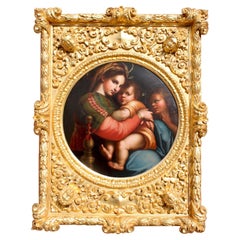
$19,850 Sale Price
39% Off
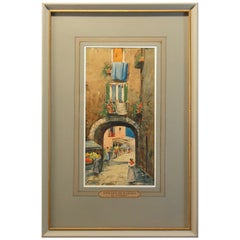
G. Cano
Italian 19th-20th Century
Street Scene in Naples Watercolor
Located in Ottawa, Ontario
G. Cano (Italian 19th-20th century) "Street Scene in Naples", watercolor, Signed lower left "Cano" watercolor on paper. Framed, Matted, Labeled "Strada Di Napoli" G. Cano. The painti...
Category
20th Century Romantic Italian Paintings
Materials
Paint
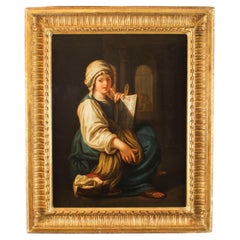
Antique Italian School Oil Painting "Young Lady Reading a Scroll" 19th C
Located in London, GB
This is a magnificent antique Italian School, 19th Century, oil on canvas painting of a young lady reading a scroll,mid 19th century in date.
...
Category
1850s Antique Italian Paintings
Materials
Canvas
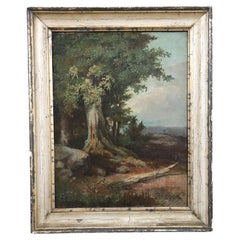
Italian Oil Painting on Canvas Forest Landscape, Late 19th Century
Located in Casale Monferrato, IT
We present this splendid oil on canvas painting of the Italian school dating back to the end of the 19th century. The painting has two initials on the lower left ST but the artist ha...
Category
Late 19th Century Antique Italian Paintings
Materials
Canvas
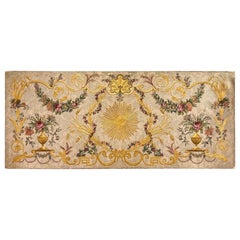
19th Century Italian Raised Gilt Gesso and Oil Painted Panel
Located in Dallas, TX
Outstanding 19th century Italian raised gilt gesso and oil painted panel. Very pretty images of leaves, flowers and urns. An exceptional piece!
Category
19th Century Antique Italian Paintings
Materials
Gesso, Canvas, Paint
Still Thinking About These?
All Recently ViewedMore Ways To Browse
Gold Coin Glasses
Gold Match Box
Grand Tour Oil Lamp
Grand Tour Red
Grape Bucket
Green Porcelain Parrots
Green Tara Statue
Greyhound Table
Guan Yu
Gucci Bar Set 1970
Guilloche Pill Box
Gunnar Tibergaard Nielsen
Haeger Sculpture
Hampton And Sons
Hand Painted Accent Cabinet
Handblown Glass Decanter
Hart Iron
Headrest Ceramic