Art by Medium: Woodcut
to
490
3,592
516
329
182
269
Overall Width
to
Overall Height
to
55
736
3,488
615
30
103
436
320
164
217
402
166
163
121
30
2,430
590
249
215
208
114
62
44
42
27
7
3
1
1
3,434
1,311
120
2,349
1,213
896
853
622
471
459
405
389
366
353
272
242
215
211
187
176
145
134
104
4,895
185,070
97,536
79,552
78,311
170
152
57
51
47
394
2,265
1,925
1,890
Medium: Woodcut
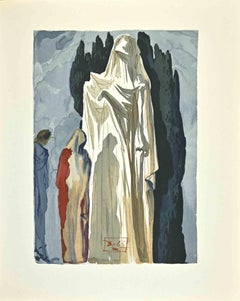
The Heretics - Woodcut print - 1963
Located in Roma, IT
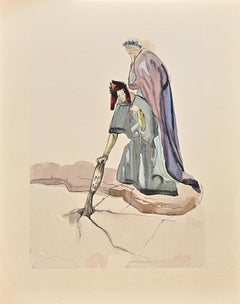
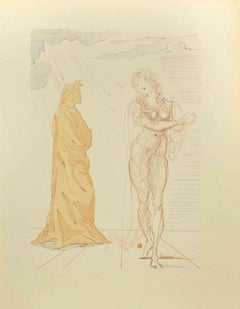
The Heretics - Hell plate 10 is a woodcut print realized in 1963 for a series illustrating the Medieval poem of the "Divine Comedy" by Dante Alighieri.
Good conditions.
Limited e...
Category
1960s Surrealist Art by Medium: Woodcut
Materials
Woodcut
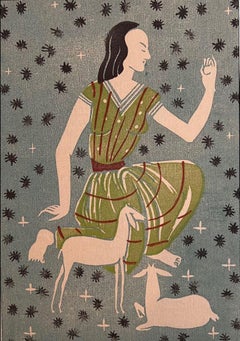
Milwaukee Handicraft Project WPA
Located in Los Angeles, CA
Milwaukee Handicraft Project, Applied Design Blockprinted Textiles Volume VI Supplement, c. 1935 - 1942, twelve block printed designs on linen, images are various sizes, each is mounted in its original folder which measures 24 x 19 inches, all bear the Milwaukee Handicraft Project label, various designers, including Barbara Warren (1915 - 2005) ("Checkered Flower" and perhaps others), includes original portfolio binder
The Milwaukee Handicraft Project (MHP) was the most prolific and successful of the decorative arts projects of the Works Progress Administration (WPA). It served as a model for many other similar projects across the United States and attracted the attention of thought leaders as diverse as Frank Lloyd Wright and First Lady Eleanor Roosevelt. Designed with the dual goals of providing work for underprivileged women and the creation of well-designed household objects, the MHP began in 1935 under the direction of Elsa Ulbricht...
Category
1930s American Modern Art by Medium: Woodcut
Materials
Textile, Linen, Linocut, Woodcut
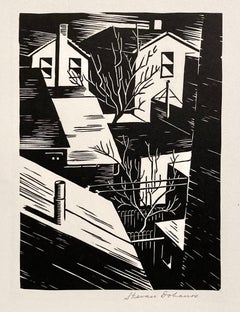
Stevan Dohanos, Backyard
Located in New York, NY
Stevan Dohanos was an accomplished draftsman who work was widely known through the Saturday Evening Post. This print 'Backyard,' however, leaves aside the illustrative magazine work ...
Category
1930s American Modern Art by Medium: Woodcut
Materials
Woodcut
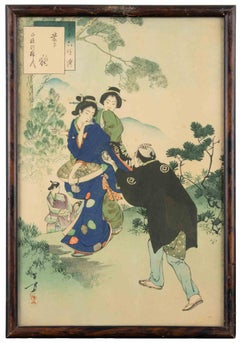
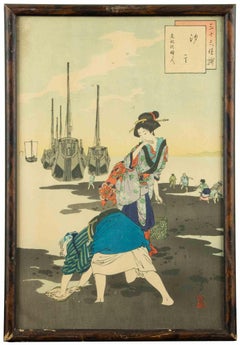
Sanjûroku Kasen... - Woodcut by Mizuno Toshikata - 1893
Located in Roma, IT
Nishiki-e (woodcut print), in vertical oban format (31x20.5) realized by Mizuno Toshikata in 1893 (Meiji 26).
Belongs to the Series "Sanjûroku Kasen" (Thirty-Six Beauties in Compari...
Category
1890s Modern Art by Medium: Woodcut
Materials
Woodcut
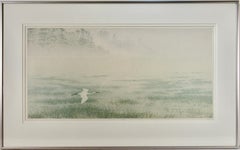
Asagiri
Located in San Francisco, CA
This artwork titled "Asagiri" c.1990, is a color woodblock print on paper by noted Canadian/Japanese artist Suezan Aikins, b.1952. It is signed and numbered 150/200 in pencil by the artist. The artwork (image) size is 11.25 x 23.25 inches, framed size is 18.65 x 30 inches. Custom framed in a silver metal frame, with double off white matting. It is in excellent condition, the frame have some small minor rubs, barely visible.
About the artwork:
This artwork required 7 different carved wood blocks and 21 layers of colors to complete.
About the artist:
Born in Montreal in 1952, Suezan was influenced early in her life by the works of modern Japanese woodblock printmakers which hung throughout her parents’ home. She attended the Fine Arts programme at Mount Allison University in Sackville, New Brunswick (1969 - 1971), The Ontario College of Art (1971-73), L’ ecole du Musee des Beaux Arts (1974), Nova Scotia College of Art and Design -BFA (1975) as well as a very intensive year of study with Toshi Yoshida in Tokyo (1984-85).
She has exhibited extensively in both public and private galleries throughout North America and Japan. Recent exhibitions include solo shows in Tokyo, Osaka, Okinawa, and Boston with group exhibitions at the Wenniger Gallery, Boston, Royal Canadian Academy in Toronto and the Canadian Museum of Nature in Ottawa.
Her paintings and woodblock prints are found in many collections such as The Canada Council Art Bank, The Nickle Art Museum, The Art Gallery of Nova Scotia, The Royal Bank of Canada, Prince Takamanonamiya Norihito, the Embassy of Canada in Tokyo, The Thomas Moore Institute as well as private collections.
Suezan Aikins was awarded the Elizabeth Greenshields Foundation grant in 1983, Nova Scotia Department of Culture - Development Grants in 1980, 1987 and 1988. She was elected to the Royal Canadian Academy of Art in 1990 and received the Canadian Progress Club- Women of Excellence Award for Culture in 1993. Her work has been featured in a number of television documentaries as well as many Canadian magazines.
STUDIES:
Yoshida Woodblock Print Studio Tokyo, 84-85
Nova Scotia College of Art & Design, Halifax, 74-75 BFA
Ecole du Musee des Beaux Arts, Montreal, 74
Ontario College of Art, Toronto, 71-73
Mt. Allison University, 69-72
SELECTED SOLO SHOWS:
25 Year Retrospective of Woodblock Prints traveled to three Public Galleries in Germany: Dornum Castle; Tollhousverein, Leer; Rastede Palace, Oldenberg 2000-2001 color catalog and reviews.
Private Exhibitions, Falmouth, Mass., July 1996; Montreal, November 1996; Gibson Island, Md., April 1999.
Gold Paintings and Woodblock Retrospective, travelling: Kabutoya Gallery, Tokyo; Genkan Gallery, Tokyo American Club; Blue Nile Gallery, Osaka; Kanda's Gallery BOQ, Okinawa; May 1994 (color catalogue)
Edo Gallery, Boston, November 1992, Private Exhibitions, Chatham, Mass, July 1992, Toronto, Oct. 1991
New Paintings and Woodblocks Kabutoya Gallery, Tokyo, May 1991, and also in 1987.
Japanese Garden and Pavilion Foundation, Montreal, September 1990, Ownens Art Gallery, Mount Allison University 1988
Zwickers Gallery, Halifax, NS, 1979; Gallery 78; Fredericton, November, 1983; Robertson Galleries, Ottawa, November, 1982
SELECTED GROUP SHOWS:
"A New Leaf" 30 foot instalation of mixed media/ goldleaf reliefs, Artsplace, Annapolis Royal, N.S., 2000 color catalog
"Far and Wide" Juried Bienials, Art Gallery of Nova Scotia; 1996 to '99, travelling, catalogs
"Moku Hanga Travelling Exhibition: Contemporary Japanese Woodcuts...
Category
Late 20th Century Realist Art by Medium: Woodcut
Materials
Woodcut
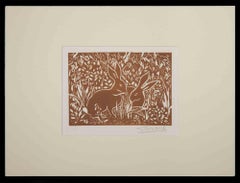
Rabbits - Original Woodcut Print by Giselle Halff - 1950s
Located in Roma, IT
Rabbits is an original woodcut print realized by Giselle Halff in the mid-20th Century.
Good Conditions.
The artwork is depicted through soft strokes in a well-balanced composition...
Category
Mid-20th Century Modern Art by Medium: Woodcut
Materials
Woodcut
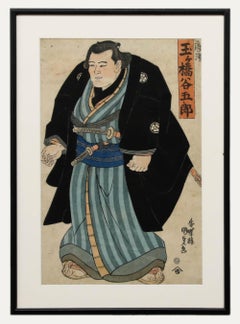
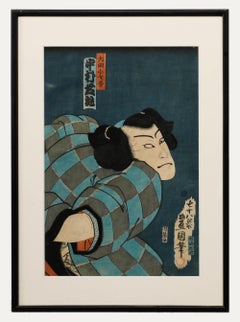
19th Century Japanese Woodblock - Well Dressed Samurai
Located in Corsham, GB
Signed and inscribed with characters. Presented in a contemporary black frame. On paper.
Category
19th Century Art by Medium: Woodcut
Materials
Woodcut
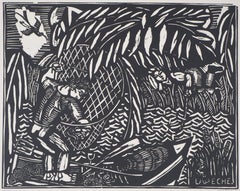
The Fisherman (Angling) - Original woodcut - Signed
By Raoul Dufy
Located in Paris, IDF
Raoul DUFY
The Fisherman (Angling)
Original woodcut
Signed stamp of the artist's studio
Justified Artist Proof (aside the edition numbered on /220)
Titled in the board
50.5 x 65.4 c...
Category
Late 20th Century Modern Art by Medium: Woodcut
Materials
Woodcut
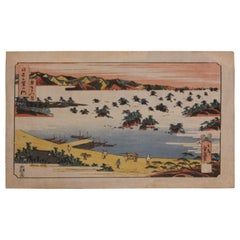
Edo Landscape Japanese Woodblock Print
Located in Houston, TX
Edo Meisho woodblock print of a famous Japanese coastal dock. This woodblock is most likely apart of the series "One Hundred Famous Views of Edo." The woodblock print is printed on r...
Category
1850s Edo Art by Medium: Woodcut
Materials
Woodcut
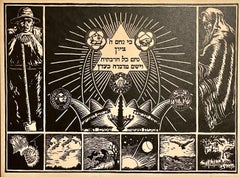
Rare 1922 German Jewish Judaica Zion Woodcut Woodblock Print Hermann Fechenbach
By Hermann Israel Fechenbach
Located in Surfside, FL
Title: Zion
Subject: Various biblical images depicting Creation and prayer
1922
Medium: woodcut
Frame: 14" x 18"
Image: 12.5" x 16.75"
Provenance: owned and signed verso by Peter Keil.
Central panel shows the Jewish star over a crown, with inscription in Hebrew: "When God comforts Zion, He will comfort all its ruins and make its deserts look like Eden," and "You have sanctified the seventh day, the goal of creation of Heaven and Earth." This is flanked by a Palestinian farmer pioneer on the left and a Jew praying on the right. The lower tier shows six vignettes of the days of creation from Genesis.
Hermann Fechenbach was born in 1897 in Württemberg, Germany. He grew up in Bad Mergentheim where his parents had an inn, which served as a meeting place for the local Jewish community.
He left school early and through family connections with clothing retailers received training in window dressing. His skill with brush writing was quickly recognised by a big firm in Dortmund where he was responsible for the displays in 10 large windows. He received his conscription papers in 1916 and recalls “being as patriotic as any other fool”. In August 1917 he was involved in a grenade attack in which he was the sole survivor. With serious injuries to both legs he struggled to safety and was eventually transported to a front line “slaughterhouse” where the first of a series of amputations was performed which led to the loss of his left leg.
As a result of his injuries his father dropped his opposition to him becoming an artist. His formal art education started in 1918 with training at a Stuttgart handcraft school for invalids. He attended the Academies in Stuttgart and Munich to learn painting and restoration for 3 years. He was influenced at this time by Max Liebermann. He has been compared to Kathe Kollwitz and was a contemporary of Jakob Steinhardt and hermann Struck. In 1923 he went to Florence for a year. While in Florence he started to produce a series of miniature wood engravings to illustrate the stories of Genesis. This was followed by periods in Pisa, Venice, Vienna and Amsterdam. In 1924 he returned to Stuttgart to paint in the contemporary style “Die Neue Sachlichkeit”. (The New Objectivity was a movement in German art that arose during the 1920s Weimar republic as a reaction against expressionism. The term was coined by Gustav Friedrich Hartlaub, the director of the Kunsthalle in Mannheim, who used it as the title of an art exhibition staged in 1925 to showcase artists who were working in a post-expressionist spirit. These artists—who included Max Beckmann, Otto Dix, George Grosz, Christian Schad, Rudolf Schlichter and Jeanne Mammen) Every spring and autumn he exhibited at the “Kunstgebit” which served as the showcase for all serious artists of the period.
His professional status “Kunstmaler und Grafiker” was recognised by Berlin in 1926. Practically all his work from this period was sold following exhibition.
In 1926 he collaborated with an architect friend to build a bungalow in Hohenheim, a non-Jewish area and a suburb of Stuttgart. Hermann alternately lived in his country bungalow and his town studio, producing portraits for sale or barter and wood engravings for his own pleasure.
In 1930 he married a non-Jewish professional photographer – Greta Batze. They had a studio in Stuttgart, which was used to teach art to a group of 12 students.
In 1933 the Nazi influence removed his name from the official state register together with the right to exhibit. By spending most of his time in his bungalow out of the Jewish quarter the Fechenbachs escaped being registered by the Nazis for some years. They were ostracised and abused by their non-Jewish neighbours. Hermann made weekly visits to friends in town to teach them the practical skills they would need assuming they were to escape from Germany. His energies were directed towards protection and survival.
Ultimately the Nazi persecution forced the Fechenbachs to flee their homeland. They moved to Palestine for 3 months in 1938, but found the political and physical environment unsustainable.
Greta arrived in England penniless in January 1939 to work as a domestic servant and to find a guarantor for her husband. Hermann arrived in May 1939. They moved to Blackheath a few months later. Hermann resumed his painting and engraving as a means of earning a living. He raised enough money to get his parents out of Germany to join his brothers in Argentina but was unable to save his twin sister Rosa who died in a Nazi concentration camp. In 1940 Hermann was interned in Bury as a suspect alien. He protested about his treatment by starting a hunger strike. Because of his persistence he was moved to a prison in Liverpool. From Liverpool he was moved to the Hutchinson Camp in the Isle of Man with fellow artist Kurt Schwitters. Arrangements were made for Greta to be accommodated near by. While interned he commenced work on “Refugee Impressions”, a series of linocut prints (no wood was available).
In 1941 when released from internment the Fechenbachs came under the sponsorship of Dr. Bela Horovitz, the Austrian art publisher who in turn made an introduction to Professor Tancred Borenius.
They were offered lodgings with a family in Oxford. Hermann had his first public exhibition for many years in a small gallery in Oxford in 1942. A second exhibition of oils, pencil drawings, coloured linocut and woodblock prints held later in the year was opened by the mayor of Oxford and critically acclaimed.
In 1944 the first London exhibition took place at the Anglo-Palestinian club in Piccadilly. There were two exhibitions at the Ben Uri Art gallery during this period.
In 1948 a second exhibition at the Anglo Palestinian club was inaugurated by a member of the Rothschild family and several members of Parliament. This was a great success.
In 1944 the Fechenbachs moved to a top floor studio flat in Colet Gardens. Open exhibitions were held each Spring at the Embankment from 1946 to 1951. Movietone News produced a short feature on the artist, which was shown in cinemas in England and Germany.
In 1969 he published the Genesis story in a hard back volume containing 137 prints. He started to research the fate of the entire Jewish community of Bad Mergentheim during the period of the second world war, liaising with historian Dr. Paul Sauer and Professor Max Miller, historian and theologian. In 1972 Kohlhammer published his partly autobiographical book “The last Jews of Mergentheim”. He exhibited at the Anglo-Palestinian Club & the Ben Uri Gallery in the 1940s. His works only came to prominence during the last year of his life when he exhibited at Blond Fine Art.
Peter Keil part of the Junge Wilde. In 1978, the Junge Wilde painting style arose in the German-speaking world in opposition to established avant garde, minimal art and conceptual art. It was linked to the similar Transavanguardia movement in Italy, USA (neo-expressionism) and France (Figuration Libre). They were also known as the Neue Wilde. Artists included; Austria: Siegfried Anzinger, Erwin Bohatsch, Herbert Brandl, Gunter Damisch, Hubert Scheibl, Hubert Schmalix...
Category
1980s Impressionist Art by Medium: Woodcut
Materials
Woodcut
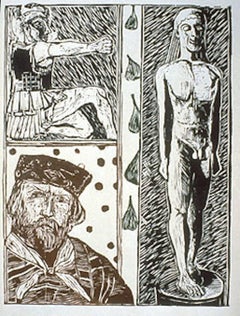
The Revolt
By Italo Scanga
Located in New York, NY
Italo Scanga was born in the Calabria region of Italy, and at 14 immigrated to the United States with his family after World War II. Living in Detroit, he worked on the General Motor...
Category
1980s Contemporary Art by Medium: Woodcut
Materials
Woodcut
$840 Sale Price
30% Off
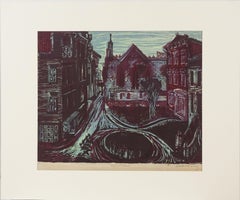
"Nightrise" Public Works Art Color Woodcut
By Ruth Chaney
Located in Soquel, CA
Bold woodblock serigraph by Ruth Chaney (American, 1908-1973). Numbered (#17), titled, signed, and dated along the bottom edge. The Smithsonian American Art Museum has an edition of...
Category
1930s American Impressionist Art by Medium: Woodcut
Materials
Paper, Ink, Woodcut
The Traitor of Montaperti - Original Woodcut Print attr. to Salvador Dalì - 1963
Located in Roma, IT
The Traitor of Montaperti from the Series "The Divine Comedy" by Dante Alighieri is an original woodcut print by Salvador Dalì, realized in 1963.
Good conditions. Not signed.
Plate...
Category
1960s Surrealist Art by Medium: Woodcut
Materials
Woodcut
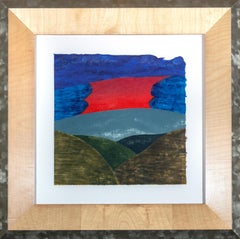
Sunset After Storm
Located in Milwaukee, WI
Original Woodcut in colors on Japanese paper.
Carol Summers has worked as an artist throughout the second half of the 20th century and into the first years of the next, outliving m...
Category
1980s Art by Medium: Woodcut
Materials
Woodcut
Rare 1923 Cubist Reuven Rubin Woodcut Woodblock Kabbalah Print Israeli Judaica
By Reuven Rubin
Located in Surfside, FL
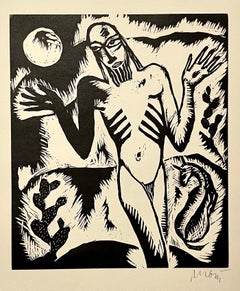
This is from the original first edition 1923 printing. there was a much later edition done after these originals.
These are individually hand signed in pencil by artist as issued.
This listing is for the one print. the other documentation is included here for provenance and is not included in this listing.
The various images inspired by the Jewish Mysticism and rabbis and mystics of jerusalem and Kabbalah is holy, dramatic and optimistic Rubin succeeded to evoke the spirit of life in Israel in those early days.
They are done in a modern art style influenced by German Expressionism, particularly, Ernst Barlach, Ernst Ludwig Kirchner, and Franz Marc, as introduced to Israel by Jakob Steinhardt, Hermann Struck and Joseph Budko.
Reuven Rubin 1893 -1974 was a Romanian-born Israeli painter and Israel's first ambassador to Romania.
Rubin Zelicovich (later Reuven Rubin) was born in Galati to a poor Romanian Jewish Hasidic family. He was the eighth of 13 children. In 1912, he left for Ottoman-ruled Palestine to study art at Bezalel Academy of Art and Design in Jerusalem. Finding himself at odds with the artistic views of the Academy's teachers, he left for Paris, France, in 1913 to pursue his studies at the École Nationale Supérieure des Beaux-Arts. He was of the well known Jewish artists in Paris along with Marc Chagall and Chaim Soutine,
At the outbreak of World War I, he was returned to Romania, where he spent the war years.
In 1921, he traveled to the United States with his friend and fellow artist, Arthur Kolnik. In New York City, the two met artist Alfred Stieglitz, who was instrumental in organizing their first American show at the Anderson Gallery. Following the exhibition, in 1922, they both returned to Europe. In 1923, Rubin emigrated to Mandate Palestine.
Rubin met his wife, Esther, in 1928, aboard a passenger ship to Palestine on his return from a show in New York. She was a Bronx girl who had won a trip to Palestine in a Young Judaea competition. He died in 1974.
Part of the early generation of artists in Israel, Joseph Zaritsky, Arieh Lubin, Reuven Rubin, Sionah Tagger, Pinchas Litvinovsky, Mordecai Ardon, Yitzhak Katz, and Baruch Agadati; These painters depicted the country’s landscapes in the 1920s rebelled against the Bezalel school of Boris Schatz. They sought current styles in Europe that would help portray their own country’s landscape, in keeping with the spirit of the time. Rubin’s Cezannesque landscapes from the 1920s were defined by both a modern and a naive style, portraying the landscape and inhabitants of Israel in a sensitive fashion. His landscape paintings in particular paid special detail to a spiritual, translucent light. His early work bore the influences of Futurism, Vorticism, Cubism and Surrealism.
In Palestine, he became one of the founders of the new Eretz-Yisrael style. Recurring themes in his work were the bible, the prophet, the biblical landscape, folklore and folk art, people, including Yemenite, Hasidic Jews and Arabs. Many of his paintings are sun-bathed depictions of Jerusalem and the Galilee. Rubin might have been influenced by the work of Henri Rousseau whose naice style combined with Eastern nuances, as well as with the neo-Byzantine art to which Rubin had been exposed in his native Romania. In accordance with his integrative style, he signed his works with his first name in Hebrew and his surname in Roman letters.
In 1924, he was the first artist to hold a solo exhibition at the Tower of David, in Jerusalem (later exhibited in Tel Aviv at Gymnasia Herzliya). That year he was elected chairman of the Association of Painters and Sculptors of Palestine. From the 1930s onwards, Rubin designed backdrops for Habima Theater, the Ohel Theater and other theaters.
His biography, published in 1969, is titled My Life - My Art. He died in Tel Aviv in October 1974, after having bequeathed his home on 14 Bialik Street and a core collection of his paintings to the city of Tel Aviv. The Rubin Museum opened in 1983. The director and curator of the museum is his daughter-in-law, Carmela Rubin. Rubin's paintings are now increasingly sought after. At a Sotheby's auction in New York in 2007, his work accounted for six of the ten top lots. Along with Yaacov Agam and Menashe Kadishman he is among Israel's best known artists internationally. Education
1912 Bezalel Academy of Arts and Design, Jerusalem
1913-14 École des Beaux Arts, Paris and Académie Colarossi, Paris
Select Group Exhibitions
Eged - Palestine Painters Group Eged - Palestine Painters Group, Allenby Street, Tel Aviv 1929
Artists: Chana Orloff, Abraham Melnikoff, Rubin, Reuven Nahum Gutman, Sionah Tagger,Arieh Allweil,
Jewish Artists Association, Levant Fair, Tel Aviv, 1929
Artists: Ludwig Blum,Eliyahu Sigad, Shmuel Ovadyahu, Itzhak Frenel Frenkel,Ozer Shabat, Menahem Shemi...
Category
1920s Abstract Art by Medium: Woodcut
Materials
Woodcut
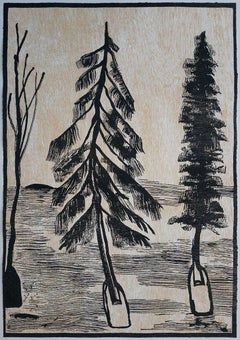
Kcho, Untitled I, 2019 Original Woodcut 45x31in landscape abstract povera art
Located in Miami, FL
Kcho (Alexis Leiva Machado) (Cuba, 1970)
'Untitled I', 2019
woodcut, silkscreen on paper Intaglio 300 g.
44.7 x 31.2 in. (113.5 x 79 cm.)
Edition of 30
ID: KCH-121
Unframed
Category
2010s Contemporary Art by Medium: Woodcut
Materials
Woodcut, Ink
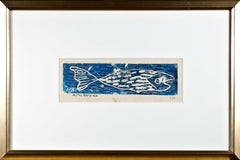
Fish (blue)
By Milton Avery
Located in Milwaukee, WI
Milton Avery
Fish (blue), 1952, (A/P)
Catalogue raisonné : Lunn 41.
Woodcut, printed in blue2.38 x 9 in (6.05 x 22.86 cm)Framed 12.50 x 18.75 in
From the blue prints, approximately 1...
Category
1950s Art by Medium: Woodcut
Materials
Woodcut
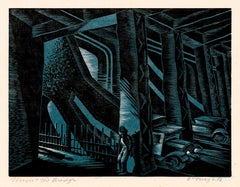
Under the Bridge
— 1930s Chicago, Modernist Color Woodcut
Located in Myrtle Beach, SC
Charles Turzak, 'Under the Bridge', color woodcut, edition c. 50, 1934. Signed and titled in pencil. A fine, richly-inked impression, with fresh colors, on cream wove Japan paper; th...
Category
1930s American Modern Art by Medium: Woodcut
Materials
Woodcut
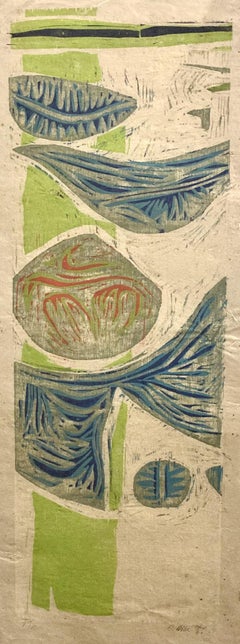
Clinton Hill, (Vertical Landscape), 1960, woodcut, landscape/abstraction
By Clinton Hill
Located in New York, NY
Clinton Hill (1922-2003), lived in SoHo, New York, and was a frequent Gallery visitor. Born in Idaho and raised on a working ranch, he joined the US Navy during World War II and beca...
Category
Mid-20th Century Abstract Art by Medium: Woodcut
Materials
Woodcut
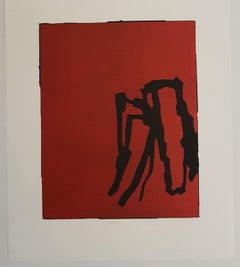
Letchkov
By Martin Noel
Located in Kansas City, MO
Martin Noel
"Letchkov"
Year: 1994
Color woodcut on handmade paper
Size: 27.75 x 22.5 inches (70 x 60 cm)
Signed by hand, lower center
Publisher: Edition by Griffelkunst-Vereinigung, ...
Category
1990s Abstract Art by Medium: Woodcut
Materials
Woodcut

$798 Sale Price
46% Off
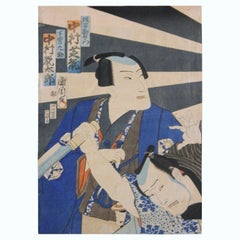
Two Kabuki Actors Japanese Woodblock Print
Located in Houston, TX
Two kabuki actors posing a samurai's. The print is printed on rice paper and is not framed. It is stamped by the artist with details about the actors in ...
Category
1860s Edo Art by Medium: Woodcut
Materials
Woodcut
Sanjûroku Kasen... - Woodcut by Mizuno Toshikata - 1893
Located in Roma, IT
Nishiki-e (woodcut print), in vertical oban format (31x20.5) realized by Mizuno Toshikata in 1893 (Meiji 26).
Belongs to the Series "Sanjûroku Kasen" (Thirty-Six Beauties in Compari...
Category
1890s Modern Art by Medium: Woodcut
Materials
Woodcut
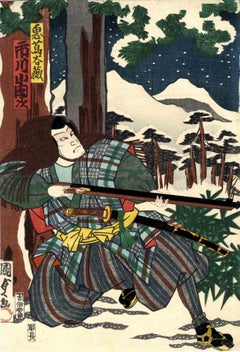
Kabuki - Woodcut by Utagawa Kunisada II - 1840
Located in Roma, IT
Kabuki is an original artwork realized in 1864 by Utagawa Kunisada II (1823 1880).
Scene at night in a snowy forest, the actor Ichikawa Kodanji in the ro...
Category
1850s Modern Art by Medium: Woodcut
Materials
Woodcut
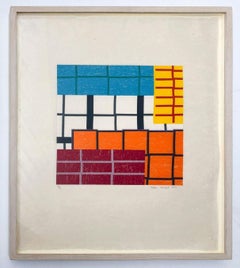
Stephen Westfall - Jig -Geometric Abstraction Abstract woodblock signed/N Framed
Located in New York, NY
Stephen Westfall
Jig, 2005
Woodblock, on Hiromi Iwa Hara-shi Kasa Japanese paper
Signed, dated 2005 and numbered 10/35 in graphite pencil on the front
Frame included
Elegantly floate...
Category
Early 2000s Post-Minimalist Art by Medium: Woodcut
Materials
Woodcut
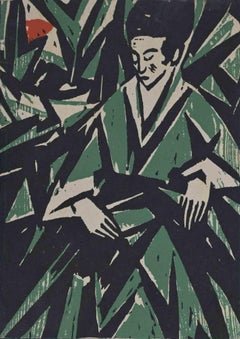
Woman in Green - Woodcut by Otto Lange - 1916
Located in Roma, IT
Woman in Green is a Colored print on paper, realized by Otto Lange in 1916
Woodcut on paper.
Good conditions.
Category
1910s Modern Art by Medium: Woodcut
Materials
Woodcut
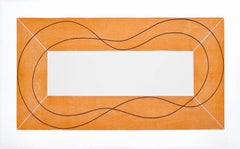
Extended Frame with Separation
Located in New York, NY
Associated with the Minimalist art movement of the 1960s, Mangold developed a reductive vocabulary based on geometric forms, monochromatic color, and an emphasis on the flatness of t...
Category
21st Century and Contemporary Minimalist Art by Medium: Woodcut
Materials
Woodcut
Arp, Composition, Arp: On My Way (after)
By Jean Arp
Located in Southampton, NY
Woodcut on wove paper. Inscription: Unsigned and unnumbered, as issued. Good Condition. Notes: From the folio, The Documents of Modern Art. Arp: On My Way, Poetry And Essays 1912 - 1...
Category
1940s Modern Art by Medium: Woodcut
Materials
Woodcut
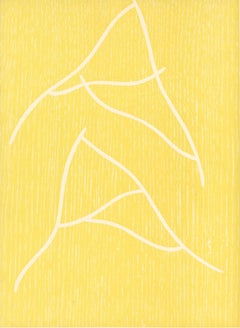
$716 Sale Price
34% Off
Dierdre, Surrealist Woodcut Print on Rice Paper by Leonard Baskin
Located in Long Island City, NY
This woodcut print was created by American artist Leonard Baskin. Baskin is well known for his somewhat grotesque, intricate, surreal drawings and natural subject matter. This print ...
Category
1950s Surrealist Art by Medium: Woodcut
Materials
Rice Paper, Woodcut

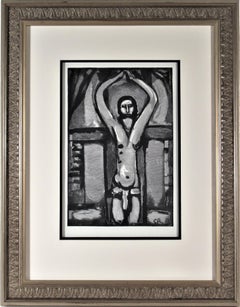
$1,280 Sale Price
20% Off
Christ, from La Passion
Located in San Francisco, CA
This artwork "Christ, from La Passion" 1939, is a wood engraving by French artist Georges Rouault, 1871-1958. (Block engraved by Georges Aubert) It is signed in the block as issue. ...
Category
Early 20th Century Modern Art by Medium: Woodcut
Materials
Woodcut
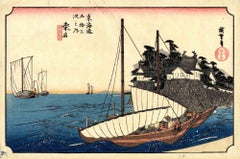
Kuwana Station - Woodcut after Utagawa Hiroshige -1920s
Located in Roma, IT
Kuwana Station is an original modern artwork realized after Utagawa Hiroshige (1797 – 12 October 1858) in 1920s.
Original woodcut print oban yokoe. After the famous Tokaido series, ...
Category
1920s Modern Art by Medium: Woodcut
Materials
Woodcut
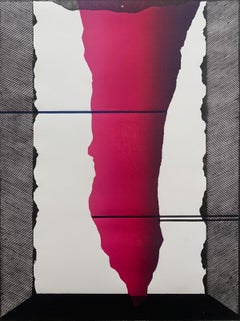
$268 Sale Price
25% Off
Equivalent shapes. Woodcut, Linocut, Op art, Abstract Print, Polish art
Located in Warsaw, PL
Contemporary op art abstract linocut and woodcut print by Polish artist Ryszard Gieryszewski. Print is mostly black and white with red. Title of this artwork is 'Equivalent shapes'. ...
Category
Early 2000s Abstract Art by Medium: Woodcut
Materials
Paper, Linocut, Woodcut
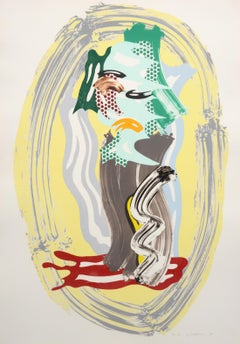
Roy Lichtenstein GREEN FACE Lithograph
Screenprint, 58.5"H
Located in Lake Worth Beach, FL
Artist/Designer; Manufacturer: Roy Lichtenstein (American, 1923-1997)
Marking(s); notes: signed, blind stamp, marking(s); PP 1/2 aside from the edition of 60; 1989
Materials: lithogr...
Category
1980s Pop Art Art by Medium: Woodcut
Materials
Screen, Lithograph, Woodcut
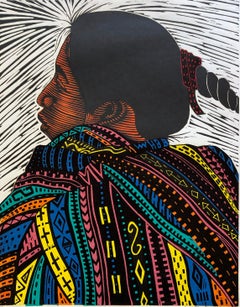
Maya, Indigenous woman in colorful traditional fabric, by Juan Fuentes
By Juan Fuentes
Located in Palm Springs, CA
Juan Fuentes’ Maya is a vibrant and dignified portrait celebrating Indigenous identity and textile tradition. Shown in profile, the figure is wrapped in an elaborately patterned garm...
Category
2010s Contemporary Art by Medium: Woodcut
Materials
Woodcut
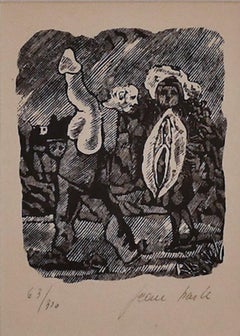
Erotic Scene - Woodcut by Mino Maccari - 1945
By Mino Maccari
Located in Roma, IT
Erotic Scene is an original xilography artwork realized by Mino Maccari in 1945. Hand-signed in the pseudonym of "Jean Baschie" which is the artist's signature in 1944-45 ca. erotic ...
Category
1940s Art by Medium: Woodcut
Materials
Woodcut
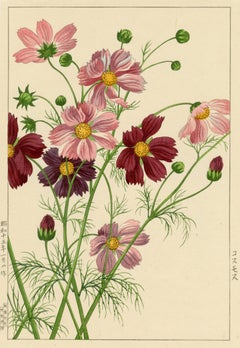
Cosmos
Located in Fairlawn, OH
Cosmos
Color woodcut with gauffage (embossing), January 1940
Unsigned (as usual)
Publisher: Takemura Hideo
(active Yokohama 1926-1940)
Condition: excellent
Image size: 14 3/8 x 9 5/8 inches
Provenance: Robert O. Muller Estate
Biography
Hodo Nishimura...
Category
1940s Modern Art by Medium: Woodcut
Materials
Woodcut
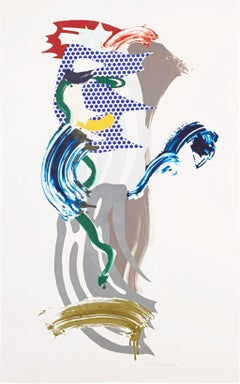
Blue Face
Located in New York, NY
A stunning example of abstracted imagery easily identifiable as the work of Roy Lichtenstein, Blue Face was created by the artist in 1989 as a truly mixed me...
Category
20th Century Pop Art Art by Medium: Woodcut
Materials
Lithograph, Screen, Woodcut
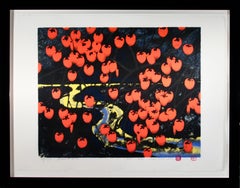
Persimmons
Located in San Francisco, CA
This artwork titled "Persimmons" 1980, is a colors woodcut on wove paper by noted Korean artist Bong Kyu Ahn, b.1938. It is hand signed, dated, titled, and numbered 10/90 in pencil b...
Category
Late 20th Century Realist Art by Medium: Woodcut
Materials
Woodcut
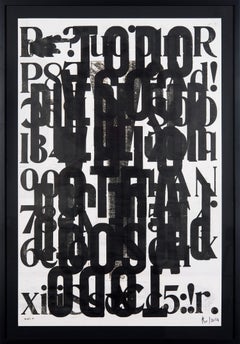
"Poner en Palabras" Traditional Wooden Typography on Reclaimed Poster Paper
By Ro Barragan
Located in New York, NY
In Ro Barragan's latest work we explore a production of typographic posters that seeks to highlight the multiplicity of meanings in everyday messages. Words meet, bifurcate, overlap, amalgamate and juxtapose in speeches and the context of communications. It is in this complex multiplicity, that manifests itself in a printed text, which also functions as an image. The material used is the same as the one historically used in urban advertising posters: the work is developed by using typographic printing methods, with mobile types of wood, in typographic families dating back to the last century. The works of art are printed on sulfite paper of various sizes. This piece comes displayed on a black contemporary frame under glass.
Art measures 42 x 27.5 in
Frame measures 47 x 32.5 in
The machines of the early 20th century and manual presses of various sizes are used for printing, which still works in historical workshops in Argentina – Pucará printing shop in La Tablada - and in the Ilusión Gráfica workshop, owned by Ro Barragán, where it is sought to continue the tradition and the typographic trade, linking its production with artistic practices.
Ro holds a Master in Aesthetics and Art Theory by the National University of La Plata, all while developing artistic activities since 1994. She has participated in collective and individual exhibitions in Painting, Engraving, Objects, Digital Art, Installations and Interactive Art, in Buenos Aires and other cities of Argentina, Bogotá, Rome, and Miami. She also has developed art activities in the context of the street, through stickers and posters. She is a Teacher of the Engraving and Complementary Printed Art Workshop at the Faculty of Fine Arts of the National University of La Plata and a teacher of the typography workshop at the Museo de Calcos y Escultura comparada Ernesto de la Cárcova, city of Buenos Aires. She is the creator of Ilusión Gráfica, a typographic printing company that seeks to preserve the tradition of printing with wooden mobile...
Category
2010s Contemporary Art by Medium: Woodcut
Materials
Paper, Woodcut
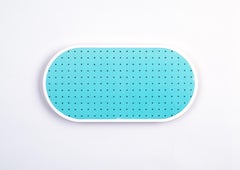
dot pool screen
Located in Columbia, MO
Kristen Martincic earned her BFA from Bowling Green State University and her MFA from the University of Nebraska-Lincoln. The artist, who currently lives and works in Columbia, Misso...
Category
21st Century and Contemporary Contemporary Art by Medium: Woodcut
Materials
Woodcut, Birch, Acrylic
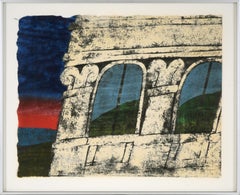
"Casa Marquez" Original Woodblock Print, Signed and Numbered 93/100
Located in Soquel, CA
"Casa Marquez" Original Woodblock Print, Signed and Numbered 93/100
Boldly colored woodblock print by Carol Summers (American, 1925-2016). This piece is a closeup on a large stone building, with a landscape reflected in the windows. The building has carved ornamentation in a classical style. There is a bright red sunset in the background behind the building. The title refers to the author Gabriel García Márquez.
Signed "Carol Summers" in the lower right corner.
Numbered and titled "93/100 Casa Marquez" in the upper right corner.
Presented in a silver colored aluminum frame.
Frame size: 19.25"H x 23.25"W
Paper size: 16"H x 20"W
Carol Summers (1925-2016) has worked as an artist throughout the second half of the 20th century and into the first years of the next, outliving most of his mid-century modernist peers. Initially trained as a painter, Summers was drawn to color woodcuts around 1950 and it became his specialty thereafter. Over the years he has developed a process and style that is both innovative and readily recognizable. His art is known for it’s large scale, saturated fields of bold color, semi-abstract treatment of landscapes from around the world and a luminescent quality achieved through a printmaking process he invented.
In a career that has extended over half a century, Summers has hand-pulled approximately 245 woodcuts in editions that have typically run from 25 to 100 in number. His talent was both inherited and learned. Born in 1925 in Kingston, a small town in upstate New York, Summers was raised in nearby Woodstock with his older sister, Mary. His parents were both artists who had met in art school in St. Louis. During the Great Depression, when Carol was growing up, his father supported the family as a medical illustrator until he could return to painting. His mother was a watercolorist and also quite knowledgeable about the different kinds of papers used for various kinds of painting. Many years later, Summers would paint or print on thinly textured paper originally collected by his mother.
From 1948 to 1951, Carol Summers trained in the classical fine and studio arts at Bard College and at the Art Students League of New York. He studied painting with Steven Hirsh and printmaking with Louis Schanker. He admired the shapes and colors favored by early modernists Paul Klee (Sw: 1879-1940) and Matt Phillips (Am: b.1927- ). After graduating, Summers quit working as a part-time carpenter and cabinetmaker (which had supported his schooling and living expenses) to focus fulltime on art. That same year, an early abstract, Bridge No. 1 was selected for a Purchase Prize in a competition sponsored by the Brooklyn Museum.
In 1952, his work (Cathedral, Construction and Icarus) was shown the first time at the Museum of Modern Art in New York City in an exhibition of American woodcuts...
Category
1980s Contemporary Art by Medium: Woodcut
Materials
Ink, Handmade Paper, Woodcut
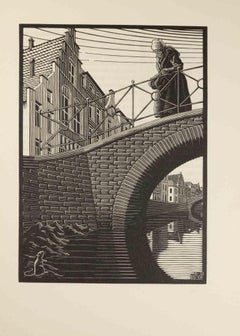
The Bridge - Woodcut by Maurits Cornelis Escher - 1932
Located in Roma, IT
Woodcut print from the Series "Der vreeselijke avonturen vas Scholastica" (The Terrible Adventures of Scholastica).
Edition of 300, published by A. J. van Dishoeck.
Unsigned, ass i...
Category
1930s Modern Art by Medium: Woodcut
Materials
Woodcut
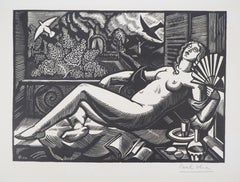
Summer : Nude with a Fan - Original woodcut, Handsigned
By Paul Vera
Located in Paris, IDF
Paul VERA
Summer : Nude with a Fan, 1922
Original woodcut
Handsigned in pencil
Numbered /154
On vellum 32.5 x 25.5 cm (c. 13 x 10 in)
Bears the blind stamp ...
Category
1920s Art Deco Art by Medium: Woodcut
Materials
Woodcut
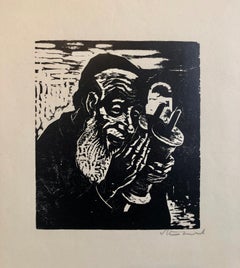
Jewish Rabbi with Torah German Expressionist Woodcut Israeli Early Bezalel
Located in Surfside, FL
Hand signed in pencil, woodblock print woodcut.
Jacob Steinhardt
1887-1968
Steinhardt, Jakob, Painter and Woodcut Artist. b. 1887, Yaacov Steinhardt was born in the then remote, largely Polish town of Zerkow in the Posen District of Germany. (poland/german) Immigrated 1933. Studies: 1906 School of Art, 1906 Studied in Berlin Arts and Crafts School. Berlin; 1907 painting...
Category
20th Century Expressionist Art by Medium: Woodcut
Materials
Woodcut
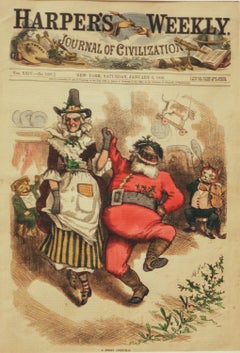
A Merry Christmas original wood engraving by Thomas Nast 1880
Located in Paonia, CO
Thomas Nast is one of America’s great illustrators and is responsible for creating the image of Santa Claus as we know him today. This is a hand-colored wood engraving from the cover...
Category
1880s Other Art Style Art by Medium: Woodcut
Materials
Woodcut
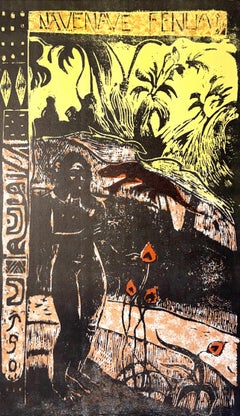
Gauguin, Delightful Land (Nave nave fenua), Gauguin (after)
By Paul Gauguin
Located in Southampton, NY
Woodcut on vélin Utopian paper. Unsigned and unnumbered, as issued. Good Condition. Notes: From the folio, Gauguin, A portfolio of 12 color woodblocks, Paul Gauguin, French, 1848-1903 from the collection of the Museum Of Fine Arts, Boston, 1946. Rendered by Albert Carman (1899-1949); published the Museum Of Fine Arts, Boston and The Studio Publications, Inc., New York and London; printed by Holme Press Inc., New York, in an edition of MMMD. Excerpted from the folio, Paul Gauguin and Emil Bernard at Pont-Aven, Brittany, in 1888, each made a bas-relief, wooden panel to decorate a piece of furniture for a friend. In order to keep a record of their designs, a few inked impressions were made on paper. The illustration at left is a reproduction of a print which is possibly one of the above mentioned. It is further possible that this experiment later gave Gauguin the idea of making woodcuts. Just as his work in painting expressed a revolt against the overemphasis on factual representation of the nineteenth century in favor of decorative pattern and color, so also his woodcuts leaned strongly to the same side of the balance. Ten of the cuts reproduced (all excepting Soyez Amoureuses and Changement de Residence), which constitute the whole of his best known series, were made at Pont-Aven beginning in the fall of 1894, after Gauguin's return from his first trip to Tahiti and after he broke his ankle. They were at first roughly cut with a common carpenter's gouge, and the flat surfaces sandpapered and engraved with a sharp in-strument, perhaps an engraver's burin. A few trial proofs were printed in black ink only. Then the hollows were deepened with a woodcutter's gouge and highlights were added. An edition of thirty to fifty impressions of each subject, with the addition of color blocks (one, two or three), was made by Louis Roy...
Category
1940s Post-Impressionist Art by Medium: Woodcut
Materials
Woodcut
$716 Sale Price
20% Off
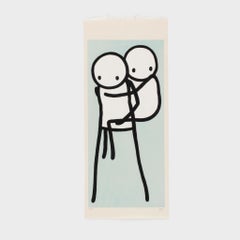
Stik, Onbu (Piggyback) (Blue), 2013
By Stik
Located in Bristol, GB
Woodcut on rice paper
Edition 2 of 15
47.5 x 20 cm (18.7 x 7.9 in)
58 x 30.3 x 3 cm, 22.8 x 11.9 x 1.2 in
Signed and numbered on the front
Artwork in mint condition. Minor undulation...
Category
21st Century and Contemporary Contemporary Art by Medium: Woodcut
Materials
Woodcut
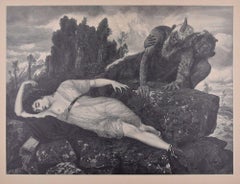
Sleeping Diana - Original Woodcut by J.J. Weber - 1898
Located in Roma, IT
Image dimensions: 34.2 x 45.5 cm.
Sleeping Diana is an original print, realized in 1898.
Black and white woodcut print on applied Japon paper.
Good conditions except for yellowing of paper (especially along the margins), and very light folds on lower left side.
The print was realized by Johann Jacob Weber and it's part of the series Meisterwerke der Holzschneidekunst (original title: SECHZEHN HOLZSCHNITTE NACH GEMÄLDEN ARNOLD BÖCKLIN...
Category
1890s Symbolist Art by Medium: Woodcut
Materials
Woodcut
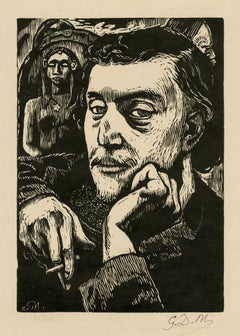
Portrait de Paul Gauguin
Located in Fairlawn, OH
Portrait de Paul Gauguin
Woodcut, c. 1900
Initialed in pencil lower right
Numbered in pencil lower left
Edition: 100 (34/100)
Annotated verso: “epreuve sur japon”
Condition: Excellent
Image size: 6 3/4 x 4 3/4 inches
Sheet size: 11 x 8 5/8 inches
Note: Born in New York, Monfreid studied in France at the Academy Julian. He was a friend of Gauiguin, Verlaine and Maillol. He formed a noted collection of works by Gauguin. In 1924, Monfreid published the manuscript for Paul Gauguin’s Noa Noa with 24 woodcuts inspired by Gauguin...
Category
Early 1900s Post-Impressionist Art by Medium: Woodcut
Materials
Woodcut
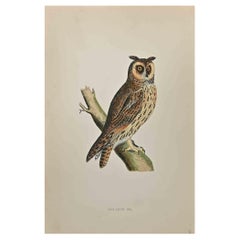
Long-Eared Owl - Woodcut Print by Alexander Francis Lydon - 1870
Located in Roma, IT
Long-Eared Owl is a modern artwork realized in 1870 by the British artist Alexander Francis Lydon (1836-1917) .
Woodcut print, hand colored, published by London, Bell & Sons, 1870....
Category
1870s Modern Art by Medium: Woodcut
Materials
Woodcut
Cosmic Explosion
By Ruth Leaf
Located in San Francisco, CA
This artwork titled "Cosmic Explosion" c.2000, is an original colors woodcut on thin rice paper paper by noted American artist Ruth Leaf, 1923-2015. It is hand signed, titled and ins...
Category
Late 20th Century Abstract Expressionist Art by Medium: Woodcut
Materials
Woodcut
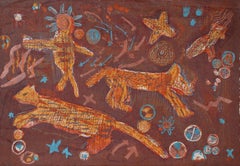
Homage a Dito, 1982, Folk Art Woodcut by Florence Grace Putterman
By Florence Putterman
Located in Long Island City, NY
Artist: Florence Grace Putterman, American (1927 - )
Title: Homage a Dito
Year: 1982
Medium: Woodcut, signed in pencil
Edition: TP
Size: 27.5 x 39 in. (69.85 x 99.06 cm)
Category
1980s Conceptual Art by Medium: Woodcut
Materials
Woodcut
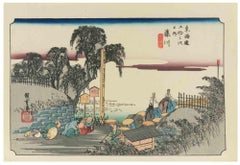
Fujikawa - Woodcut by Utagawa Kunisada - 1832
Located in Roma, IT
Fujikawa is a woodcut print realized by Utagawa Hiroshige in 1833.
It is part of the suite "The Fifty-three Stations of Tokaido".
Very good condition.
Category
1830s Modern Art by Medium: Woodcut
Materials
Woodcut
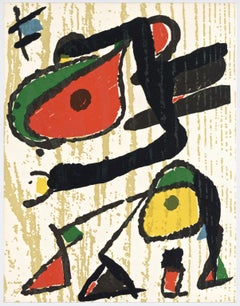
original woodcut
By Joan Miró
Located in Henderson, NV
Medium: original color woodcut. Reference: Dupin 1293. Published for the Jacques Dupin catalogue raisonne "Miro Graveur III" in 1992. Sheet size: 12 1/2 x 9 3/4 inches (320 x 248 mm)...
Category
1990s Abstract Art by Medium: Woodcut
Materials
Woodcut
19th Century Japanese Woodblock - Restraint
Located in Corsham, GB
A dynamic Japanese woodblock depicting a woman captured with her hands behind her back. Signed and inscribed with characters. Presented in a contemporary black frame. On paper.
Category
19th Century Art by Medium: Woodcut
Materials
Woodcut
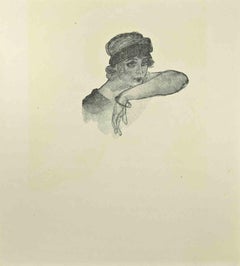
Woman - Woodcut after Jean Paul Sauget - 1921
Located in Roma, IT
Woman is a woodcut print print on paper, realized after Jean Paul Sauget for Maurice Magre's Les Soirs d'Opium.
Published in 1921.
Good conditions.
Category
1920s Modern Art by Medium: Woodcut
Materials
Woodcut
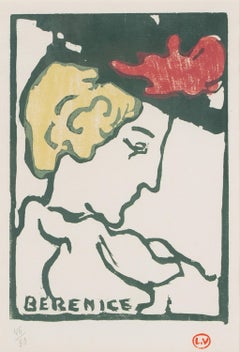
Berenice
By Louis Valtat
Located in Fairlawn, OH
Berenice
Color woodcut, 1900-1910
Signed with the artist's red ink stamp (see photo)
Edition: 50 (46/50)
Signed with the artist's red ink initials stamp, Lugt 1771, Sup.
Condition: E...
Category
Early 1900s French School Art by Medium: Woodcut
Materials
Woodcut
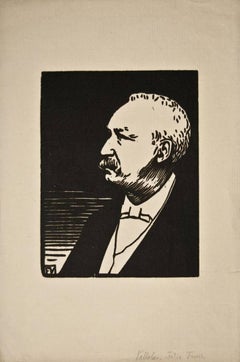
Portrait of Felix Faure - Woodcut Print by F. Vallotton
Located in Roma, IT
Signed on plate with Felix Vallotton's F.V. monogram.
Image Dimensions : 16 x 12.5 cm
Passepartout included : 39.5 x 34.5 cm
This artwork is shipped from Italy. Under existing legis...
Category
Late 19th Century Post-Impressionist Art by Medium: Woodcut
Materials
Woodcut
Virgil Comforts Dante - Woodcut - 1963
Located in Roma, IT
Virgil Comforts Dante - Hell, Plate-2- Divine Comedy is a woodcut print realized in 1963 for a series illustrating the Medieval poem of the "Divine Comedy" by Dante Alighieri.
Not ...
Category
1960s Surrealist Art by Medium: Woodcut
Materials
Woodcut
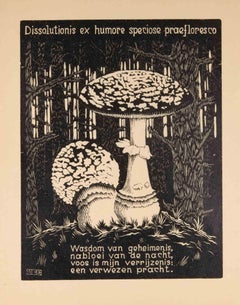
Toadstool - Woodcut by Maurits Cornelis Escher - 1931
Located in Roma, IT
Woodcut print realized by Escher for the series "Emblemata", and published in 1931.
On Hollande van Gelder paper.
Edition of 300.
Unsigned, as issued. Excellent condition, matted....
Category
1930s Modern Art by Medium: Woodcut
Materials
Woodcut
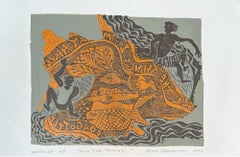
All The Things - Surfing Art - Figurative - Woodcut Print By Marc Zimmerman
Located in Carmel, CA
All The Things - Surfing Art - Figurative - Woodcut Print By Marc Zimmerman
Limited Edition 01/04
This masterwork is exhibited in the Zimmerman Gallery, Carmel CA.
Immerse yoursel...
Category
2010s Contemporary Art by Medium: Woodcut
Materials
Woodcut
Woodcut art for sale on 1stDibs.
Find a wide variety of authentic Woodcut art available on 1stDibs. While artists have worked in this medium across a range of time periods, art made with this material during the 21st Century is especially popular. If you’re looking to add art created with this material to introduce a provocative pop of color and texture to an otherwise neutral space in your home, the works available on 1stDibs include elements of orange, yellow, purple, blue and other colors. There are many well-known artists whose body of work includes ceramic sculptures. Popular artists on 1stDibs associated with pieces like this include Mino Maccari, Utagawa Kunisada (Toyokuni III), Eric Gill, and Utagawa Hiroshige. Frequently made by artists working in the Modern, Contemporary, all of these pieces for sale are unique and many will draw the attention of guests in your home. Not every interior allows for large Woodcut art, so small editions measuring 0.04 inches across are also available